States of Matter — Chemistry STD 11 Science — Question
Maharashtra BoardEnglish MediumSTD 11 ScienceChemistryStates of Matter6 Marks
Question
Explain ion$-$dipole interactions.
✓
Answer
Ion-dipole interactions:
$i.$ An ion$-$dipole force is the result of electrostatic interactions between an ion $($cation or anion$)$ and the partial charges on a polar molecule.
$ii.$ The strength of this interaction depends on the charge and size of an ion. It also depends on the magnitude of dipole moment and size of the molecule.
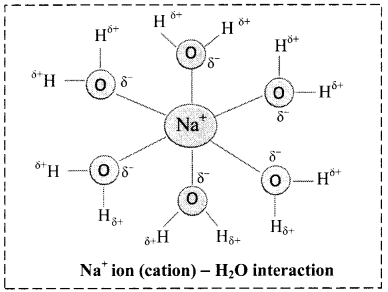
$iii.$ Ion$-$dipole forces are particularly important in aqueous solutions of ionic substances. When an ionic compound is dissolved in water, the ions get separated and surrounded by water molecules. This process is called hydration of ions.
$iv.$ For example, $Na^+$ ion $($cation$) – H_2O$ interaction is shown in the following figure:
$v.$ The charge density on $Na+$ is more concentrated than the charge density on $Cl^–$ because $Na^+$ is smaller in size than $Cl^–.$ This makes the interaction between $(Na^+)$ and negative end of the polar $H_2O$ molecule stronger than the corresponding interaction between $(Cl^–)$ and positive end of the polar $H_2O$ molecule.
$vi.$ More the charge on cation, stronger is the ion$-$dipole interaction. For example, $Mg^{2+}$ ion has higher charge and smaller ionic radius $(78 \ pm)$ than $Na^+$ ion $(98 \ pm),$ hence $Mg^{2+}$ ion is surrounded $($hydrated$)$ more strongly with water molecules and exerts strong ion$-$dipole interaction.
Thus, the strength of interaction increases with increase in charge on cation and with decrease in ionic size or radius.
Therefore, ion$-$dipole forces increase in the order$: Na^+ < Mg^{2+} < Al^{3+}.$
Need a full question paper?
Generate a complete, print-ready paper with questions like this in minutes — across 16+ boards, with answer keys.