Question
Explain linear charge density.

Answer

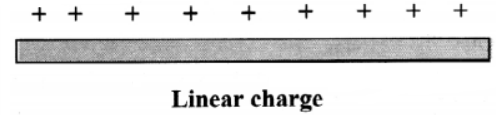
Consider charge q uniformly distributed along a linear conductor of length l, then the linear charge density (λ) is given as,
$\lambda=\frac{q}{l}$
For example, charge distributed uniformly on a straight thin rod or a thin nylon thread. If the charge is not distributed uniformly over the length of thin conductor then charge dq on small element of length dl can be written as dq = λ dl.
Image

Need a full question paper?

Generate a complete, print-ready paper with questions like this in minutes — across 16+ boards, with answer keys.
Start Generating Free

Similar questions

An artificial satellite revolves around a planet in circular orbit close to its surface. Obtain the formula for period of the satellite in terms of density p and radius R of planet.
Determine the vector product of $\overrightarrow{ v _1}=2 \hat{i}+3 \hat{j}-\hat{k}$ and $\overrightarrow{ v _2}=\hat{i}+2 \hat{j}-3 \hat{k}$ are perpendicular to each other, determine the value of $a$.
A point object is kept $10\ cm$ away from a double convex lens of refractive index $1.5$ and radii of curvature $10\ cm$ and $8\ cm.$ Determine location of the final image considering paraxial rays only.
A current of 4 A flows through an automobile headlight. How many electrons flow through the headlight in a time of 2 hrs?
Draw a diagram showing different types of EM waves.
Find the distance from a charge of $4 µC$ placed in air which produces electric field of intensity $9 \times 10^3 N/C.$
An aeroplane $A,$ is travelling in a straight line with a velocity of $300 \ km/hr$ with respect to Earth. Another aeroplane $B,$ is travelling in the opposite direction with a velocity of $350 \ km/hr$ with respect to Earth. What is the relative velocity of $A$ with respect to $B$? What should be the velocity of a third aeroplane $C$ moving parallel to $A,$ relative to the Earth if it has a relative velocity of $100 \ km/hr$ with respect to $A$?
Explain the term uniform circular motion.
What happens to the apparent weight of the person inside the lift moving with net upward acceleration?
Derive equations of motion for a particle moving in a plane and show that the motion can be resolved in two independent motions in mutually perpendicular directions.