Question
Explain Lorentz force and state its characteristics.

Answer

Suppose a point charge $q$ moving with a velocity $\vec{v}$ in presence of the electric field $\overrightarrow{ E }(\vec{r})$ and the magnetic field $\overrightarrow{ B }(\vec{r})$.
Force on charge $q$ due to the electric and magnetic field.
$\begin{aligned}
\overrightarrow{ F } & =q[\overrightarrow{ E }(r)+(\vec{v} \times \overrightarrow{ B }(\vec{r}))] \\
\therefore \quad \overrightarrow{ F } & =q \overrightarrow{ E }(\vec{r})+q \times \times \overrightarrow{ B })
\end{aligned}$
[Here $\overrightarrow{ B }(r)=\overrightarrow{ B }$ ]
Electric force $\overrightarrow{ F }_{\text {electric }}=q \cdot \overrightarrow{ E }(\vec{r})$
Magnetic force $\overrightarrow{ F }$. magnetic $=q(\overrightarrow{ v } \times \overrightarrow{ B })$
$\therefore \overrightarrow{ F }=\overrightarrow{ F }_{\text {electric }}+\overrightarrow{ F }_{\text {magnetic }}$
The combination of electric and magnetic force here is known as Lorentz force.
• Characteristics :
(1) The Lorentz force depends on charge ( $q$ ), velocity ( $\vec{v}$ ) and the magnetic field $(\vec{B})$. Force on negative charge is opposite to that on a positive charge.
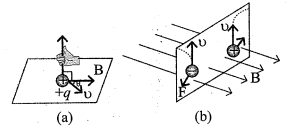
(2) The direction of magnetic force $\vec{F}_m=q(\vec{v} \times$ $\vec{B}$ ) can be found using right hand screw rule.
Image
(3) If velocity $\vec{v}$ and the magnetic field $\vec{B}$ are parallel $(\theta=0)$ anti parallel $\left(\theta=180^{\circ}, \pi\right)$ to each other, the force becomes zero.
The magnetic force is maximum when the velocity $\vec{v}$ and the magnetic field $\vec{B}$ are perpendicular to each other.
(4) If charge is not moving i.e. the charge is stationary. then $\vec{v}=0$ hence the magnetic force is zero.

Need a full question paper?

Generate a complete, print-ready paper with questions like this in minutes — across 16+ boards, with answer keys.
Start Generating Free

Similar questions

A bulb rated 60W at 220V is connected across a household supply of alternating voltage of 220V. Calculate the maximum instantaneous current through the filament.
  1. Draw a graph showing variation of photocurrent with anode potential for a particular intensity of incident radiation. Mark saturation current and stopping potential.
  2. By how much would the stopping potential for a given photosensitive surface go up if the frequency of the incidentradiations were to be increased from $4\times10^{15}\text{ }\text{Hz}\text{ }\text{to}8\text{ }\times10^{15}\text{ }\text{Hz}$?
A gas cylinder has walls that can bear a maximum pressure of 1.0 × 10⁶Pa. It contains a gas at 8.0 × 10⁵Pa and 300K. The cylinder is steadily heated. Neglecting any change in the volume, calculate the temperature at which the cylinder will break.
A given galvanometer is to be converted into (i) an ammeter (ii) a milliammeter (iii) a voltmeter. In which case will the required resistance be (i) least (ii) highest and why?
What is reverse bias? Explain the change occuring in the junction under the effect of reverse bias.
The earth’s surface has a negative surface charge density of 10-9 Cm-2. The potential difference of 400 kV between the top of the atmosphere and the surface results (due to the low conductivity of the lower atmosphere) in a current of only 1800 A over the entire globe. If there were no mechanism of sustaining atmospheric electric field, how much time (roughly) would be required to neutralise the earth’s surface? (This never happens in practice because there is a mechanism to replenish electric charges, namely the continual thunderstorms and lightning in different parts of the globe). (Radius of earth = 6.37 × 106 m.)
Indium antimonide has a band gap of 0.23eV between the valence and the conduction band. Find the temperature at which kT equals the band gap.
Both alternating current and direct current are measured in amperes. But how is the ampere defined for an alternating current?
Prove that a closed equipotential surface with no charge within itself must enclose an equipotential volume.
Does a nucleus lose mass when it suffers gamma decay?