Question
Explain the D and L notation method of spatial arrangement with respect to glucose.

Answer

The letters 'D' or 'L' before the name of any compound indicate the relative configuration of a particular stereoisomer of a compound with respect to configuration of some other compound, configuration of which is known.
In the case of carbohydrates, this refers to their relation with a particular isomer of glyceraldehyde.
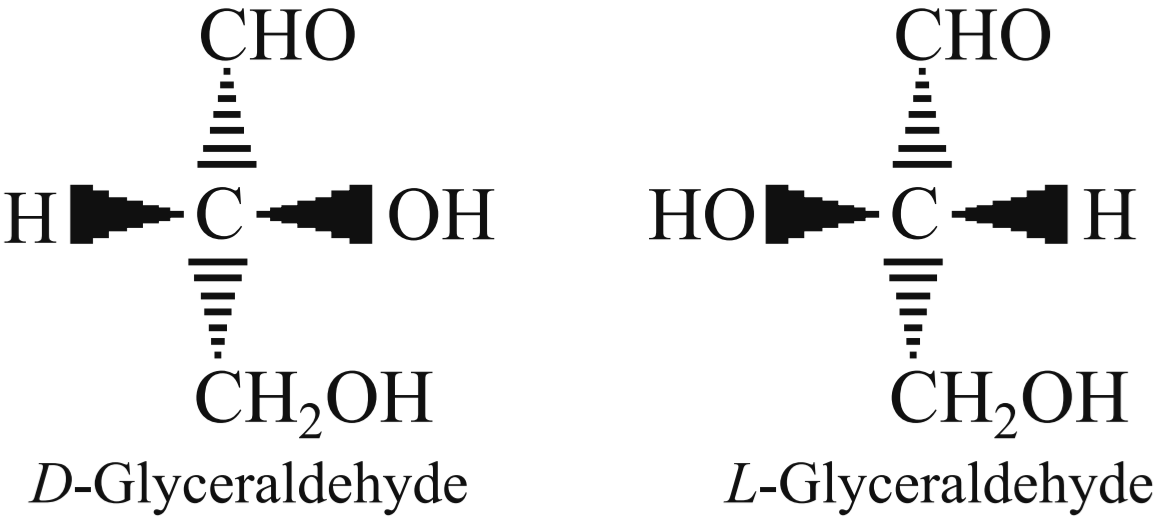
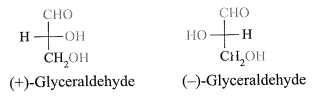
Glyceraldehyde contains one asymmetric carbon atom and exists in two enantiomeric forms as shown below
Image
(+) Isomer of glyceraldehyde has 'D' configuration it means that the -OH group lies on right hand side in the structure.
All those compounds which can be chemically correlated to D(+) isomer of glyceraldehyde are said to have D-configuration.
Where as those which can be correlated to L (-) isomer of glyceraldehyde are said to have L-configuration. In 'L(-)' isomer -OH group is on left hand side.
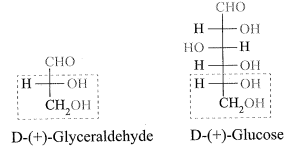
For assigning the configuration of monosaccharides it is the lowest asymmetric carbon atom (as shown below) which is compared. As in (+) glucose -OH on the lowest assymmetric carbon is on the right side which is compared to (+) glyceraldehyde. So, (+) glucose is assigned D-configuration.
Image
Other asymmetric carbon atoms of glucose are not considered for this comparison. Also, the structure of glucose and glyceraldehyde is written in a way that most oxidised carbon (in this case -CHO) is at the top.

Need a full question paper?

Generate a complete, print-ready paper with questions like this in minutes — across 16+ boards, with answer keys.

Start Generating Free

Similar questions

Read the passage given below and answer the following questions:
In an assembly of atoms or molecules, a solid phase is formed whenever the interatomic attractive forces significantly exceed the disruptive thermal forces and thus restrict the mobility of atoms, forcing them into more or less fixed positions. From energy considerations, it is evident that in such solids the atoms or molecules will always attempt to assume highly ordered structures which are characterised by symmetry. Depending on the nature of the active interatomic forces, all solids may be subdivided into the following categories :
Ionic solids: These solids consist of positively and negatively charged ions arranged in a regular fashion throughout the solid. These solids are very hard and brittle, have very high melting points and have high enthalpies of vaporisation, e.g., NaCl, MgO, KCl, LiCl etc.
Covalent solids: In these solids, the constituent particles are atoms which are linked together by a continuous system of covalent bonds. These bonds are strong and directional in nature. The covalent crystals are hard, have high melting points, are poor conductors of electricity. Diamond is a typical example of covalent solids.
Metallic solids: ln these solids, the constituent particles are positive ions immersed in a sea of mobile electrons. Metallic solids may be hard as well as soft. They are good conductors of heat and electricity, e.g., common metals such as nickel, copper and alloys.
Molecular solids: ln these the constituent particles are molecules. The molecules are held together by dispersion forces or London forces, dipole-dipole forces or hydrogen bonds.
In these questions (Q. No. i-iv), a statement of assertion followed by a statement of reason is given. Choose the correct answer out of the following choices.
  1. Assertion and reason both are correct statements, and reason is correct explanation for assertion.
  2. Assertion and reason both are correct statements, but reason is not correct explanation for assertion.
  3. Assertion is correct statement, but reason is wrong statement.
  4. Assertion is wrong statement, but reason is correct statement.
  1. Assertion: Molecular solids are characterized by low melting point.
Reason: Molecular solids are made up of covalent molecules.
  1. Assertion: Ionic solids are characterized by high melting and boiling point.
Reason: Ionic solids have coulombic forces of attraction between their ions.
  1. Assertion: Covalent solids are insulators of electricity.
Reason: Covalent solids are constituted by ions.
  1. Assertion: Diamond and graphite do not have the same covalent structure.
Reason: Silicon carbide is typical example of network solid.
  1. Assertion: Covalent solids have high melting points.
Reason: Covalent solids have strong electrostatic forces of attraction.
Read the passage given below and answer the following questions:
Carbohydrates can exist in either of two conformations, as determined by the orientation of the hydroxyl group about the asymmetric carbon farthest from the carbonyl.

By convention, a monosaccharide is said to have D-configuration if the hydroxyl group attached to the asymmetric carbon atom adjacent to the $-CH_2OH$ group is on the right hand side irrespective of the positions of the other hydroxyl groups. On the other hand, the molecule is assigned L-configuration if the -OH group attached to the carbon adjacent to the $- CH_2OH$ group is on the left hand side.
The following questions are multiple choice questions. Choose the most appropriate answer:
  1. D-Glyceraldehyde and L-Glyceraldehyde are:
  1. Epimers.
  2. Enantiomers.
  3. Anomers.
  4. Conformational diasteriomers.
  1. Which of the following monosaccharides, is the majority found in the human body?
  1. D-type.
  2. L-type.
  3. Both of these.
  4. None of these.
  1. The two functional groups present in a typical carbohydrate are:
  1. -OH and -COOH
  2. -CHO and -COOH
  3. >C= O and -OH
  4. -OH and -CHO
  1. Monosaccharides contain:
  1. Always six carbon atoms.
  2. Always five carbon atoms.
  3. Always four carbon atoms.
  4. May contain 3 to 7 carbon atoms.
  1. The correct corresponding order of names of four aldoses with configuration given below respectively, is:
  1. L-erythrose, L-threose, L-erythrose, D-threose.
  2. D-threose, D-erythrose, L-threose, L-erythrose.
  3. L-erythrose, L-threose, D-erythrose, D-threose.
  4. D-erythrose, D-threose, L-erythrose, L-threose.
Read the passage given below and answer the following questions:
When haloalkanes with $\beta-$hydrogen atom are boiled with alcoholic solution of KOH, they undergo elimination of hydrogen halide resulting in the formation of alkenes. These reactions are called $\beta-$elimination reactions or dehydrohalogenation reactions. These reactions follow Saytzeff's rule. Substitution and elimination reactions often compete with each other. Mostly bases behave as nucleophiles and therefore can engage in substitution or elimination reactions depending upon the alkyl halide and the reaction conditions.
The following questions are multiple choice questions. Choose the most appropriate answer:
  1. Among the following the most reactive towards alcoholic $KOH$ is:
  1. $CH_2 = CHBr$
  2. $CH_3COCH_2CH_2Br$
  3. $CH_3CH2Br$
  4. $CH_3CH_2CH_2Br$
  1. The general reaction, $\text{R}-\text{X}\xrightarrow{\text{aq.OH}^-}\text{ROH}+\text{X}^-,$ is expected to follow decreasing order of reactivity as in:
  1. $t-BuI> t-BuBr > t-BuCI > t-BuF$
  2. $t-BuF > t-BuCI > t-BuBr > t-BuI$
  3. $t-BuBr > t-BuCI >t-BuI> t-BuF$
  4. $t-BuF > t-BuCI > t-BuI > t-BuBr$
  1. Reaction of t-butyl bromide with sodium methoxide produces:
  1. Sodium t-butoxide.
  2. t-butyl methyl ether.
  3. Iso-butane.
  4. Iso-butylene.
  1. In the elimination reactions, the reactivity of alkyl halides follows the sequence:
  1. $R - F > R - CI > R - Br > R - I$
  2. $R - I > R - Br > R - Cl > R - F$
  3. $R - I > R - F > R - Br > R - CI$
  4. $R - F > R - I > R - Br > R - CI$
  1. The ease of dehydrohalogenation of alkyl halide with alcoholic $KOH$ is:
  1. $3^\circ < 2^\circ < 1^\circ$
  2. $3^\circ > 2^\circ > 1^\circ$
  3. $3^\circ < 2^\circ > 1^\circ$
  4. $3^\circ > 2^\circ < 1^\circ$
Electrical work done in unit time is equal to electrical potential multiplied by total charge passed. ln order to obtain maximum work from a cell, the charge has to be passed reversibly. The reversible work done by a cell is equal to decrease in its Gibb's energy. Hence, Gibb's energy of reaction is given by
$\Delta\text{G}=\text{nFE}_\text{cell}$
Hence, Eis the emfof the cell and nFis the amount of energy.
In these questions (Q. No. i-Iv), a statement of assertion followed by a statement ofreason is given. Choose the correct answer out of the following choices.
  1. Assertion and reason both are correct statements and reason is correct explanation for assertion.
  2. Assertion and reason both are correct statements but reason is not correct explanation for assertion.
  3. Assertion is correct statement but reason is wrong statement.
  4. Assertion is wrong statement but reason is correct statement.
  1. Assertion: $\Delta\text{G}^\circ=-\text{nFE}^\circ$
Reason: E should be positive for a spontaneous reaction.
  1. Assertion: An electrochemical cell can be set up only if the red ox reaction is spontaneous.
Reason: A reaction is spontaneous if free energy change is negative.
  1. Assertion: For an electrochemical cell, $\Delta\text{G}<0$ and $\text{E}_\text{cell}>0.$
Reason: The given cell is non-spontaneous.
  1. Assertion: Current stops flowing when $E_{cell} = 0.$
Reason: Equilibrium of the cell reaction is attained.
  1. Assertion: $E_{cell}$ should have a positive value for the cell to function.
Reason: $E_{cell} = E_{cathode} - E_{anode}$
Write detailed note on: Starch
Read the passage given below and answer the following questions:
All the elements of group $16$ form hydrides: $H_2O, H_2S, H_2Se, H_2Te$ and $H_2Po.$ All these hydrides have angular structure which involves $sp^3$ hybridisation of the central atom. All hydrides are volatile. The volatility increases from $H_2O$ to $H_2S$ and then decreases. All hydrides are weakly acidic in character. The increase in acidic character from $H_2O$ to $H_2Te$ is a resultof thedecrease in the $1 H-E ($where$ E = O, S, Se, Te, Po)$ bond dissociation enthalpy from $H_2O$ to $H_2Te.$ All the hydrides except water are reducing agents. The reducing property of these hydrides increases from $H_2S$ to $H_2Te.$
In these questions $(Q.No. i - iv),$ a statement of assertion followed by a statement of reason is given. Choose the correct answer out of the following choices.
  1. Assertion and reason both are correct statements and reason is correct explanation for assertion.
  2. Assertion and reason both are correct statements but reason is not correct explanation for assertion.
  3. Assertion is correct statement but reason is wrong statement.
  4. Assertion is wrong statement but reason is correct statement.
  1. Assertion: Water has high boiling point.
Reason: Water molecules are associated with hydrogen bonding.
  1. Assertion: $H_2Te$ has less acidic character than $H_2S.$
Reason: Bond dissociation enthalpy of $H-Te$ is less than $H-S.$
  1. Assertion: Reducing nature of hydrides of group-16 elements increases as the atomic number of central atom increases.
Reason: Due to strong force of attraction of $H-E$ bond.
  1. Assertion: $H_2O$ is the only hydrides of the chakogens which is liquid.
Reason: In ice each $O-$atom is surrounded by $4H-$atoms.
  1. Assertion: The thermal stability of the hydrides decreases as: $H_2O > H_2S > H_2Se > H_2Te.$
Reason: Due to increase in the size of central atom on going down the group.
Read the passage given below and answer the following questions:
The f-block elements are those in which the differentiating electron enters the $(n -2)f$ orbital. There are two series of F-block elements corresponding to filling of $4f $ and $5f-$orbitals. The series of $4f-$orbitals is called lanthanides. Lanthanides show different oxidation states depending upon stability of $f^0, f^7$ and $F^{14}$ configurations, though the most conunon oxidation states is $+3$. There is a regular decrease in size oflanthanides ions with increase in atomic number which is known as lanthanide contraction.
The following questions are multiple choice questions. Choose the most appropriate answer:
  1. The atomic numbers of three lanthanide elements $X, Y$ and $Z$ are $65, 68$ and $70$ respectively, their $Ln^{3+}$ electronic configuration is:
  1. $4f^8, 4f^{11}, 4f^{13}$
  2. $4f^{11}, 4f^8, 4f^{13}$
  3. $4f^0, 4f^2, 4f^{11}$
  4. $4f^3, 4f^7, 4f^9$
  1. Lanthanide contraction is observed in:
  1. $Gd$
  2. $At$
  3. $Xe$
  4. $Te$
  1. Which of the following is not the configuration oflanthanoid?
  1. $[Xe]4f^{10}6s^2$
  2. $[Xe]4f^15d^16s^2$
  3. $[Xe]4d^{14}5d^{10}6s^2$
  4. $[Xe]4f^75d^16s^2$
  1. Name a member of the lanthanoid series which is well known to exhibit +4 oxidation state.
  1. Cerium $(Z = 58)$
  2. Europium $(Z = 63)$
  3. Lanthanum $(Z = 57)$
  4. Gadolinium $(Z = 64)$
  1. Identify the incorrect statement among the following.
  1. Lanthanoid contraction is the accumulation of successive shrinkages.
  2. The different radii of $Zr$ and $Hf$ due to consequence of the lanthanoid contraction.
  3. Shielding power of $4f$ electrons is quite weak.
  4. There is a decrease in the radii of the atoms or ions as one proceeds from La to Lu.
What change in the concentration of H₂ will triple the rate of reaction?
(c). Suppose a reaction between A and B, was experimentally found to be first order with respect to both A and B. So the rate equation is:
Rate = k[A][B]
Which of these two mechanisms is consistent with this experimental finding? Why?
Mechanism 1
A → C + D (slow)
B+C → E (fast)
Mechanism 2
A+B →C + D (slow)
C → E (fast)
Read the passage given below and answer the following questions:
A chlorocompound $(A)$ on reduction with $Zn-Cu$ and ethanol gives the hydrocarbon $(B)$ with five carbon atoms. When $(A)$ is dissolved in dry ether and treated with sodium metal it gave $2, 2, 5, 5 -$ tetramethylhexane. The treatment of $(A)$ with alcoholic $KCN$ gives compound $( C).$
The following questions are multiple choice questions. Choose the most appropriate answer:
  1. The compound $(A)$ is:
  1. $1-$chloro$-2, 2-$dimethylpropane.
  2. $1-$chloro$-2, 2-$dimethyl butane.
  3. $1-$chloro$-2-$methyl butane.
  4. $2-$chloro$-2-$methyl butane.
  1. The reaction of $(C)$ with Na, $C_2H_5OH$ gives:
  1. $(CH_3)_3C CH_2CONH_2$
  2. $(CH_3)_3C NH_2$
  3. $(CH_3)_3C CH_2CH_2NH_2$
  4. $(CH_3)_2CHCH_2NH_2$
  1. The reaction of $(C)$ with Na, $C_2H_5OH$ is called:
  1. Gilman reaction.
  2. Mendius reaction.
  3. Grooves process.
  4. Swart's reaction.
  1. The reaction of $(A)$ with aq. $KOH$ will preferably favour:
  1. $S_N1$ mechanism.
  2. $S_N2$ mechanism.
  3. $E_1$ mechanism.
  4. $E_2$ mechanism.
  1. Compound $(B)$ is:
  1. $N-$pentane.
  2. $2, 2-$dimethylpropane.
  3. $2-$methylbutane.
  4. None of these.
Dependence of the rate of reaction on the concentration of reactants, temperature, and other factors is the most general method for weeding out unsuitable reaction mechanisms. The term mechanism means all the individual collisional or elementary processes involving molecules $($atoms, radicals, and ions included$)$ that take place simultaneously or consecutively to produce the observed overall reaction. For example, when hydrogen gas reacts with bromine, the rate of the reaction was found to be proportional to the concentration of $H_2$ and to the square root of the concentration of $Br_2.$ Furthermore, the rate was inhibited by increasing the concentration of $HBr$ as the reaction proceeded. These observations are not consistent with a mechanism involving bimolecular collisions of a single molecule of each kind. The currently accepted mechanism is considerably more complicated, involving the dissociation of bromine molecules into atoms followed by reactions between atoms and molecules: It is clear from this example that the mechanism cannot be predicted from the overall stoichiometry. $($source: Moore, $J. W.,$ Pearson, $R. G. (1981).$ Kinetics and mechanism. John Wiley Sons.$)$
$(a).$ Predict the expression for the rate of reaction and order for the following:
$H_2 + Br_2 \rightarrow 2 HBr$
What are the units of rate constant for the above reaction?
$(b).$ How will the rate of reaction be affected if the concentration of $Br_2$ is tripled?