Question
Explain the following:
$\mathrm{BF}_3$ does not hydrolyse.

Answer

Unlike other boron halides, $\mathrm{BF}_3$ does not hydrolyse completely. Instead, it hydrolyses incompletely to form boric acid and fluoroboric acid. This is because the HF first formed reacts with $\mathrm{H}_3 \mathrm{BO}_3$.
$\text{BF}_3+3\text{H}_2\text{O}\rightarrow\text{H}_3\text{BO}_3+3\text{HF}\ ]\times4$
$\frac{\text{H}_3\text{BO}_3+4\text{HF}\rightarrow\text{H}^++[\text{BF}_4]^-+3\text{H}_2\text{O]}\times3}{4\text{BF}_3+3\text{H}_2\text{O}\rightarrow\text{H}_3\text{BO}_3+3[\text{BF}_4]^-+3\text{H}^+}$

Need a full question paper?

Generate a complete, print-ready paper with questions like this in minutes — across 16+ boards, with answer keys.
Start Generating Free

Similar questions

Find out the value of $\text{K}_{\text{c}}$ for each of the following equilibria from the value of $\text{K}_{\text{p}}$:
$2\text{CaCO}_3\text{ (S)}\rightleftharpoons\text{CaO(S) + CO}_2\text{ (g)};\text{ k}_{\text{p}}=167\text{ at }1073\text{K}$
How can the production of dihydrogen, obtained from ‘coal gasification’, be increased?
If $4g$ of $NaOH$ dissolves in 36g of $H_2O$, calculate the mole fraction of each component in the solution. Also, determine the molarity of solution (specific gravity of solution is $1g mL^{–1}).$
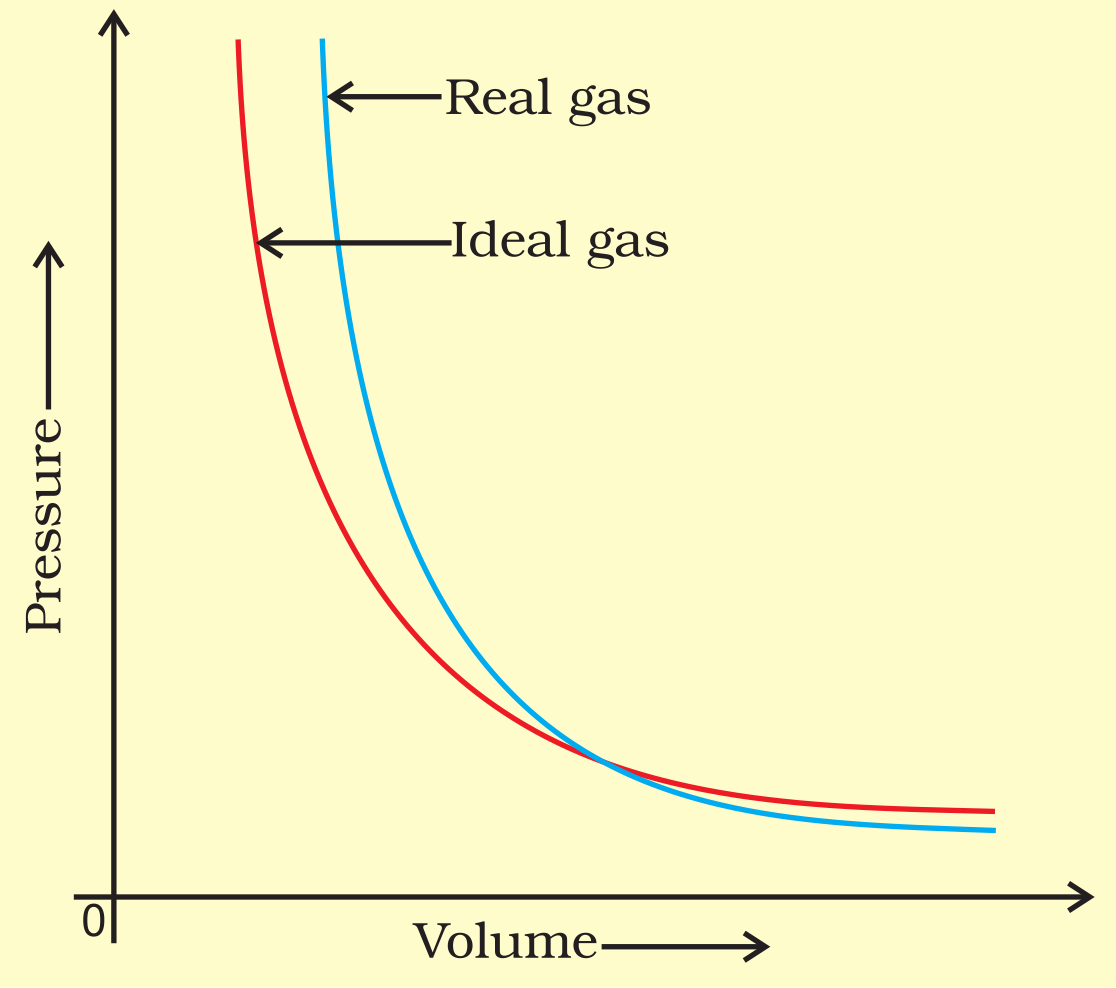
Pressure versus volume graph for a real gas and an ideal gas are shown in Fig. Answer the following questions on the basis of this graph.
  1. Interpret the behaviour of real gas with respect to ideal gas at low pressure.
  2. Interpret the behaviour of real gas with respect to ideal gas at high pressure.
  3. Mark the pressure and volume by drawing a line at the point where real gas behaves as an ideal gas.
If ice and water are in equilibrium at $0^{\circ} C$ then $\Delta H =6.0 kJ mol ^{-1}$. Find value of $\Delta S$ and $\Delta G$.
An alkane has a molecular mass of 72. Give all the possible structural isomers along with their IUPAC names.
Consider the reactions: $6CO_2(g) + 6H_2O(l) → C_6H_{12}O_6(aq) + 6O_2(g)$Why it is more appropriate to write these reactions as:
$6CO_2(g) + 12H_2O(l) → C_6H_{12}O_6(aq) + 6H_2O(l) + 6O_2(g)$
Also suggest a technique to investigate the path of the above redox reactions.
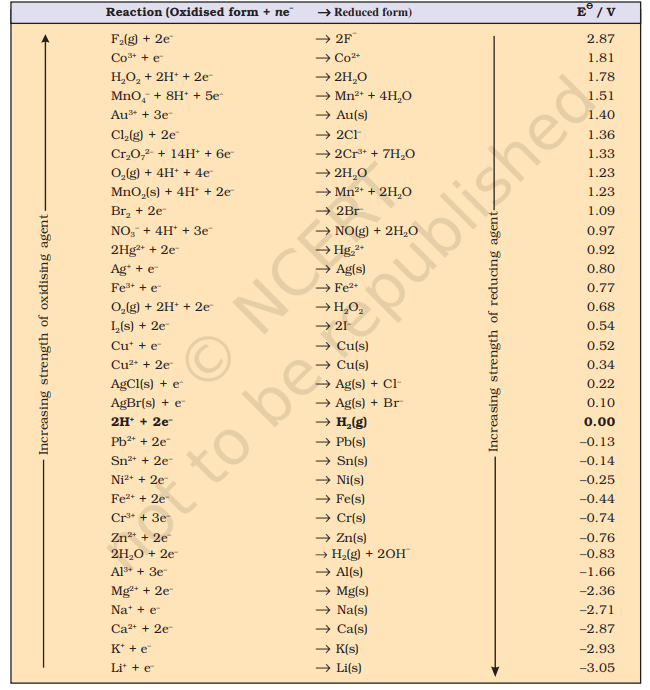
Using the standard electrode potentials given in the Table, predict if the reaction between the following is feasible:
$\mathrm{Ag}^{+}(\mathrm{aq})$ and $\mathrm{Cu}(\mathrm{s})$.
Match the correct ionisation enthalpies and electron gain enthalpies of the following elements.
 
Elements
 
$\Delta\text{H}_1$
$\Delta\text{H}_2$
$\Delta_\text{eg}\text{H}$
(i)
Most reactive non-metal
A.
419
3051
-48
(ii)
Most reactive metal
B.
1681
3374
-328
(iii)
Least reactive element
C.
738
1451
-40
(iv)
Metal forming binary halide
D.
2372
5251
+48
Correct the following electronic configuration of the elements in the ground state.
  1. $1\text{s}^2\ 2\text{s}^1,2\text{p}^2_\text{x},2\text{p}^2_\text{y},2\text{p}^2_\text{z},3\text{s}62,2\text{p}^1_\text{x}$
  2. $1\text{s}^2\ 2\text{s}^1,2\text{p}^1_\text{x},2\text{p}^1_\text{y},2\text{p}^1_\text{z}$
  3. $1\text{s}^2\ 2\text{s}^1,2\text{p}^6,3\text{s}^2,3\text{p}^6,3\text{d}^5$
  4. $1\text{s}^2\ 2\text{s}^2,2\text{p}^6,3\text{p}^6,3\text{d}^4,4\text{s}^2$