Question
Explain the following: (i) Markownikov's Law (ii) Peroxide effect

Answer

SELF

Need a full question paper?

Generate a complete, print-ready paper with questions like this in minutes — across 16+ boards, with answer keys.
Start Generating Free

Similar questions

Enthalpies of formation of $CO ( g ), CO _2(g), N _2 O ( g )$ and $N _2 O _4(g)$ are $-110,-393,81$ and $9.7 kJ mol ^{-1}$ respectively. Find the value of $\Delta rH$ for the reaction: $N _2 O _4(g)+3 CO ( g ) \longrightarrow N _2 O ( g )+3 CO _2(g)$
The ionization constant of benzoic acid is $6.46 \times 10^{–5}$ and $K_{sp}$ for silver benzoate is $2.5 \times 10^{–13}$. How many times is silver benzoate more soluble in a buffer of $pH\ 3.19$ compared to its solubility in pure water?
When heated in air, the alkali metals form various oxides. Mention the oxides formed by $Li, Na$ and $K$.
What is Gibbs energy? How does this explain spontaneity?
The reactant which is entirely consumed in reaction is known as limiting reagent. In the reaction 2A + 4B → 3C + 4D, when 5 moles of A react with 6 moles of B, then
  1. Which is the limiting reagent?
  2. Calculate the amount of C formed?
  1. Why is HF liquid but HCl, HBr, Hl are gases?
  2. Why is o-nitrophenol steam volatile whereas p-nitrophenol is not steam volatile?
  1. Arrange the following in decreasing order of their bond angle: $H_2O, NH_3, H_2S$
  2. Sketch the bond moments and resultant dipole moment of the following molecule:
$H_2O, NH_3, NF_3$ and $PCl_5$​​​​​​​
  1. Draw shape of the following molecules on the basis of VSEPR theory:
$XeF_4$ and $SF_4$​​​​​​​. (At. No. of Xe = 54, At. No. of S = 16)
  1. For the reaction:
$\text{N}_2(\text{g})+3\text{H}_2(\text{g})\rightleftharpoons2\text{NH}_3(\text{g}),$
The value of $K_p$ is $3.6 \times 10^{-2}$ at $500K$.
Colculate the value of $K_c$ for the reaction at the same temperature R = 0.083L bar $K^{-1}mol^{-1}$​​​​​​​.
  1. What is the effect of increasing pressure in the reactions? Give reason.
$\text{PCl}_5(\text{g})\rightleftharpoons\text{PCl}_3(\text{g})+\text{Cl}_2\text{(g)}$
$\text{N}_2(\text{g})+\text{O}_2(\text{g})\rightleftharpoons2\text{NO(g)}$
  1. Complete the equations for:
  1. $\text{BF}_3+\text{LiH}\rightarrow$
  2. $\text{B}_2\text{H}_6+\text{H}_2\text{O}\rightarrow$
  1. Give reasons:
  1. Conc $HNO_3$ is transported in aluminium container.
  2. Graphite is used as lubricant.
  3. Lead (IV) chloride is highly unstable towards heat.
Explain why cation are smaller and anions larger in radii than their parent atoms?
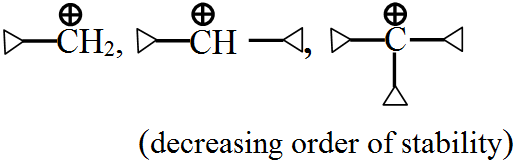
  1. Arrange the following according to given property
$\text{CH}_3\stackrel{\oplus \ \ \ }{\text{CH}}_2,\text{C}_6\text{H}_5-\stackrel{\oplus\ \ \ \ }{\text{CH}}_2,(\text{CH}_3)_3\stackrel{\oplus \ \ \ \ }{\text{CH}},$
$\text{CH}_2=\text{CH}-\stackrel{\oplus\ \ \ \ }{\text{CH}}_2$ (decreasing order of stability)
  1. $\text{HC}\equiv\text{C}^{\ominus},\text{Ch}_2=\stackrel{\ominus\ \ \ \ \ \ }{\text{CH}_2},\text{CH}_3-\stackrel{\ominus\ \ \ \ \ }{\text{CH}_2},\stackrel{\ominus \ \ \ \ \ }{\text{CH}_3}$ (increasing order of stabillity)
  2. $\text{C}_6\text{H}_5\stackrel{\bf. \ \ \ \ }{\text{CHCH}_3},\text{C}_6\text{H}_5\text{CH}_2\stackrel{\bf.\ \ \ \ \ }{\text{CH}_2},\text{C}_6\text{H}_5\stackrel{\bf.}{\text{C}}_3(\text{CH}_3)_2$ (increasing order of stabillity)
  3. $\text{CH}_3-\stackrel{\oplus \ \ \ \ }{\text{CH}}-\text{O}-\text{CH}_3,\text{CH}_3-\stackrel{\oplus \ \ \ \ }{\text{CH}},-\text{OCH}_3,$
${\ \ \ \ \ \ \ \ \ \ \ \ \ \ \ \ \ \ \ \ \text{O}}\\{\ \ \ \ \ \ \ \\ \ \ \ \ \ \ \ \ \ \ \ \ \ \\ \|}\\\ \text{CH}_3-\stackrel{\oplus \ \ \ \ }{\text{CH}}\text{C}-\text{OCH}_3$ (decreasing order of stability)
  1.