Explain the meaning of inflationary gap. Explain any two measures of correcting it.
OR
Explain and graphically represent the concept of inflationary gap. Explain any one measure of removing this gap.
OR
Explain and graphically represent the concept of inflationary gap. Explain any one measure of removing this gap.
Download our app for free and get started
When at full employment level of income, AD is greater than AS, the excess of AD over AS is termed as "Excess Demand".
Showing the concept of Excess 1demand, diagrammatically, we use the concept of "Inflationary Gap". (Shown by CD in the diagram).
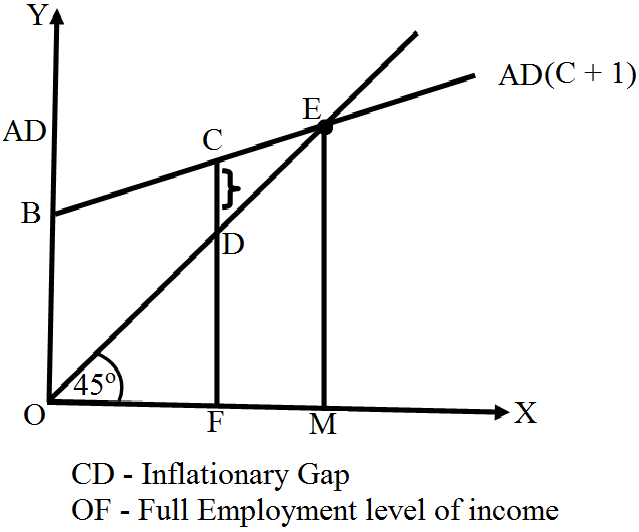
Point E, denotes the point of equilibrium, as at this point AD curve intersects the 45° Line. OM is the equilibrium income. OF denotes full employment level of income. At this level DF denotes aggregate supply, (Since income is same as Aggregate Supply). But the Aggregate Demand (AD) at full employment is CF, It means that AD (CF) is more than what is required to sustain full employment output. It denotes a situation of Excess Demand equal to CD(CF-DF), which denotes "Inflationary Gap".
To correct inflationary gap, the following measures can be taken:
Showing the concept of Excess 1demand, diagrammatically, we use the concept of "Inflationary Gap". (Shown by CD in the diagram).
Point E, denotes the point of equilibrium, as at this point AD curve intersects the 45° Line. OM is the equilibrium income. OF denotes full employment level of income. At this level DF denotes aggregate supply, (Since income is same as Aggregate Supply). But the Aggregate Demand (AD) at full employment is CF, It means that AD (CF) is more than what is required to sustain full employment output. It denotes a situation of Excess Demand equal to CD(CF-DF), which denotes "Inflationary Gap".
To correct inflationary gap, the following measures can be taken:
- Reduce government spending (Fiscal measure), which will directly reduce AD and thereby remove the inflationary gap.
- The central bank can raise the bank rate, as a result the commercial banks are compelled to raise their lending rate, so demand for loans will fall. This is turn will reduce investment and in turn reduce AD in the economy.

Download our appand get started for free
Experience the future of education. Simply download our apps or reach out to us for more information. Let's shape the future of learning together!No signup needed.*
Similar Questions
- 1View SolutionDifferentiate between APC and APS and tell which of them is negative.
- 2View SolutionWhat happens to the level of national income when aggregate demand falls short of aggregate supply?
- 3View SolutionTax rates on higher income group have been increased. Which economic value does it reflect? Explain.
- 4View SolutionWhat are two alternative ways of determining equilibrium level of income? How are these related?
- 5View SolutionWhat are the reasons or causes for deficient demand?
- 6View SolutionAn economy is in equilibrium. Calculate the National Income from the following:Autonomous Consumption = 120Marginal Propensity to Save = 0·2Investment Expenditure = 150
- 7View SolutionWhat is ex-Ante consumption? Distinguish between autonomous consumption and induced consumption.
- 8View SolutionDefine investment multiplier. Explain the relationship between marginal propensity to save and investment multiplier.
- 9View SolutionDiscuss the working of the adjustment mechanism in the following situations:
- Aggregate demand is greater than Aggregate supply.
- Ex-ante Investments are lesser than Ex-ante Savings.
- 10View SolutionWhat are the reasons or causes for excess demand?