Question
Explain the reflection of a plane wave using Huygen's principle.

Answer


Image
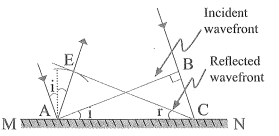
Consider a plane wave AB incident at an angle $i$ on a reflecting surface MN .
If $v$ is the speed of wave in the given medium, $\tau$ represents the time taken by the wavefront to advance from point B to C , then the distance $BC =v \tau$.
In order to construct the reflected wavefront we draw a sphere of radius $v \tau$ from the point A as shown in fig.
Let $C E$ represent the tangent plane drawn from the point C to this sphere.
Obviously,
$AE = BC =v \tau$
From fig., incident and reflected wave fronts make angle $i$ and $r$ with reflecting surface, MN respectively.
From fig.,
AC is the common side between $\triangle AEC$ and $\triangle ABC$.
Also, $\angle AEC =\angle ABC =\frac{\pi}{2}$.
$\text { and } AE = BC =v \tau$
So $\triangle AEC$ and $\triangle ABC$ are congruent.
And therfore, $\angle i=\angle r$,
which is law of reflection.

Need a full question paper?

Generate a complete, print-ready paper with questions like this in minutes — across 16+ boards, with answer keys.
Start Generating Free

Similar questions

Obtain the de Broglie wavelength of a neutron of kinetic energy $150\ eV$. As you have seen in Exercise $11.31,$ an electron beam of this energy is suitable for crystal diffraction experiments. Would a neutron beam of the same energy be equally suitable? Explain. $(m_n = 1.675 \times 10^{–27} \ kg).$
Explain the close relationship between the internal structure of an atom and the emission spectrum.
Two convex lenses of same focal length but of aperture $A_1$ and $A_2 (A_2 < A_1),$ are used as the objective lenses in two astronomical telescopes having identical eyepieces. What is the ratio of their resolving power? Which telescope will you prefer and why? Give reason.
  1. Can two equipotential surfaces intersect each other? Give reasons.
  2. Two charges – q and +q are located at points A (0, 0, –a) and B (0, 0, +a) respectively. How much work is done in moving a test charge from point P (7, 0, 0) to Q (-3, 0, 0)?
An electric field $\vec{\text{E}}=\vec{\text{i}}\text{Ax}$ exists in the space, where $A= 10Vm^{-2}.$ Take the potential at $(10m, 20m)$ to be zero. Find the potential at the origin.
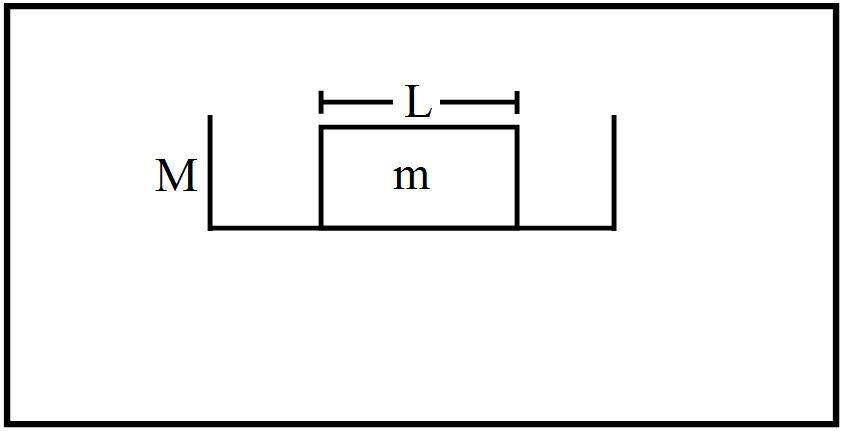
Consider a gravity-free hall in which a tray of mass M, carrying a cubical block of ice of mass m and edge L, is at rest in the middle. If the ice melts, by what distance does the centre of mass of "the tray plus the ice" system descend?
A charge Q is placed at the centre of a cube. Find the flux of the electric field through the six surfaces of the cube.
Differentiate between electric lines of force and magnetic lines of force.
Find the angular separation between the consecutive bright fringes in a Young's double slit experiment with blue$-$green light of wavelength $500\ nm$. The separation between the slits is $2.0 \times 10^{-3}m.$
At what separation should two equal charges, 1.0C each, be placed so that the force between them equals the weight of a 50kg person?