Question
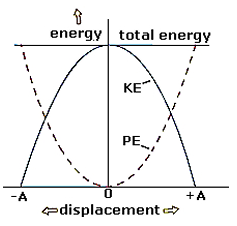
Explain the total energy in simple harmonic motion and show the graphical representation of energy in SHM.
Answer

The total energy of the system of a block and a spring is equal to the sum of the potential energy stored in the spring plus the kinetic energy of the block and is proportional to the square of the amplitude.
$
\begin{aligned}
& \frac{1}{2} m \omega^2\left(A^2-x^2\right)+\frac{1}{2} m \omega^2 x^2 \\
& E=\frac{1}{2} m \omega^2 A^2
\end{aligned}
$
Hence, the total energy of the particle in SHM is constant and it is independent of the instantaneous displacement. Relationship between potential energy, kinetic energy, and time in Simple Harmonic Motion at $t=0$, when $x= \pm A$.
Image

Need a full question paper?

Generate a complete, print-ready paper with questions like this in minutes — across 16+ boards, with answer keys.
Start Generating Free

Similar questions

The blades of a windmill sweep out a circle of area A.
  1. If the wind flows at a velocity v perpendicular to the circle, what is the mass of the air passing through it in time t?
  2. What is the kinetic energy of the air?
  3. Assume that the windmill converts 25% of the wind’s energy into electrical energy, and that A = 30 m2, v = 36km/h and the density of air is 1.2kgm-3. What is the electrical power produced?
A professor reads a greeting card received on his 50th birthday with +2.5D glasses keeping the card 25cm away. Ten years later, he reads his farewell letter with the same glasses but he has to keep the letter 50cm away. What power of lens should he now use?
Explain why
A spinning cricket ball in air does not follow a parabolic trajectory.
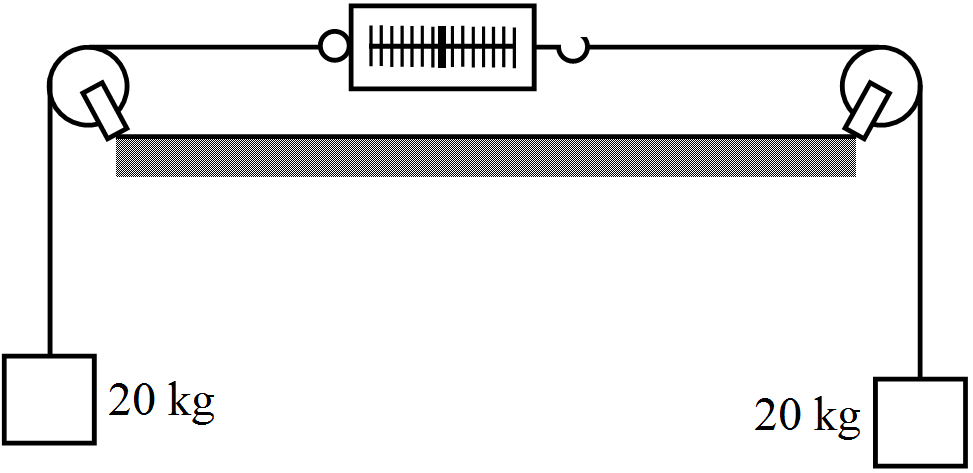
Figure shows a light spring balance connected to two blocks of mass 20kg each. The graduations in the balance measure the tension in the spring.
  1. What is the reading of the balance?
  2. Will the reading change if the balance is heavy, say 2.0kg?
  3. What will happen if the spring is light but the blocks have unequal masses?
​​​​​​​
A bullet of mass 25g is fired horizontally into a ballistic pendulum of mass 5.0kg and gets embedded in it. If the centre of the pendulum rises by a distance of 10cm, find the speed of the bullet.
Find the value of $\frac{\text{t}}{\tau}$ for which the current in an LR circuit builds up to:
  1. 90%,
  2. 99%
  3. 99·9% of the steady-state value.
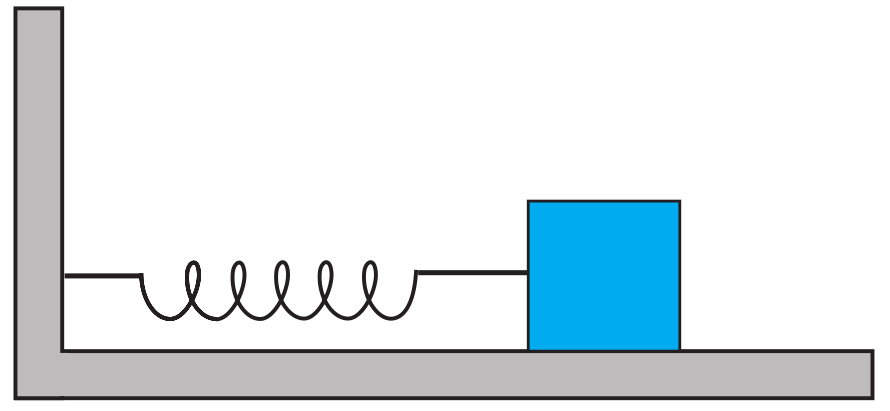
A spring having with a spring constant 1200N m-1 is mounted on a horizontal table as shown in Fig. A mass of 3kg is attached to the free end of the spring. The mass is then pulled sideways to a distance of 2.0cm and released.

Determine (i) the frequency of oscillations, (ii) maximum acceleration of the mass, and (iii) the maximum speed of the mass.
A 20cm long conducting rod is set into pure translation with a uniform velocity of 10cm/s-1 perpendicular to its length. A uniform magnetic field of magnitude 0.10T exists in a direction perpendicular to the plane of motion.
  1. Find the average magnetic force on the free electrons of the rod.
  2. For what electric field inside the rod, the electric force on a free elctron will balance the magnetic force? How is this electric field created?
  3. Find the motional emf between the ends of the rod.
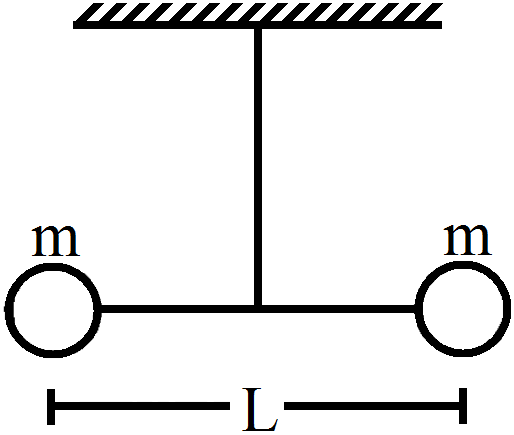
Two small balls, each of mass m are connected by a light rigid rod of length L. The system is suspended from its centre by a thin wire of torsional constant k. The rod is rotated about the wire through an angle $\theta_0$ and released. Find the tension in the rod' as the system passes through the mean position.

A vessel filled with water is kept on a weighing pan and the scale adjusted to zero. A block of mass M and density $\rho$ is suspended by a massless spring of spring constant k. This block is submerged inside into the water in the vessel. What is the reading of the scale?