Question
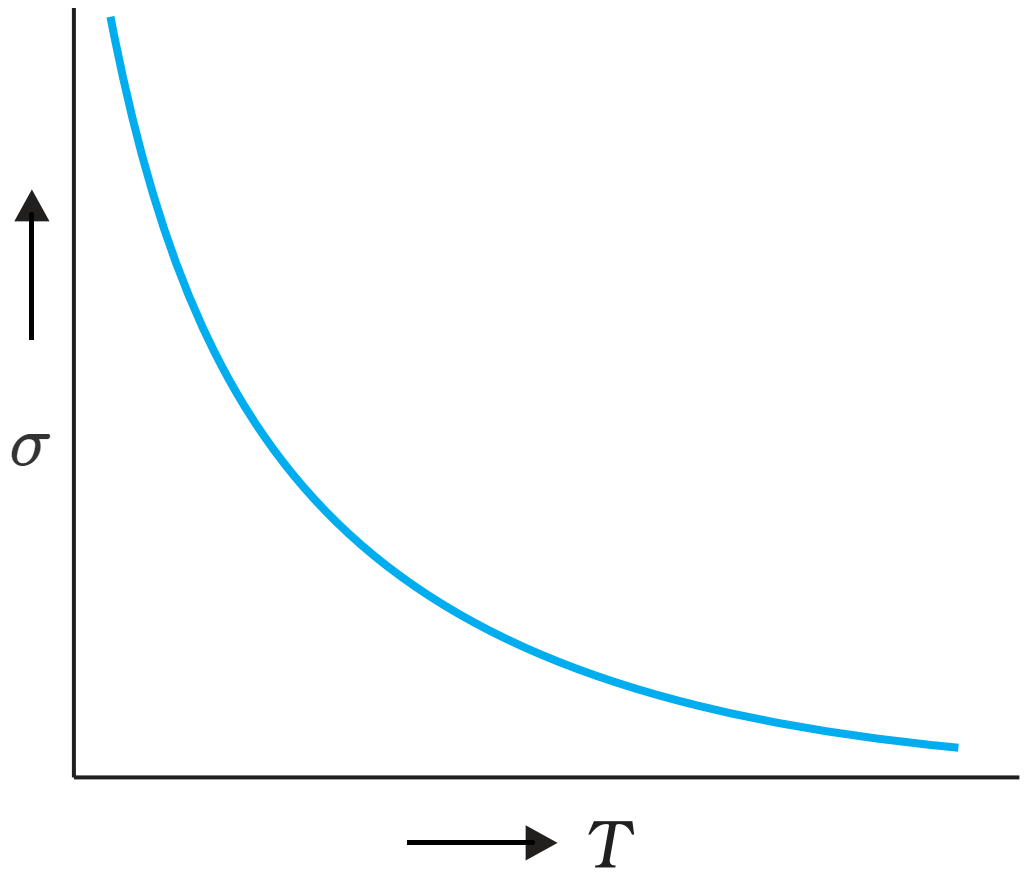
Explain the variation of conductivity with temperature for:
  1. A metallic conductor.
  2. Ionic conductors.
  3. Semiconductors.

Answer

Conductivity of a metallic conductor $\sigma=\frac{1}{\rho}=\frac{\text{ne}^2\tau}{\text{m}}.$
Where m = mass of charge carrier, e = charge on each carrier $\tau$ = relaxation time, n = number density of charge carriers
  1. With rise of temperature, the collision of electrons with fixed lattice ions/ atoms increases so that relaxation time $(\tau)$ decreases. Consequently, the conductivity of metals decreases with rise of temperature.
  2. Conductivity of ionic conductor increases with increase of temperature because with increase of temperature, the ionic bonds break releasing positive and negative ions which are charge carriers in ionic conductors.
  3. In the case of a semiconductors, when temperature increases, covalent bonds break and charge carriers (electrons and holes) become free i.e., n increases, so conductivity increases with rise of temperature.

Need a full question paper?

Generate a complete, print-ready paper with questions like this in minutes — across 16+ boards, with answer keys.
Start Generating Free

Similar questions

Check that the ratio $ke ^2 / Gm _{ e } m _{ p }$, is dimen-sionless. Look up a Table of Physical Constants and determine the value of this ratio. What does the ratio signify?
Obtain an expression for motional electromotive force.

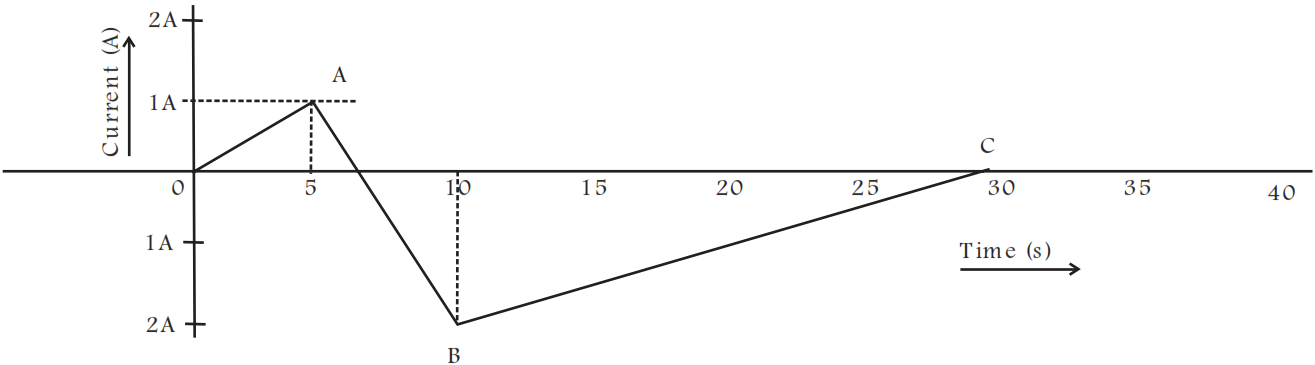
A (current vs time) graph of the current passing through a solenoid is shown in Fig. For which time is the back electromotive force (u) a maximum. If the back emf at t = 3s is e, find the back emf at t = 7s, 15s and 40s. OA, AB and BC are straight line segments.
A parallel$-$plate capacitor has plate area $100\ cm^2$ and plate separation $1.0\ cm.$ A glass plate $($dielectric constant $6.0)$ of thickness $6.0\ mm$ and an ebonite plate $($dielectric constant $4.0)$ are inserted one over the other to fill the space between the plates of the capacitor. Find the new capacitance.
Suppose the block of the previous problem is pushed down the incline with a force of 4N. How far will the block move in the first two seconds after starting from rest? The mass of the block is 4kg.
The radius of a gold nucleus $(Z = 79) $ is about $7.0 \times 10^{-15}m$. Assume that the positive charge is distributed uniformly throughout the nuclear volume. Find the strength of the electric field at:
  1. The surface of the nucleus.
  2. At the middle point of a radius. Remembering that gold is a conductor, is it justified to assume that the positive charge is uniformly distributed over the entire volume of the nucleus and does not come to the outer surface?
Suppose the loop in Exercise $6.4$ is stationary but the current feeding the electromagnet that produces the magnetic field is gradually reduced so that the field decreases from its initial value of $0.3T$ at the rate of $0.02T s^{–1}$. If the cut is joined and the loop has a resistance of $1.6\Omega ,$ how much power is dissipated by the loop as heat? What is the source of this power?
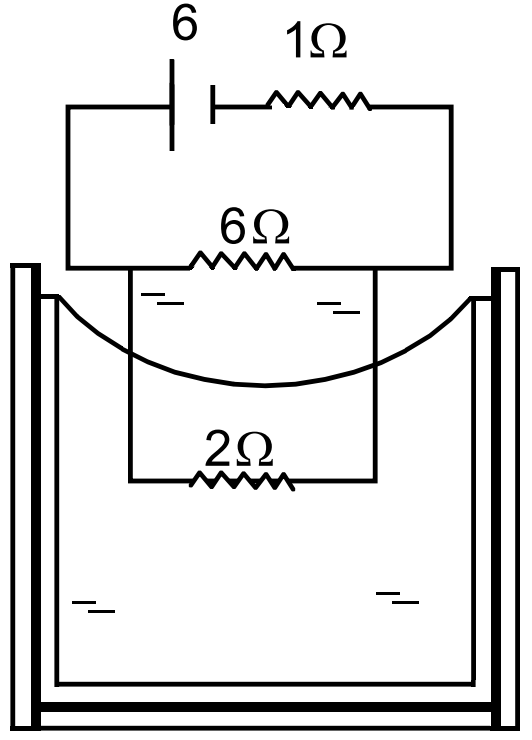
The $2.0\Omega$ resistor shown in the figure is dipped into a calorimeter containing water. The heat capacity of the calorimeter together with water is $2000JK-^1$.
  1. If the circuit is active for $15$ minutes, what would be the rise in the temperature of the water?
  2. Suppose the $6.0\Omega$ resistor gets burnt. What would be the rise in the temperature of the water in the next $15$ minutes?
  1. Derive the expression for the torque on a rectangular current carrying loop suspended in a uniform magnetic field.
  2. A proton and a deuteron having equal momenta enter in a region of uniform magnetic field at right angle to the direction of the field. Depict their trajectories in the field.
A bucket full of water is placed in a room at $15^\circ C$ with initial relative humidity $40\%$. The volume of the room is $50m^3$.
  1. How much water will evaporate?
  2. lf the room temperature is increased by $5^\circ C,$ how much more water will evaporate? The saturation vapour pressure of water at $15^\circ C$ and $20^\circ C$ are $1.6\ kPa$ and $2.4\ kPa$ respectively.