Find the centre of mass of a uniform:
- Half-disc.
- Quarter-disc.
Download our app for free and get started
Let mass of half disc is M. Area of half disc $=\frac{\pi\text{R}^2}{2}$ Mass per unit area $\text{m}=\frac{2\text{M}}{\pi\text{R}^2}$ 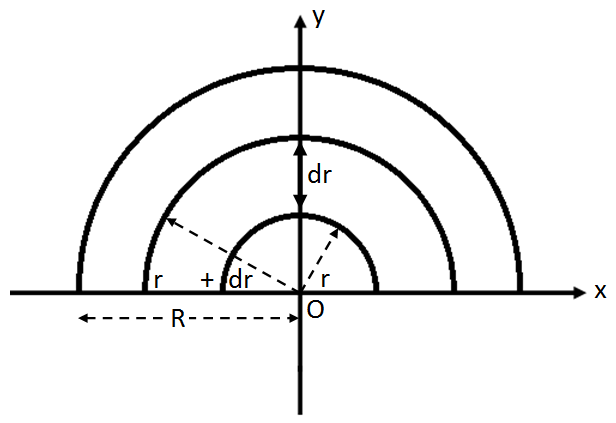
Surface area of a semicircular strip $=\frac{\pi}{2}\big[(\text{r}+\text{dr})^2-\text{r}^2\big]$
$=\frac{\pi}{2}\big[\text{r}^2+\text{dr}^2+2\text{rdr}-\text{r}^2\big]$
$=\pi\text{r dr} $
$\therefore$ Mass of strip $\text{dm}=\frac{2\text{M}}{\pi\text{R}^2}\cdot\pi\text{r dr}$
$\text{dm}=\frac{2\text{M}}{\text{R}^2}\cdot\text{r dr}$
Let (x, y) are the co-ordinates of c.m. of this strip $(\text{x},\text{y})=\Big(0,\frac{2\text{r}}{\pi}\Big)$
$\text{x}=\text{x}_\text{cm}=\frac{1}{\text{M}}\int\limits^{\text{R}}_0\text{x dm}=\int\limits^{\text{R}}_00\text{ dm}=0$
$\text{y}_\text{cm}=\frac{1}{\text{M}}\int\limits^{\text{R}}_0\text{y dm}=\frac{1}{\text{M}}\int\limits^{\text{R}}_0\frac{2\text{r}}{\pi}\times\frac{\text{2}\text{M}}{\text{R}^2}\text{r dr}$
$=\frac{1}{\text{m}}\cdot\frac{4\text{M}}{\pi\text{R}^2}\int\limits^{\text{R}}_0\text{r}^2\text{ dr}=\frac{4\text{M}}{\pi\text{R}^2}\Big[\frac{\text{r}^3}{3}\Big]_0^{\text{R}}=\frac{4}{3\pi\text{R}^2}\cdot\text{R}^3$
$\text{y}_\text{cm}=\frac{4\text{R}}{3\pi}$
So, centre of mass of circular half disc $=\Big(0,\frac{4\text{R}}{3\pi}\Big)$
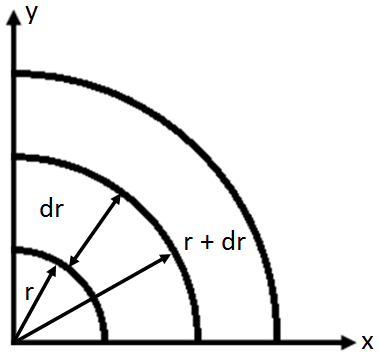
Using symmetry,
For a half disc along y-axis c.m. will be at $\text{y}=\frac{4\text{R}}{3\pi}$
So, the c.m. of quarter disc $=\Big(\frac{4\text{R}}{3\pi},\frac{4\text{R}}{3\pi}\Big)$
- The half disc can be divided into a larger number of semi circular strips.
Surface area of a semicircular strip $=\frac{\pi}{2}\big[(\text{r}+\text{dr})^2-\text{r}^2\big]$
$=\frac{\pi}{2}\big[\text{r}^2+\text{dr}^2+2\text{rdr}-\text{r}^2\big]$
$=\pi\text{r dr} $
$\therefore$ Mass of strip $\text{dm}=\frac{2\text{M}}{\pi\text{R}^2}\cdot\pi\text{r dr}$
$\text{dm}=\frac{2\text{M}}{\text{R}^2}\cdot\text{r dr}$
Let (x, y) are the co-ordinates of c.m. of this strip $(\text{x},\text{y})=\Big(0,\frac{2\text{r}}{\pi}\Big)$
$\text{x}=\text{x}_\text{cm}=\frac{1}{\text{M}}\int\limits^{\text{R}}_0\text{x dm}=\int\limits^{\text{R}}_00\text{ dm}=0$
$\text{y}_\text{cm}=\frac{1}{\text{M}}\int\limits^{\text{R}}_0\text{y dm}=\frac{1}{\text{M}}\int\limits^{\text{R}}_0\frac{2\text{r}}{\pi}\times\frac{\text{2}\text{M}}{\text{R}^2}\text{r dr}$
$=\frac{1}{\text{m}}\cdot\frac{4\text{M}}{\pi\text{R}^2}\int\limits^{\text{R}}_0\text{r}^2\text{ dr}=\frac{4\text{M}}{\pi\text{R}^2}\Big[\frac{\text{r}^3}{3}\Big]_0^{\text{R}}=\frac{4}{3\pi\text{R}^2}\cdot\text{R}^3$
$\text{y}_\text{cm}=\frac{4\text{R}}{3\pi}$
So, centre of mass of circular half disc $=\Big(0,\frac{4\text{R}}{3\pi}\Big)$
- Mass per unit area of quarter disc centre of mass of a uniform quarter disc,
Using symmetry,
For a half disc along y-axis c.m. will be at $\text{y}=\frac{4\text{R}}{3\pi}$
So, the c.m. of quarter disc $=\Big(\frac{4\text{R}}{3\pi},\frac{4\text{R}}{3\pi}\Big)$

Download our appand get started for free
Experience the future of education. Simply download our apps or reach out to us for more information. Let's shape the future of learning together!No signup needed.*
Similar Questions
- 1View SolutionSuppose the particle of the previous problem has a mass m and a speed v before the collision and it sticks to the rod after the collision. The rod has a mass M:
- Find the velocity of the centre of mass C of the system constituting ''The rod plus the particle''.
- Find the velocity of the particle with respect to C before the collision.
- Find the velocity of the rod with respect to C before the collision.
- Find the angular momentum of the particle and of the rod about the centre of mass C before the collision.
- Find the moment of inertia of the system about the vertical axis through the centre of mass C after the collision.
- Find the velocity of the centre of mass C and the angular velocity of the system about the centre of mass after the collision.
- 2A disc of mass $5kg$ and radius $50cm$ rolls on the ground at the rate of $10ms^{-1}$. Calculate the K.E. of the disc. $\Big(\text{Given}:\text{I}=\frac{1}{2}\text{MR}^2\Big)$View Solution
- 3A uniform square plate S(side c) and a uniform rectangular plate R(sides b, a) have identical areas and masses:View Solution
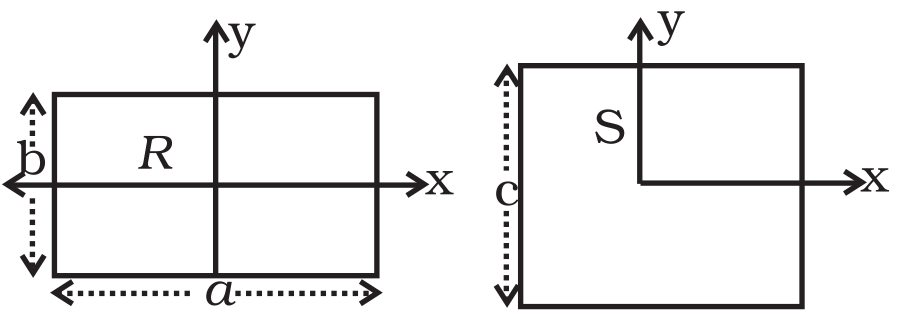
Show that:- $\frac{\text{I}_\text{xR}}{\text{I}_\text{xS}}<1$
- $\frac{\text{I}_\text{ys}}{\text{I}_\text{ys}}>1$
- $\frac{\text{I}_{2\text{R}}}{\text{I}_{2\text{s}}}>1$
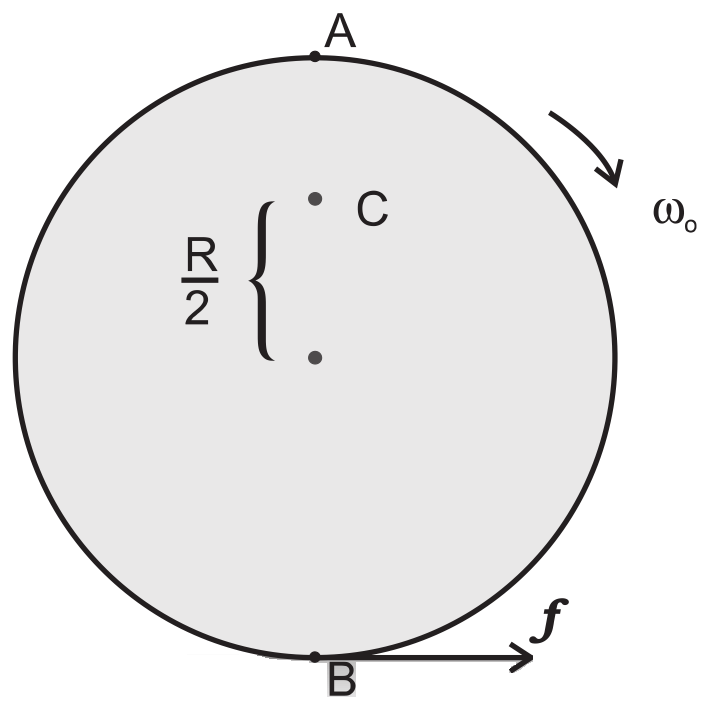
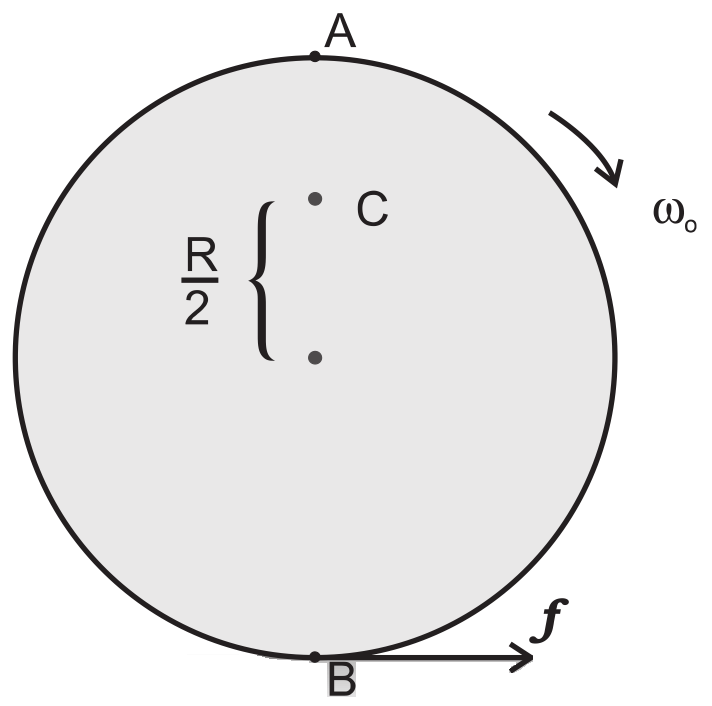
- 4A disc rotating about its axis with angular speed $\omega_0$ is placed lightly (without any translational push) on a perfectly frictionless table. The radius of the disc is R. What are the linear velocities of the points A, B and C on the disc shown in will the disc roll in the direction indicated?View Solution
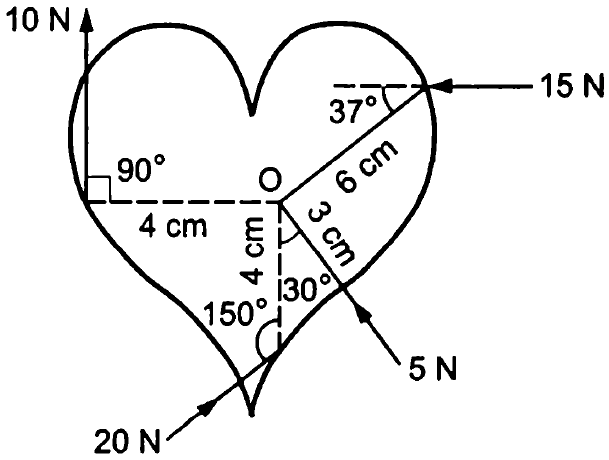
- 5View SolutionCalculate the total torque acting on the body shown in figure about the point O.
- 6View SolutionCalculate the velocity of the centre of mass of the system of particles shown in figure.
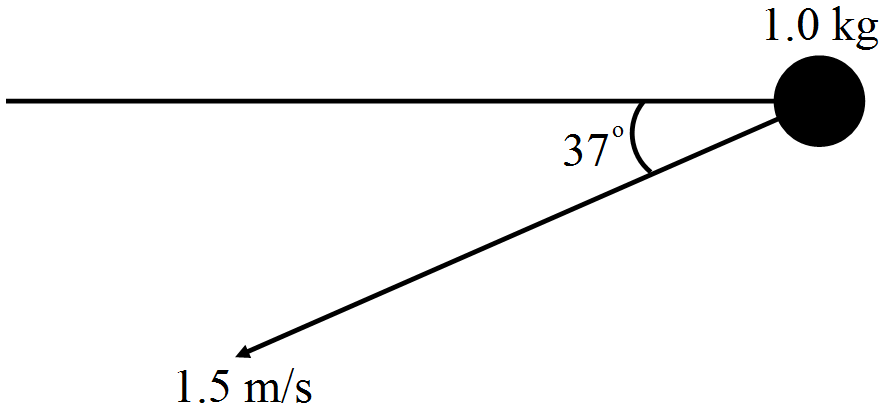
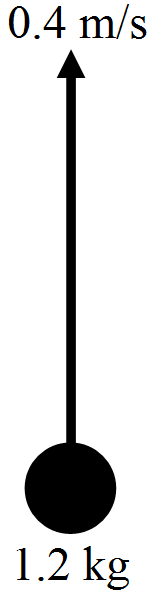
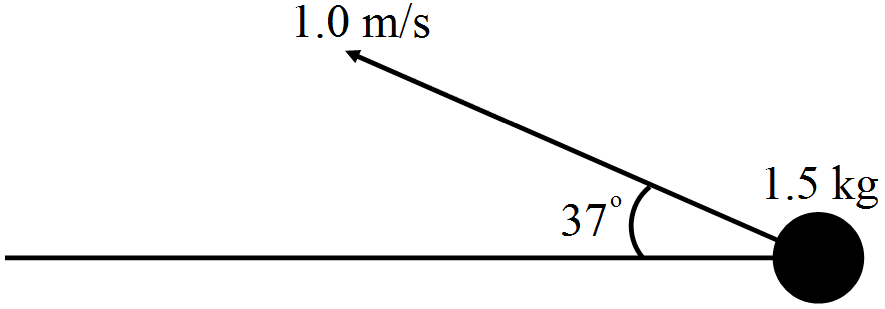

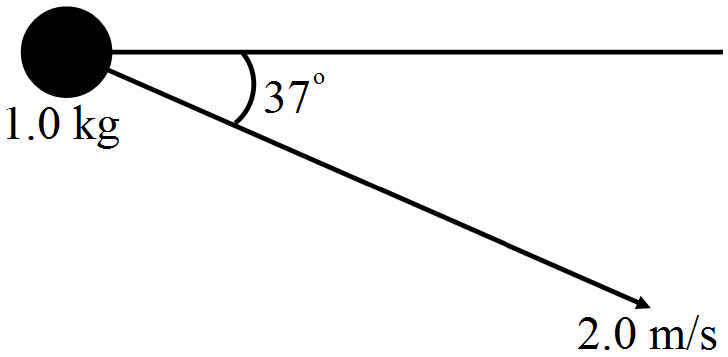
- 7View SolutionTorques of equal magnitude are applied to a hollow cylinder and a solid sphere, both having the same mass and radius. The cylinder is free to rotate about its standard axis of symmetry, and the sphere is free to rotate about an axis passing through its centre. Which of the two will acquire a greater angular speed after a given time.
- 8A uniform disc of radius R, is resting on a table on its rim.The coefficient of friction between disc and table is $\mu.$Now the disc is pulled with a force F as shown in the figure. What is the maximum value of F for which the disc rolls without slipping?View Solution
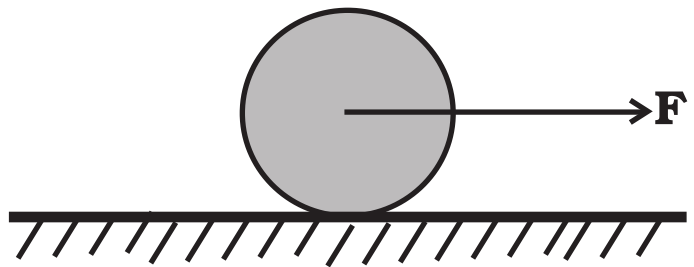
- 9A meter stick held vertically, with one end on the ground, is then allowed to fall. What is the value of the radial and tangential acceleration of the top end of the stick when the stick has turned through on angle $\theta?$ What is the speed with which the top end of the stick hits the ground? Assume that the end of the stick in. contact with the ground does not slip.View Solution
- 10A disc rotating about its axis with angular speed $\omega_0$ is placed lightly (without any translational push) on a perfectly frictionless table. The radius of the disc is R. What are the linear velocities of the points A, B and C on the disc shown in will the disc roll in the direction indicated?View Solution