Question
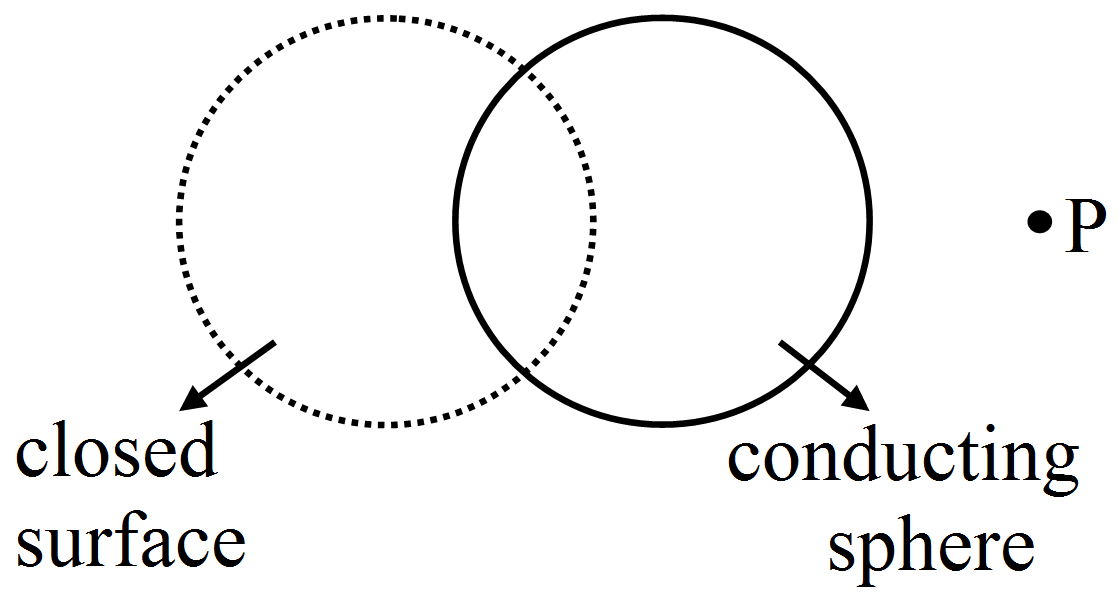
Figure shows a closed surface which intersects a conducting sphere. If a positive charged is placed at the point P, the flux of the electic field through the closed surface:
Answer

  1. Will become positive.
Explanation:
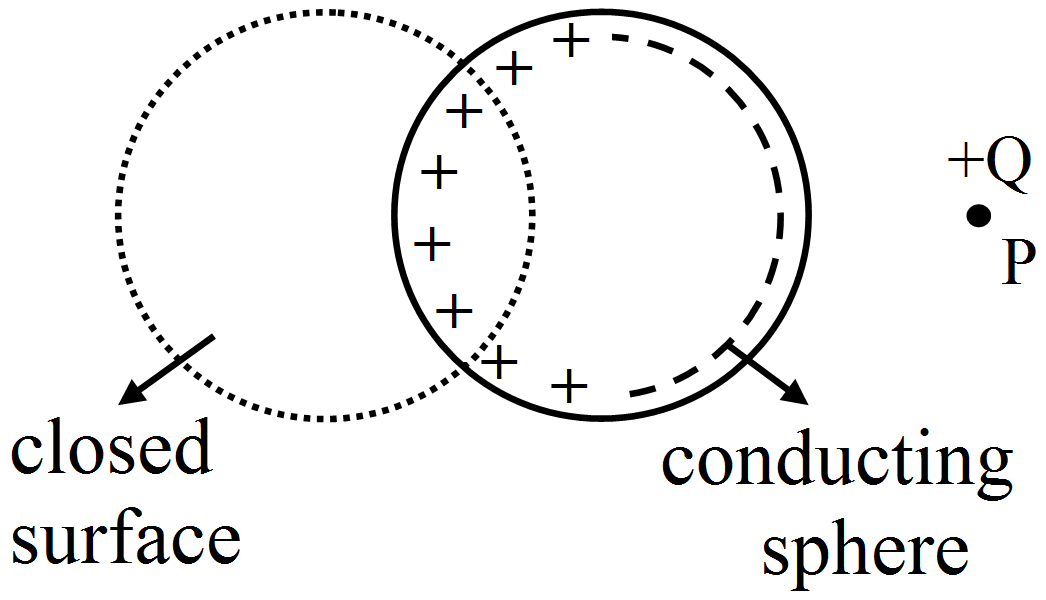
Charge distribution:

Due to charge distribution, intersection by the closed surface of conducting sphere containing the positive charge. So we can say that the flux of the electric field through the closed surface will become positive.
$\therefore\phi=\frac{\text{q}_{\text{in}}}{\epsilon_0}\Rightarrow+\text{ve}$

Need a full question paper?

Generate a complete, print-ready paper with questions like this in minutes — across 16+ boards, with answer keys.

Start Generating Free

Similar questions

The capacity of an air condenser is $2.0\mu F.$ If a medium is placed between its plates. The capacity becomes $12\mu F.$ The dielectric constant of the medium will be
According to Lenz's law there is conversion of:
X-ray incident on a material:
Weber $/ \mathrm{m}^2$ is equal to
The net resistance of a voltmeter should be large to ensure that(a) It does not get overheated(b) It does not draw excessive current(c) It can measure large potential difference(d)  It does not appreciably change the potential difference to be measured


A current passes through a resistor. Let $K_1$ and $K_2$ represent the average kinetic energy of the conduction electrons and the metal ions, respectively:
A free neutron decays into a proton, an electron and(a) A neutrino(b) An antineutrino(c) An alpha particle(d) A beta particle
       
Doppler's effect in sound in addition to relative velocity between source and observer, also depends while source and observer or both are moving. Doppler effect in light depend only on the relative velocity of source and observer. The reason of this is(a) Einstein mass - energy relation(b) Einstein theory of relativity(c) Photoelectric effect(d) None of these
   
   
A double convex lens of glass of m = 1.5 has radius of curvature of each of its surface is 0.2 m.  The power of the lens is(a) + 10 dioptres (b) – 10 dioptres(c) – 5 dioptres(d)  +5 dioptres
       
Kirchoff's current law (or junction law) is a result of the conservation of which quantity ?