Polar molecules are the molecules:
NEET 2021, Easy


Download our appand get started for free
Experience the future of education. Simply download our apps or reach out to us for more information. Let's shape the future of learning together!No signup needed.*
Similar Questions
- 1The energy stored in a condenser of capacity $C$ which has been raised to a potential $V$ is given byView Solution
- 2Find equivalent capacitance between $A$ and $B$......$C$View Solution
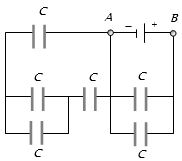
- 3Assertion $(A):$ A spherical equipotential surface is not possible for a point charge.View Solution
Reason $(R):$ A spherical equipotential surface is possible inside a spherical capacitor.
- 4A pellet carrying a charge of $0.5$ coulomb is accelerated through a potential of $2000$ volts. It attains some kinetic energy equal toView Solution
- 5Electric potential at any point is $V = -5x + 3y + \sqrt {15} z$, then the magnitude of the electric field isView Solution
- 6View SolutionPutting a dielectric substance between two plates of condenser, capacity, potential and potential energy respectively
- 7Consider a thin spherical shell of radius $R$ with its centre at the origin, carrying uniform positive surface charge density. The variation of the magnitude of the electric field $|\vec{E}(r)|$ and the electric potential $V(r)$ with the distance r from the centre, is best represented by which graph?View Solution
- 8The capacitance $(C)$ for an isolated conducting sphere of radius $(a)$ is given by $4\pi \varepsilon_0a$. If the sphere is enclosed with an earthed concentric sphere. The ratio of the radii of the spheres $\frac{n}{{(n - 1)}}$ being then the capacitance of such a sphere will be increased by a factorView Solution
- 9A parallel plate capacitor is filled with $3$ dielectric materials of same thickness, as shown in the sketch. The dielectric constants are such that $k_3 > k_2 > k_1$. Let the magnitudes of the electric field in and potential drops across each dielectric be $E_3$, $E_2$,$ E_1$, $\Delta V_3$, $\Delta V_2$ and $\Delta V_1$, respectively. Which one of the following statement is true ?View Solution
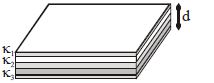
- 10A capacitor having capacitance $C$ is charged to a voltage $V$. It is then removed and connected in parallel with another identical capacitor which is uncharged. The new charge on each capacitor is nowView Solution