Question
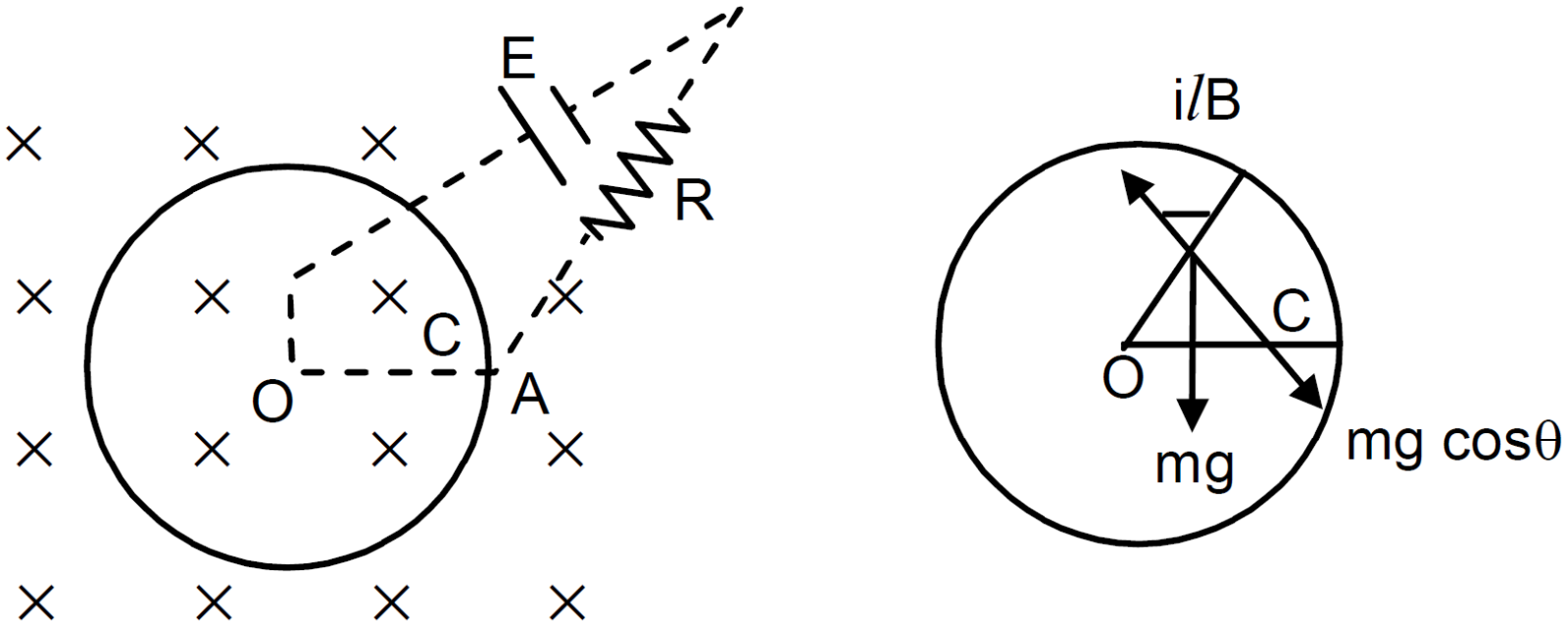
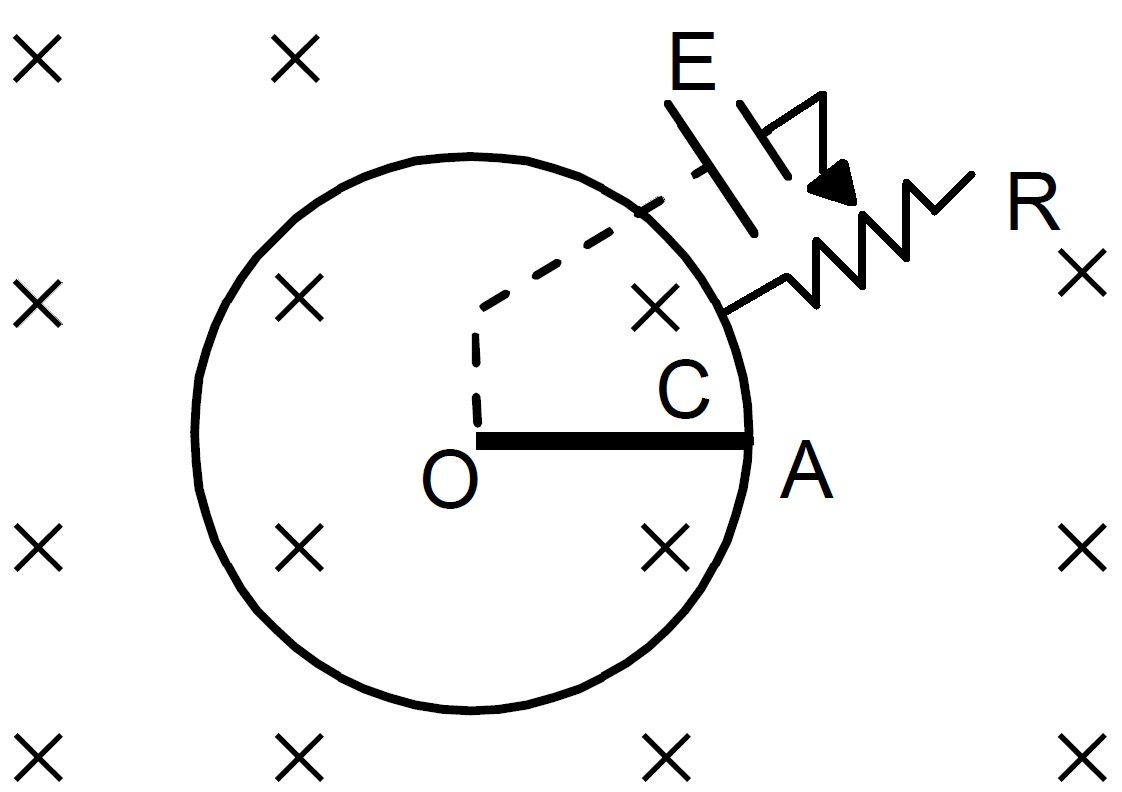
Figure shows a situation similar to the previous problem. All parameters are the same except that a battery of emf $\epsilon$ and a variable resistance R are connected between O and C. The connecting wires have zero resistance. No external force is applied on the rod (except gravity, forces by the magnetic field and by the pivot). In what way should the resistance R be changed so that the rod may rotate with uniform angular velocity in the clockwise direction? Express your answer in terms of the given quantities and the angle $\theta$ made by the rod OA with the horizontal.
Answer


$\text{emf}=\frac{1}{2}\text{B}\omega\text{a}^2$ [from previous problem]
Current $= \frac{\text{e}+\text{E}}{\text{R}}=\frac{\frac{1}{2}\times\text{B}\omega\text{a}^2+\text{E}}{\text{R}}$
$=\frac{\text{B}\omega\text{a}^2 +2\text{E}}{2\text{R}}$
$\Rightarrow \text{mg} \cos \theta =\text{ilB}$ [Net force acting on the rod is O]
$\Rightarrow \text{mg}\cos\theta =\frac{\text{B}\omega\text{a}^2+2\text{E}}{2\text{R}}\text{a}\times\text{B}$
$\Rightarrow \text{R}=\frac{\big(\text{B}\omega\text{a}^2+2\text{E}\big)\text{ab}}{2\text{mg}\cos\theta}$

Need a full question paper?

Generate a complete, print-ready paper with questions like this in minutes — across 16+ boards, with answer keys.

Start Generating Free

Similar questions

A neutron star has a density equal to that of the nuclear matter. Assuming the star to be spherical, find the radius of a neutron star whose mass is $4.0 \times 10^{30}kg \ ($twice the mass of the sun$)$.
If a proton had a radius $R$ and the charge was uniformly distributed, calculate using Bohr theory, the ground state energy of a $H-$ atom when:
  1. $R = 0.1 \mathring A .$
  2. $R = 10 \mathring A .$
Ajit had a high tension tower erected on his farm land. He kept complaining to the authorities to remove it as it was occupying a large portion of his land. His uncle, who was a teacher, explained to him the need for erecting these towers for efficient transmission of power. As Ajit realised its significance, he stopped complaining. 
Answer the following questions:
  1. Why is it necessary to transport power at high voltage?
  2. A low power factor implies large power loss. Explain.
  3. Write two values each displayed by Ajit and his uncle.
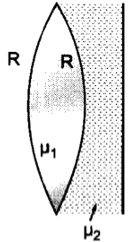
A biconvex lens with its two faces of equal radius of curvature $R$ is made of a transparent medium of refractive index $\mu_1$. It is kept in contact with a medium of refractive index $\mu_2$ as shown in the figure.
Image
$a$. Find the equivalent focal length of the combination.
$b$. Obtain the condition when this combination acts as a diverging lens.
$c$. Draw the ray diagram for the case $\mu_1>\frac{\left(\mu_2+1\right)}{2}$, when the object is kept far away from the lens. Point out the nature of the image formed by the system.
The optical properties of a medium are governed by the relative permitivity $(\epsilon_\text{r})$ and relative permeability $(\mu_\text{r})$. The refractive index is defined as $\sqrt{\mu_\text{r}\epsilon_\text{r}}=\text{n}$. For ordinary material $\epsilon_\text{r}=0$ and $\mu_\text{r}<0$ and the positive sign is taken for the square root. In $1964, $ a Russian scientist $V$. Veselago postulated the existence of material with $\epsilon_\text{r}=0$ and $\mu_\text{r}<0$. Since then such 'metamaterials' have been produced in the laboratories and their optical properties studied. For such materials $\text{n}=-\sqrt{\mu_1\epsilon_1}$. As light enters a medium of such refractive index the phases travel away from the direction of propagation.
  1. According to the description above show that if rays of light enter such a medium from air $($refractive index $= 1)$ at an angle ? In $2^{nd}$ quadrant, them the refracted beam is in the $3^{rd}$ quadrant.
  2. Prove that Snell's law holds for such a medium.
  1.  
  1. State the principle on which a potentiometer works. How can a given potentiometer be made more sensitive?
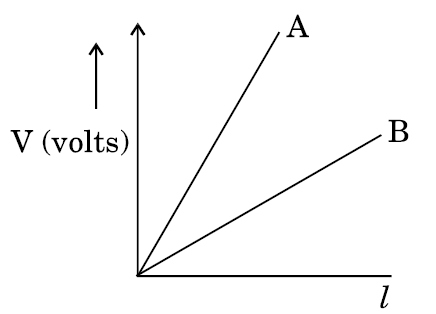
  2. In the graph shown below for two potentiometers, state with reason which of the two potentiometers$, A$ or $B,$ is more sensitive.
  1. Two metallic wires$, P_1$ and $P_2$ of the same material and same length but different cross$-$sectional areas$, A_1$ and $A_2$ are joined together and connected to a source of emf. Find the ratio of the drift velocities of free electrons in the two wires when they are connected $(i)$ in series, and $(ii)$ in parallel.
A copper wire of radius 0.1mm and resistance $1\text{k}\Omega$ is connected across a power supply of 20V.
(a) How many electrons are transferred per second between the supply and the wire at one end? (b) Write down the current density in the wire.
An electric field is uniform, and in the positive $x$ direction for positive $x$, and uniform with the same magnitude but in the negative $x$ direction for negative $x$. It is given that $E =200 \hat{ i } N / C$ for $x>0$ and $E =-200 \hat{ i } N / C$ for $x<0$. A right circular cylinder of length $20 \ cm$ and radius $5 \ cm$ has its centre at the origin and its axis along the $x-$ axis so that one face is at $x=+10 \ cm$ and the other is at $x=-10 \ cm$ (Fig. $1.25). (a)$ What is the net outward flux through each flat face? $(b)$ What is the flux through the side of the cylinder? $(c)$ What is the net outward flux through the cylinder? $(d$) What is the net charge inside the cylinder?
Two small spheres, each having a mass of 20g, are suspended from a common point by two insulating strings of length 40cm each. The spheres are identically charged and the separation between the balls at equilibrium is found to be 4cm. Find the charge on each sphere.
Consider the situation of the previous problem. If $1.0\mu\text{C}$ is placed on the upper plate instead of the middle, what will be the potential difference between:
  1. The upper and the middle plates?
  2. The middle and the lower plates?