Question
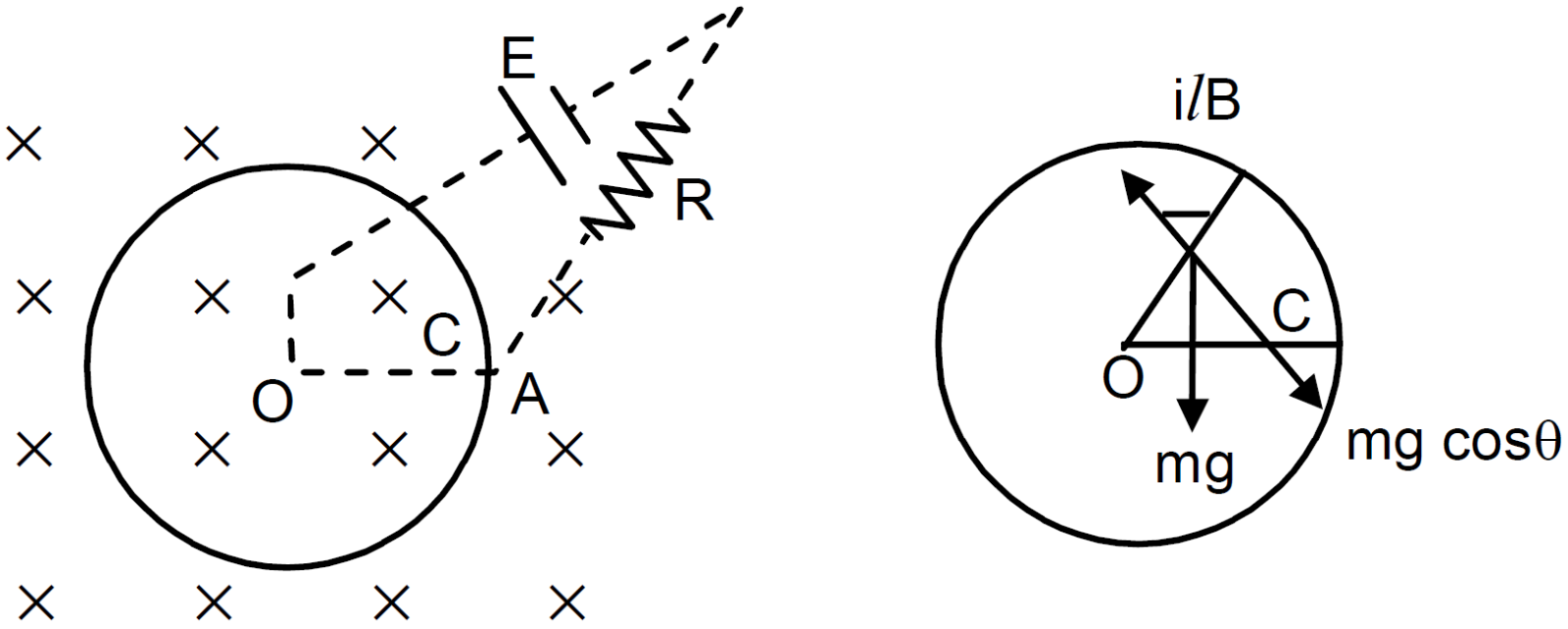
Figure shows a situation similar to the previous problem. All parameters are the same except that a battery of emf $\in$ and a variable resistance R are connected between O and C. The connecting wires have zero resistance. No external force is applied on the rod (except gravity, forces by the magnetic field and by the pivot). In what way should the resistance R be changed so that the rod may rotate with uniform angular velocity in the clockwise direction? Express your answer in terms of the given quantities and the angle $\theta$ made by the rod OA with the horizontal.
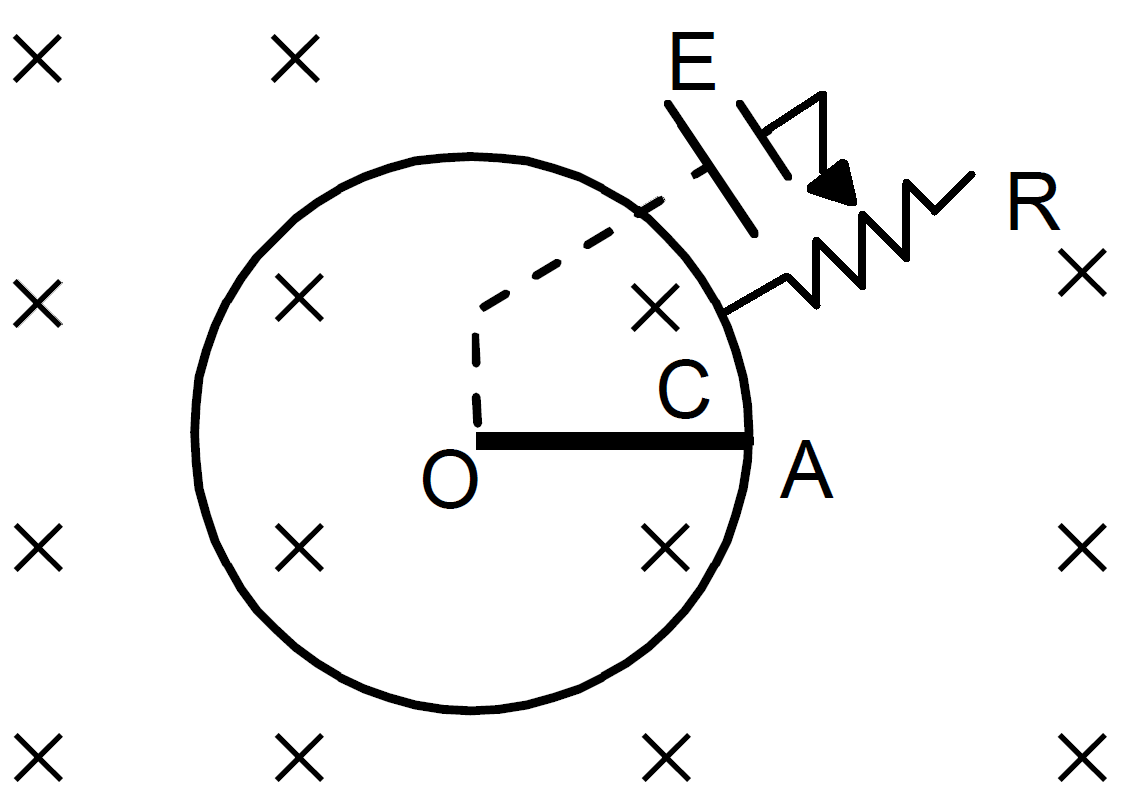
Answer


$\text{emf}=\frac{1}{2}\text{B}\omega\text{a}^2$ [from previous problem]
Current $= \frac{\text{e}+\text{E}}{\text{R}}=\frac{\frac{1}{2}\times\text{B}\omega\text{a}^2+\text{E}}{\text{R}}$
$=\frac{\text{B}\omega\text{a}^2 +2\text{E}}{2\text{R}}$
$\Rightarrow \text{mg} \cos \theta =\text{ilB}$ [Net force acting on the rod is O]
$\Rightarrow \text{mg}\cos\theta =\frac{\text{B}\omega\text{a}^2+2\text{E}}{2\text{R}}\text{a}\times\text{B}$
$\Rightarrow \text{R}=\frac{\big(\text{B}\omega\text{a}^2+2\text{E}\big)\text{ab}}{2\text{mg}\cos\theta}$

Need a full question paper?

Generate a complete, print-ready paper with questions like this in minutes — across 16+ boards, with answer keys.

Start Generating Free

Similar questions

Two point charges $q$ and $-q$ are located at points $(0,0,-a)$ and $(0,0, a)$ respectively.
$i$. Find the electrostatic potential at $(0,0, z)$ and $(x, y, 0)$.
$ii.$ How much work is done in moving a small test charge from the point $(5,0,0)$ to $(-7,0,0)$ along the $X$-axis?
$iii.$ How would your answer change if the path of the test charge between the same points is not along the $x$-axis but along any other random path?
$iv$. If the above point charges are now placed in the same positions in a uniform external electric field $\vec{E}$, what would be the potential energy of the charge system in its orientation of unstable equilibrium? Justify your answer in each case.
$i$. Prove that an ideal capacitor in an ac circuit does not dissipate power.
$ii$. An inductor of $200 mH,$ a capacitor of $400 \mu f$, and a resistor of $10 \Omega$ are connected in series to ac source of $50 V$ of variable frequency. Calculate the
$a$. the angular frequency at which maximum power dissipation occurs in the circuit and the corresponding value of the effective current and
$b$. value of $Q-$ factor in the circuit.
$i$. An alternating voltage $V = V _{ m } \sin \omega t$ applied to a series $L - C - R$ circuit derives a current given by $I = I _{ m } \sin (\omega t+\phi)$. Deduce an expression for the average power dissipated over a cycle.
$ii$. For circuit used for transporting electric power, a low power factor implies large power loss in transmission. Explain.
Derive an expression for potential due to a dipole for distances large compared to the size of the dipole. How is the potential due to dipole different from that due to a single charge?
Image
  1. Show that the normal component of electrostatic field has a discontinuity from one side of a charged surface to another given by
$(\text{E}_2-\text{E}_1).\hat{\text{n}}=\frac{\sigma}{\in_0}$

where $\hat{\text{n}}$ is a unit vector normal to the surface at a point and σ is the surface charge density at that point. (The direction of $\hat{\text{n}}$ is from side 1 to side 2.) Hence show that just outside a conductor, the electric field is σ $\hat{\text{n}} /ε_0.$
  1. Show that the tangential component of electrostatic field is continuous from one side of a charged surface to another.
[Hint: For (a), use Gauss’s law. For, (b) use the fact that work done by electrostatic field on a closed loop is zero.]
A uniform electric field $\vec{\text{E}}=\text{E}_\text{x}\hat{\text{i}}$ N/ C for x > 0 and $\vec{\text{E}}=-\text{E}_\text{x}\hat{\text{i}}$ N/ C for x < 0 are given. A right circular cylinder of length l cm and radius r cm has its centre at the origin and its axis along the X-axis. Find out the net outward flux. Using Gauss’s law, write the expression for the net charge within the cylinder.
Consider the situation of the previous problem:
  1. Find the tension in the string in equilibrium.
  2. Suppose the ball is slightly pushed aside and released. Find the time period of the small oscillations.
A small block of mass 200g is kept at the top of a frictionless incline which is 10m long and 3.2m high. How much work was required.
A parallel-plate capacitor having plate area $20cm^2$ and separation between the plates 1.00mm is connected to a battery of 12.0V. The plates are pulled apart to increase the separation to 2.0mm.
  1. Calculate the charge flown through the circuit during the process.
  2. How much energy is absorbed by the battery during the process?
  3. Calculate the stored energy in the electric field before and after the process.
  4. Using the expression for the force between the plates, find the work done by the person pulling the plates apart.
  5. Show and justify that no heat is produced during this transfer of charge as the separation is increased.
A compound microscope has a magnifying power of 100 when the image is formed at infinity. The objective has a focal length of 0.5cm and the tube length is 6.5cm. Find the focal length of the eyepiece.