A compound microscope has a magnifying power of 100 when the image is formed at infinity. The objective has a focal length of 0.5cm and the tube length is 6.5cm. Find the focal length of the eyepiece.
Download our app for free and get started
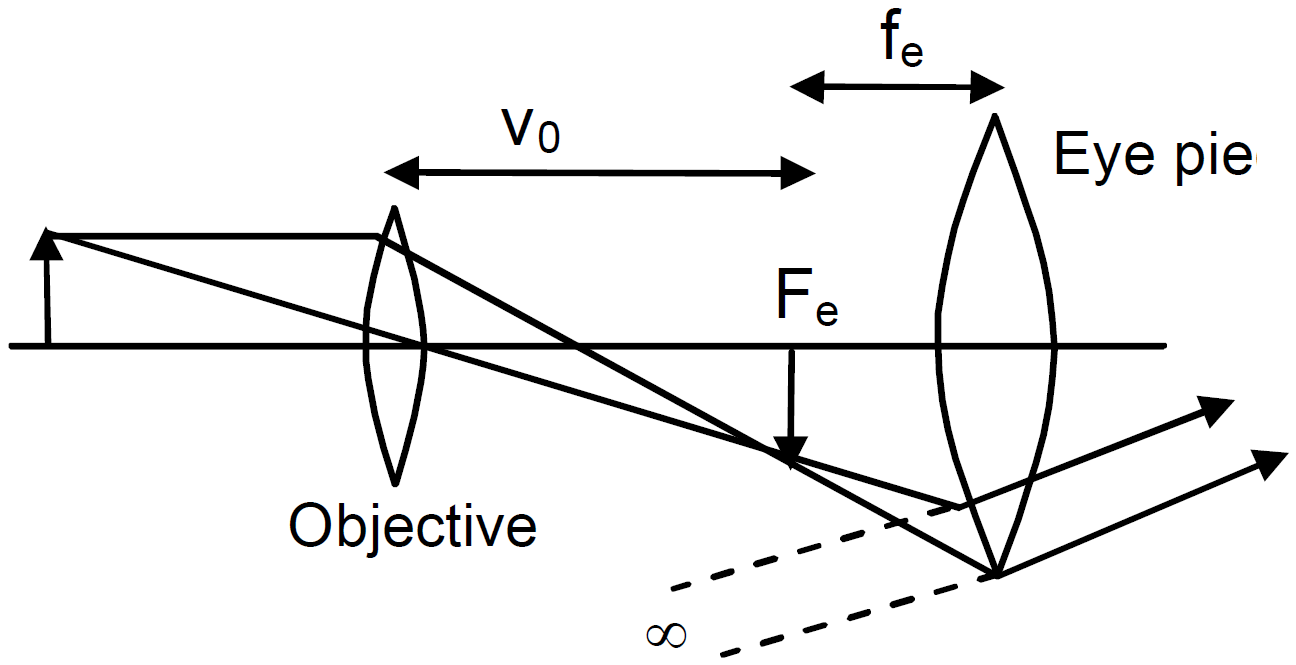
For the give compound microscope, $f_0 = 0.5cm$, tube length = 6.5cm magnifying power = 100 (normal adjustment) Since, the image is formed at infinity, the real image produced by the objective lens should lie on the focus of the eye piece.So, $v_o + f_e = 6.5cm ...(1)$
Again, magnifying power $\text{m}=\frac{\text{v}_0}{\text{u}_0}\times\frac{\text{D}}{\text{f}_\text{e}}$ [for normal adjustment]
$\Rightarrow\text{m}=\Big[1-\frac{\text{V}_0}{\text{f}_0}\Big]\frac{\text{D}}{\text{f}_\text{e}}$
$\Rightarrow100=-\Big[1-\frac{\text{V}_0}{0.5}\Big]\times\frac{25}{\text{f}_\text{e}}$ [Taking D = 25cm]
$\Rightarrow100\text{f}_\text{e}=-(1-2\text{v}_0)\times25$
$\Rightarrow2\text{v}_0-4\text{f}_\text{e}=1 $ ...(2)
Solving equation (1) and (2) we can get,
$V_0 = 4.5cm$ and $f_e = 2cm$
So, the focal length of the eye piece is 2cm.
Again, magnifying power $\text{m}=\frac{\text{v}_0}{\text{u}_0}\times\frac{\text{D}}{\text{f}_\text{e}}$ [for normal adjustment]
$\Rightarrow\text{m}=\Big[1-\frac{\text{V}_0}{\text{f}_0}\Big]\frac{\text{D}}{\text{f}_\text{e}}$
$\Rightarrow100=-\Big[1-\frac{\text{V}_0}{0.5}\Big]\times\frac{25}{\text{f}_\text{e}}$ [Taking D = 25cm]
$\Rightarrow100\text{f}_\text{e}=-(1-2\text{v}_0)\times25$
$\Rightarrow2\text{v}_0-4\text{f}_\text{e}=1 $ ...(2)
Solving equation (1) and (2) we can get,
$V_0 = 4.5cm$ and $f_e = 2cm$
So, the focal length of the eye piece is 2cm.

Download our appand get started for free
Experience the future of education. Simply download our apps or reach out to us for more information. Let's shape the future of learning together!No signup needed.*
Similar Questions
- 1View SolutionA particle executes a simple harmonic motion of amplitude 1.0cm along the principal axis of a convex lens of focal length 12cm. The mean position of oscillation is at 20cm from the lens. Find the amplitude of oscillation of the image of the particle.
- 2View Solution
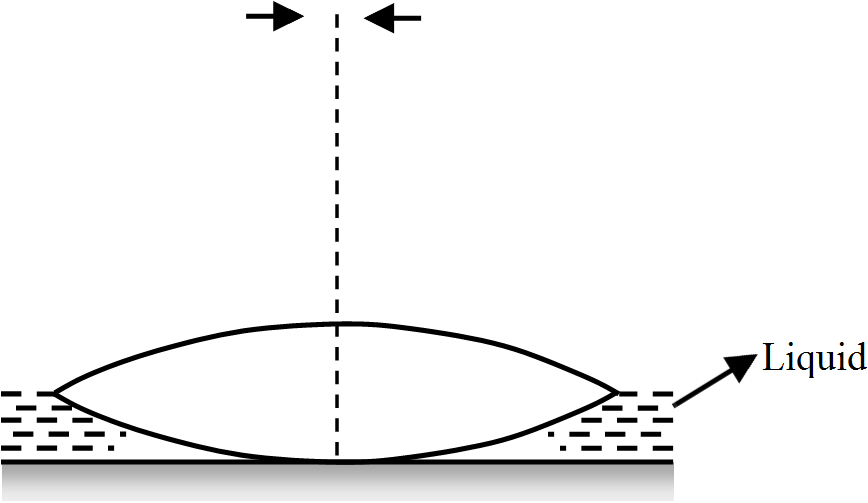
- An equiconvex lens with radii of curvature of magnitude r each, is put over a liquid layer poured on top of a plane mirror. A small needle, with its tip on the principal axis of the lens, is moved along the axis until its inverted real image coincides with the needle itself. The distance of the needle from the lens is measured to be 'a'. On removing the liquid layer and repeating the experiment the distance is found to be 'b'.
- If r = 10cm, a = 15cm, b = 10cm, find the refractive index of the liquid.
- 3View SolutionMrs. Rashmi Singh broke her reading glasses. When she went to the shopkeeper to order new spects, he suggested that she should get spectacles with plastic lenses instead of glass lenses. On getting the new spectacles, she found that the new ones were thicker than the earlier ones. She asked this question to the shopkeeper but he could not offer satisfactory explanation for this. At home, Mrs. Singh raised the same question to her daughter Anuja who explained why plastic lenses were thicker.
- Write two qualities displayed each by Anuja and her mother.
- How do you explain this fact using lens maker's formula?
- 4View Solution
- Draw a ray diagram to show refraction of a ray of monochromatic light passing through a glass prism.
- Explain briefly how the phenomenon of total internal reflection is used in fibre optics.
- 5View SolutionA diverging lens of focal length 20cm and a converging lens of focal length 30cm are placed 15cm apart with their principal axes coinciding. Where should an object be placed on the principal axis so that its image is formed at infinity?
- 6View SolutionA convex lens has a focal length of 10cm. Find the location and nature of the image if a point object is placed on the principal axis at a distance of:
- 9.8cm
- 10.2cm from the lens.
- 7View SolutionA concave mirror forms an image of 20cm high object on a screen placed 5.0m away from the mirror. The height of the image is 50cm. Find the focal length of the mirror and the distance between the mirror and the object.
- 8View SolutionLenses are constructed by a material of refractive index 1.50. The magnitude of the radii of curvature are 20cm and 30cm. Find the focal lengths of the possible lenses with the above specifications.
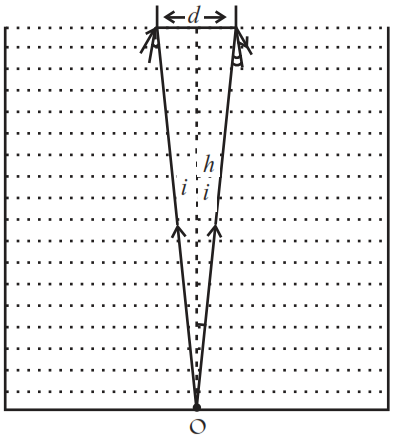
- 9View SolutionA jar of height h is filled with a transparent liquid of refractive index μ (Fig). At the centre of the jar on the bottom surface is a dot. Find the minimum diameter of a disc, such that when placed on the top surface symmetrically about the centre, the dot is invisible.
- 10View SolutionWhat is the focal length of a convex lens of focal length 30cm in contact with a concave lens of focal length 20 cm? Is the system a converging or a diverging lens? Ignore thickness of the lenses.