- A screen is placed at a distance of 100 cm from an object. The image of the object is formed on the screen by a convex lens for two different locations of the lens separated by 20 cm. Calculate the focal length of the lens used.
- A converging lens is kept coaxially in contact with a diverging lens - both the lenses being of equal focal length. What is the focal length of the combination?
CBSE OUTSIDE DELHI - SET 1 NORTH 2016
Download our app for free and get started
- For first position of the lens, we have
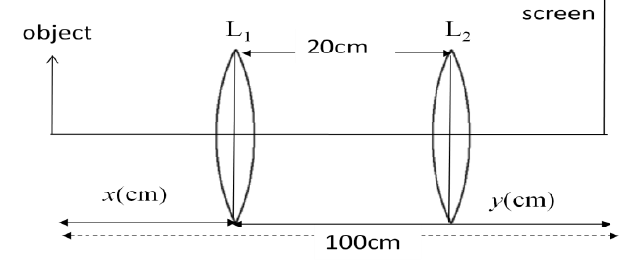
For second position of the lens, we have
$\frac{1}{\text{f}} = \frac{1}{\text{y - 20 }} -\frac{1}{(-(\text{x + 20 )})}$
$\frac{1}{\text{y}} +\frac{1}{\text{x}} =\frac{1}{(\text{y - 20)}} + \frac{1}{(\text{x + 20)}}$
$\frac{\text{x + y }}{\text{xy}} =\frac{(\text{x + 20)} + (\text{y - 20 )}}{(\text{y - 20 )}(\text{x + 20 )}}$
$\therefore\text{xy} = (\text{y - 20) }(\text{x + 20})$
$ = \text{xy} - 20 \text{x +20}\text{y - 400 }$
$\therefore\text{x - y } = - 20 $
Also , x + y =100
$\therefore$ x = 40 cm
and y = 60 cm
$\therefore\frac{1}{\text{f}} = \frac{1}{60} - \frac{1}{-40} =\frac{2+3}{120} =\frac{5}{120}$
$\therefore\text{f} = 24 \text{cm}$
Alternate Answer
We have
$\text{f} = \frac{\text{D}^{2} - \text{d}^{2}}{4\text{D}}$
$ = \frac{100^{2} - 20 ^{2}}{4\times100}$
$ =\frac{120\times80}{400}$
= 24 cm.
Alternate Answer
For the two positions of the lens, the values of the magnitudes of u and v, get interchanged.
Hence, $| \text{u + v}| = 100$
$| \text{u - v}| = 20 , $
This gives $| \text{u}| = 60 |\text{v}| = 40 $
$\therefore\text{f} = 24 \text{ cm}$
Alternate Answer
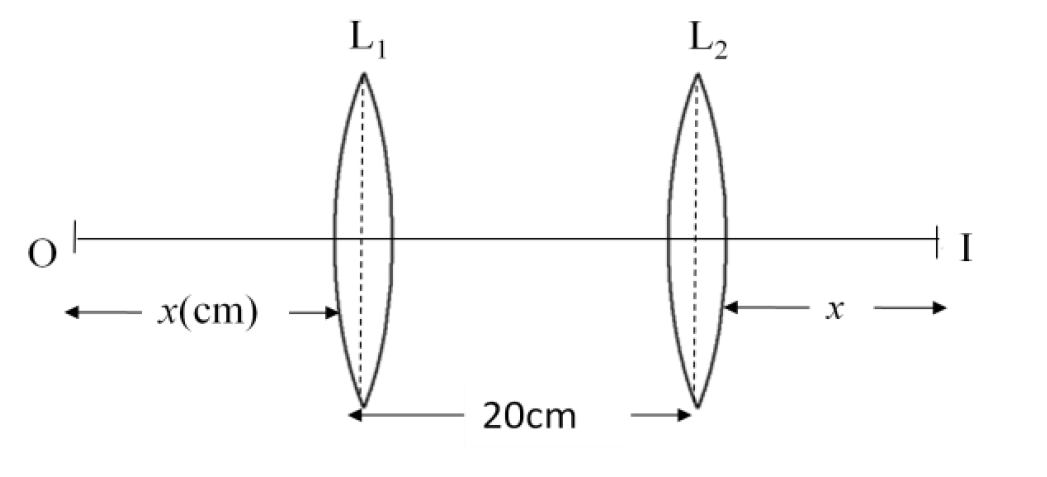
$2\text{x} + 20 = 100$
$\therefore\text{x} = 40 \text{ cm}$
For lens at position $L_1; \text{u} = -\text{x} =- 40 \text{cm} $
$\text{v} = 20 + 40 = 60\text{ cm}$
This gives f = 24 cm.
- For combination of two lenses in contact.
$P = P_1 + P_2$
$P_1 = +P , P_2 = -P$
So P= 0 and F= infinite
Alternate Answer
$\frac{1}{\text{F}} = \frac{1}{\text{f}_{1}} + \frac{1}{\text{f}_{2}}$
$ = \frac{1}{\text{f}} + (\frac{-1}{\text{f}}) = 0 $
F = infinite.

Download our appand get started for free
Experience the future of education. Simply download our apps or reach out to us for more information. Let's shape the future of learning together!No signup needed.*
Similar Questions
- 1View SolutionObtain the answers (a) to (b) in Exercise 7.13 if the circuit is connected to a high frequency supply (240V, 10kHz). Hence, explain the statement that at very high frequency, an inductor in a circuit nearly amounts to an open circuit. How does an inductor behave in a dc circuit after the steady state?
- 2View SolutionFigure shows a light bulb (B) and iron cored inductor connected to a dc battery through a switch (S).
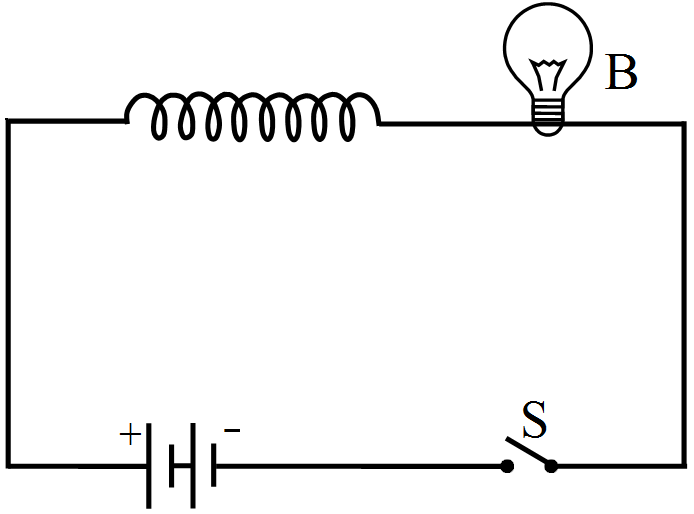
- What will one observe when switch (S) is closed?
- How will the glow of the bulb change when the battery is replaced by an ac source of rms voltage equal to the voltage of dc battery? Justify your answer in each case.
- 3View SolutionA 60μF capacitor is connected to a 110V, 60Hz ac supply. Determine the rms value of the current in the circuit.
- 4View SolutionUsing truth tables of AND gate and NOT gate show that NAND gate is an AND gate followed by a NOT gate. Hence write the truth table of NAND gate.
Why are NAND gates called ‘Universal Gates’? - 5View Solution
- Derive Snell's law on the basis of Huygen's wave theory when light is travelling from a denser to a rarer medium.
- Draw the sketches to differentiate between plane wavefront and spherical wavefront.
- 6View SolutionExplain why the reactance offered by an inductor increases with increasing frequency of an alternating voltage.
- 7An AC voltage $V = V_m$ is applied across a:View Solution
- Series RC circuit in which capacitive reactance is ‘a’ times the resistance in the circuit.
- Series RL circuit in which inductive reactance is ‘b’ times the resistance in the circuit.
- 8View Solution
- Explain briefly the process of emission of light by a Light Emitting Diode (LED).
- Which semiconductors are preferred to make LEDs and why?
- Give two advantages of using LEDs over conventional incandescent lamps.
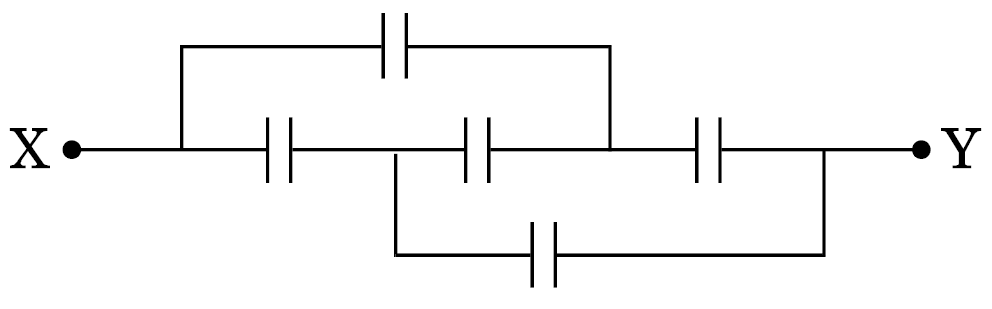
- 9Find the equivalent capacitance of the network shown in the figure, when each capacitor is of $1\mu\text{F}$. When the ends X and Y are connected to a 6 V battery, find out (i) The charge and (ii) The energy stored in the network.View Solution
- 10View Solution
- Describe briefly three experimentally observed features in the phenomenon of photoelectric effect.
- Discuss briefly how wave theory of light cannot explain these features.