MCQ
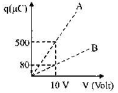
Figure shows charge $( q )$ versus voltage $( V )$ graph for series and parallel combination of two given capacitors. The capacitances are:
Image
  • A
    $60 \mu F$ and $40 \mu F$
  • B
    $40 \mu F$ and $10 \mu F$
  • C
    $50 \mu F$ and $30 \mu F$
  • D
    $20 \mu F$ and $30 \mu F$

Answer

B. $40 \mu F$ and $10 \mu F$
Explanation:
Equivalent capacitance in series combination $\left( C ^{\prime}\right)$ is given by
$
\frac{1}{C^{\prime}}=\frac{1}{C_1}+\frac{1}{C_2} \Rightarrow C^{\prime}=\frac{C_1 C_2}{C_1+C_2}
$
For parallel combination equivalent capacitance
$
C^{\prime}=C_1+C_2
$
For parallel combination
$
\begin{array}{l}
q=10\left(C_1+C_2\right) \\
q_1=500 \mu C \\
500=10\left(C_1+C_2\right) \\
C_1+C_2=50 \mu F \ldots \text { (i) }
\end{array}
$
For Series Combination-
$
q_2=10 \frac{C_1 C_2}{\left(C_1+C_2\right)}
$
$
\begin{array}{l}
80=10 \frac{C_1 C_2}{50} \text { From equation }\ldots\text{(ii)} \\
C_1 C_2=400 \ldots \text { (iii) }
\end{array}
$
From equation (i) and (ii)
$
\begin{array}{l}
C_1=10 \mu F, C_2=40 \mu F \\
=40 \mu F \text { and } 10 \mu F
\end{array}
$

Need a full question paper?

Generate a complete, print-ready paper with questions like this in minutes — across 16+ boards, with answer keys.

Start Generating Free

Similar questions

A particle performs $SHM$ about $x = 0$ such that at $t = 0$ it is at $x = 0$ and moving towards positive extreme. The time taken by it to go from $x = 0$ to $x = \frac{A}{2}$ is ..... times the time taken to go from $x = \frac{A}{2}$ to $A$. The most suitable option for the blank space is
A metallic rod of mass per unit length $0.5\; kg\; m^{-1}$ is lying horizontally on a smooth inclined plane which makes an angle of $30^o$ with the horizontal. The rod is not allowed to slide down by flowing a current through it when a magnetic field of induction $0.25\; T$ is acting on it in the vertical direction. The current flowing in the rod to keep it stationary is.....$A$
Given below are two statements : one is labelled as Assertion $(A)$ and the other is labelled as Reason $(R)$,

Assertion $(A)$ :When a fire cracker (rocket) explodes in mid air, its fragments fly in such a way that they continue moving in the same path, which the fire cracker would have followed, had it not exploded

Reason $(R)$:Explosion of cracker (rocket) occurs due to internal forces only and no external force acts for this explosion.

In the light of the above statements, choose the most appropriate answer from the options given below :

A conducting wire frame is placed in a magnetic field which is directed into the paper. The magnetic field is increasing at a constant rate. The directions of induced current in wires $AB$ and $CD$ are
The temperature of a body falls from $62^oC\, to\, 50^oC$ in $10$ minutes. If the temperature of the surroundings is $26^oC$, the temperature in next $10$ minutes will become  ...... $^oC$
Two solid rubber balls $A$ and $B$ having masses $200$ and $400\, gm$ respectively are moving in opposite directions with velocity of $A$ equal to $0.3 \,m/s$. After collision the two balls come to rest, then the velocity of $B$ is .............. $\mathrm{m} / \mathrm{s} $
A hollow sphere of inner radius $R$ and outer radius $2R$ is made of a material of thermal conductivity $K$. It is surrounded by another hollow sphere of inner radius $2R$ and outer radius $3R$ made of same material of thermal conductivity $K$. The inside of smaller sphere is maintained at $0^o C$ and the outside of bigger sphere at $100^o C$. The system is in steady state. The temperature of the interface will be ........ $^oC$
An inductor of $0.5 \,mH$, a capacitor of $200 \,\mu F$ and a resistor of $2 \,\Omega$ are connected in series with a $220 \,V$ ac source. If the current is in phase with the emf, the frequency of ac source will be ................ $\times 10^{2} \,Hz$
When a hydrogen atom emits a photon of energy $12.09 \,eV$, its orbital angular momentum changes by (where $h$ is Planck's constant)
A glass tube of uniform internal radius ( $\mathrm{r}$ ) has a valve separating the two identical ends. Initially, the valve is in a tightly closed position. End $1$ has a hemispherical soap bubble of radius $\mathrm{r}$. End $2$ has sub-hemispherical soap bubble as shown in figure. Just after opening the valve,

Figure: $Image$