Two similar wires under the same load yield elongation of $0.1$ $mm$ and $0.05$ $mm$ respectively. If the area of cross- section of the first wire is $4m{m^2},$ then the area of cross section of the second wire is..... $mm^2$
Medium
Download our app for free and get started
(b) $l = \frac{{FL}}{{AY}}\therefore l \propto \frac{1}{A}$ $(F,L$ and $Y$ are constant$)$
$\frac{{{A_2}}}{{{A_1}}} = \frac{{{l_1}}}{{{l_2}}} \Rightarrow {A_2} = {A_1}\left( {\frac{{0.1}}{{0.05}}} \right)$= $2{A_1} = 2 \times 4 = 8m{m^2}$

Download our appand get started for free
Experience the future of education. Simply download our apps or reach out to us for more information. Let's shape the future of learning together!No signup needed.*
Similar Questions
- 1A rod of length $L$ at room temperature and uniform area of cross section $A$, is made of a metal having coefficient of linear expansion $\alpha {/^o}C$. It is observed that an external compressive force $F$, is applied on each of its ends, prevents any change in the length of the rod, when it temperature rises by $\Delta \,TK$. Young’s modulus, $Y$, for this metal isView Solution
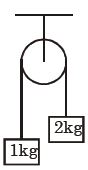
- 2The breaking stress of wire going over a smooth pully is $2 \times 10^9\, N/m^2$. What would be the minimum radius of wire used if it is not to break?View Solution
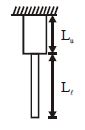
- 3A composite heavy rope of two materials is suspended vertically from a high ceiling. The ratios of different quantities for upper to lower rope are length $\frac{{{L_u}}}{{{L_l}}} = \frac{1}{2}$ , cross sectional area $\frac{{{A_u}}}{{{A_l}}} = \frac{2}{1}$ ,density $\frac{{{d_u}}}{{{d_l}}} = \frac{2}{3}$ .What is the ratio of maximum stress in the two ropesView Solution
- 4A string of area of cross-section $4\,mm ^{2}$ and length $0.5$ is connected with a rigid body of mass $2\,kg$. The body is rotated in a vertical circular path of radius $0.5\,m$. The body acquires a speed of $5\,m / s$ at the bottom of the circular path. Strain produced in the string when the body is at the bottom of the circle is $\ldots . . \times 10^{-5}$. (Use Young's modulus $10^{11}\,N / m ^{2}$ and $g =10\,m / s ^{2}$ )View Solution
- 5Auniform rod rotating in gravity free region with certain constant angular velocity. The variation of tensile stress with distance $x$ from axis of rotation is best represented by which of the following graphs.View Solution
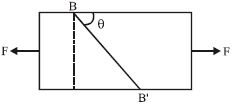
- 6A bar of cross-sectional area $A$ is subjected two equal and opposite tensile forces at its ends as shown in figure. Consider a plane $BB'$ making an angle $\theta $ with the length The ratio of tensile stress to the shearing stress on the plane $BB'$ isView Solution
- 7A steel rod has a radius $10 \,mm$ and a length of $1.0 \,m$. A force stretches it along its length and produces a strain of $0.32 \%$. Young's modulus of the steel is $2.0 \times 10^{11} \,Nm ^{-2}$. What is the magnitude of the force stretching the rod is ........ $kN$View Solution
- 8Young's moduli of the material of wires $A$ and $B$ are in the ratio of $1: 4$, while its area of cross sections are in the ratio of $1: 3$. If the same amount of load is applied to both the wires, the amount of elongation produced in the wires $A$ and $B$ will be in the ratio ofView Solution
[Assume length of wires $A$ and $B$ are same]
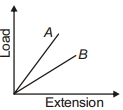
- 9In the given figure, if the dimensions of the two wires are same but materials are different, then Young's modulus is $ ........$View Solution
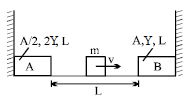
- 10In the given figure, two elastic rods $A$ & $B$ are rigidly joined to end supports. $A$ small mass $‘m’$ is moving with velocity $v$ between the rods. All collisions are assumed to be elastic & the surface is given to be frictionless. The time period of small mass $‘m’$ will be : [$A=$ area of cross section, $Y =$ Young’s modulus, $L=$ length of each rod ; here, an elastic rod may be treated as a spring of spring constant $\frac{{YA}}{L}$ ]View Solution