MCQ
The springs shown are identical. When $A = 4kg$, the elongation of spring is $1\, cm$. If $B = 6\,kg$, the elongation produced by it is  ..... $ cm$
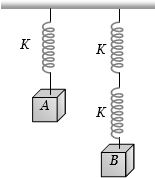
  • A
    $4$
  • $3$
  • C
    $2$
  • D
    $1$

Answer

Correct option: B.
$3$
b
b) $F = kx$

==> $mg = kx$

==> $m \propto kx$
Hence $\frac{{{m_1}}}{{{m_2}}} = \frac{{{k_1}}}{{{k_2}}} \times \frac{{{x_1}}}{{{x_2}}}$

==> $\frac{4}{6} = \frac{k}{{k/2}} \times \frac{1}{{{x_2}}}$
$ \Rightarrow {x_2} = 3\,cm$.

Need a full question paper?

Generate a complete, print-ready paper with questions like this in minutes — across 16+ boards, with answer keys.
Start Generating Free

Similar questions

If the velocity of a particle is $(10 + 2t^2) m/s$, then the average acceleration of the particle between $2s$ and $5s$ is..........$m/s^2$
A uniform string oflength $20\ m$ is suspended from a rigid support. A short wave pulse is introduced at its lowest end. It starts moving up the string. The time taken to reach the supports is (take $g= 10 $ $ms^{-2}$ )
An open organ pipe of length $L$ vibrates in second harmonic mode. The pressure vibration is maximum
If $x = a/t + b/{t^2}+c,$, where $x$ is the distance travelled by the body in metres while $t$ is the time in seconds, then the units of $b$ are
Two identical flutes produce fundamental nodes of frequency $300\,Hz$ at $27\,^oC.$ If the temperature of air in one flute is increased to $31\,^oC,$ the numbe  of the beats heard per second will be
If the units of force, energy and velocity are respectively $10\, N, 100\, J, 5\, m/s$, then  the units of length, mass and time will be
The initial velocity of a particle is $u$ (at $t = 0$) and the acceleration ${n^{th}}$ is given by $at$. Which of the following relation is valid
Consider the following two statements $A$ and $B$ and identify the correct choice $(A)$ The torques produced by two forces of couple are opposite to each other. $(B)$ The direction of torque is always perpendicular to plane of rotation of body.
The acceleration-time graph of a body is shown below The most probable velocity-time graph of the body is
A body of $5 \,kg$ is moving with a velocity of $20 \,m/s$. If a force of $100\,N$ is applied on it for $10\,s$ in the same direction as its velocity, what will now be the velocity of the body.........$m/s$