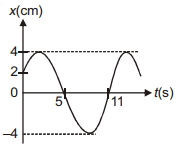
Time period is $12 \,s$ from diagram.
$\omega=\frac{2 \pi}{12}=\frac{\pi}{6}$
Amplitude $A=4$
Initial phase is determined by putting known values in the equation.
$2=4 \sin \left(\frac{\pi}{6} t+\phi\right)$
$\sin ^{-1} \frac{1}{2}=\phi[t=0]$
$\frac{\pi}{6}=\phi$
Hence equation is $x=\left(\frac{\pi}{6} t+\frac{\pi}{6}\right)$

$(A)$ the speed of the particle when it returns to its equilibrium position is $u_0$.
$(B)$ the time at which the particle passes through the equilibrium position for the first time is $t=\pi \sqrt{\frac{ m }{ k }}$.
$(C)$ the time at which the maximum compression of the spring occurs is $t =\frac{4 \pi}{3} \sqrt{\frac{ m }{ k }}$.
$(D)$ the time at which the particle passes througout the equilibrium position for the second time is $t=\frac{5 \pi}{3} \sqrt{\frac{ m }{ k }}$.
$(a)$ Potential energy is always equal to its $K.E.$
$(b)$ Average potential and kinetic energy over any given time interval are always equal.
$(c)$ Sum of the kinetic and potential energy at any point of time is constant.
$(d)$ Average $K.E.$ in one time period is equal to average potential energy in one time period.
Choose the most appropriate option from the options given below: