MCQ
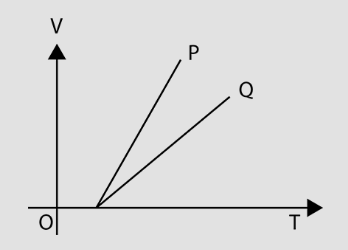
Figure shows the $V−T$ graph for two particles $P$ and $Q$. The relative velocity of $P$ w.r.t. $Q$ is:
  • A
    Is zero.
  • B
    Is non$-$zero but constant
  • C
    Continuously decreases
  • Continuously increases

Answer

Correct option: D.
Continuously increases
The difference in velocities is increasing with time as both of them have more constant but different acceleration.

Need a full question paper?

Generate a complete, print-ready paper with questions like this in minutes — across 16+ boards, with answer keys.

Start Generating Free

Similar questions

When temperature of water is raised from $O\ 'C$ to $4^\circ C,$ it:
A particle executing simple harmonic motion of amplitude $5\ cm$ has maximum speed $31.4\ cm/s.$ the frequency of its oscillations is:
If mass of a satellite is doubled and time period remain constant the ratio of orbit in the two cases will be
A metallic ball and highly stretched spring are made of the same material and have the same mass. They are heated so that they melt, the latent heat required
The angular speed of the wheel of a vehicle is increased from $360 \;rpm$ to $1200 \;rpm$ in $14 \;second$. Its angular acceleration is,
A particle is released from a height $H$. At a certain height its kinetic energy is two times its potential energy. Height and speed of particle at that instant are
Air is filled at $60^o C$ in a vessel of open mouth. The vessel is heated to a temperature $T$ so that $1/4^{th}$ part of air escapes. Assuming the volume of the vessel remaining constant, the value of $T$ is ....... $^oC$
Two wires are made of the same material and have the same volume. However wire $1$ has crosssectional area $A$ and wire $2$ has cross-section area $3A$. If the length of wire $1$ increases by $\Delta x$ on applying force $F$, how much force is needed to stretch wire $2$ by the same amount?
A truck moving on horizontal road towards east with velocity $20\, ms^{-1}$ collides elastically with a light ball moving with velocity $25\, ms^{-1}$ along west. The velocity of the ball just after collision
A plane wave is represented by $x = 1.2\sin (314\,t + 12.56y)$Where $x$ and $y$ are distances measured along in $x$ and $y$ direction in meters and $t$ is time in seconds. This wave has