Question
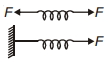
Figure shows two cases. In first case a spring (spring constant $K$ ) is pulled by two equal and opposite forces $F$ at both ends and in second case is pulled by a force $F$ at one end. Extensions $(x)$ in the springs will be
Answer

(b)

Figure $(2)$ is $F.B.D.$ of figure $(1)$ at equilibrium $F=K x$

$x=F / K$

Need a full question paper?

Generate a complete, print-ready paper with questions like this in minutes — across 16+ boards, with answer keys.
Start Generating Free

Similar questions

An iron bar of length $L$ has magnetic moment $M$. It is bent at the middle of its length such that the two arms make an angle $60^{\circ}$ with each other. The magnetic moment of this new magnet is :
A plane electromagnetic wave of frequency $50\, MHz$ travels in free space along the positive $x-$ direction. At a particular point in space and time, $\vec E = 6.3\,\hat j\,V/m$ . The corresponding magnetic field $\vec B$, at that point will be
A man crosses a $320\, m$ wide river perpendicular to the current in $4$ minutes. If in still water he can swim with a speed $5/3$ times that of the current, then the speed of the current, in $m/min$ is
$Assertion :$ A transverse waves are produced in a very long string fixed at one end. Only progressive wave is observed near the free end.
$Reason :$ Energy of reflected wave does not reach the free end.
When three identical bulbs of $60 \;W, 200\;V$ rating are connected in series to a $200 \;V$ supply, the power drawn by them will be ....... $Watt$
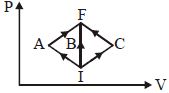
In the $P-V$ diagram, $I$ is the initial state and $F$ is the final state. The gas goes from $I$ to $F$ by $(i)\,IAF,\,\,(ii)\,IBF,\,\,(iii) ICF$. The heat absorbed by the gas is
Two balls are thrown horizontally from the top of a tower with velocities $v_1$ and $v_2$ in opposite directions at the same time. After how much time the angle between velocities of balls becomes $90^o$ ?
If error in measuring diameter of a circle is $4\%$, the error in circumference of the circle would be
A body is projected vertically upward with speed $40 \,m / s$. The distance travelled by body in the last second of upward journey is ...........$m$ [take $g=9.8 \,m / s ^2$ and neglect effect of air resistance]
In a co-axial straight cable, the central conductor and the outer conductor carry equal currents in opposite directions. The magnetic field is zero.