Question
Find $\gamma$ for polyatomic gas and hence determine its value for a triatomic gas in which the molecules are linearly arranged.

Answer

The energy of a polyatomic gas having 'n' degrees of freedom is given by.
$\text{E}=\text{n}\times\frac{1}{2}\text{KT}\times\text{N}=\frac{\text{n}}{2}\text{RT}$
$\therefore\text{C}_\text{v}=\frac{\text{dE}}{\text{dT}}=\frac{\text{n}}{2}\text{R}$
$\therefore\text{C}_\text{p}=\text{C}_\text{v}+\text{R}=\frac{\text{n}}{2}\text{R}+\text{R}=\Big(\frac{\text{n}}{2}+1\Big)\text{R}$
$\therefore\gamma=\frac{\text{C}_\text{p}}{\text{C}_\text{v}}=\frac{\frac{\text{n}}{2}+1}{\frac{\text{n}}{2}}=1+\frac{2}{\text{n}}.$
In case of a triatomic gas, n = 7
$\therefore\gamma=\gamma=1+\frac{2}{7}=\frac{9}{7}.$

Need a full question paper?

Generate a complete, print-ready paper with questions like this in minutes — across 16+ boards, with answer keys.

Start Generating Free

Similar questions

A stone of mass m tied to the end of a string revolves in a vertical circle of radius R. The net forces at the lowest and highest points of the circle directed vertically downwards are: [Choose the correct alternative]
 
Lowest Point
Highest Point
(a)
$mg - T_1$
$mg + T_2$
(b)
$mg + T_1$
$mg - T_2$
(c)
$mg + T_1 - (mv_1^2)/R$
$mg - T_2 + (mv_1^2)/R$
(d)
$mg - T_1 - (mv_1^2)/R$
$mg + T_2 + (mv_1^2)/R$
$T_1$ and $v_1$ denote the tension and speed at the lowest point. $T_2$ and $v_2$​​​​​​​ denote corresponding values at the highest point.
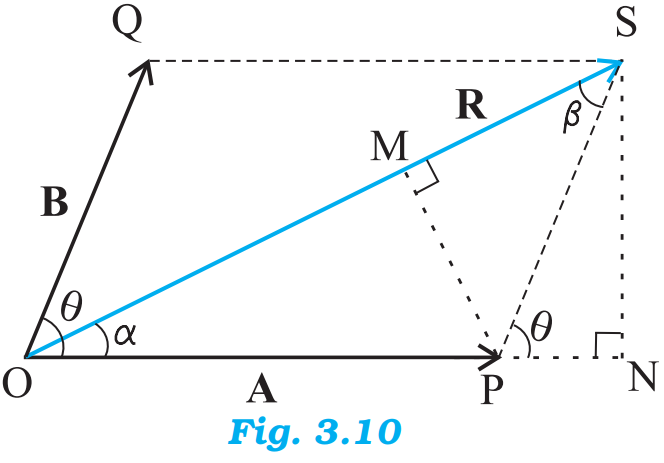
Find the magnitude and direction of the resultant of two vectors $A$ and $B$ in terms of their magnitudes and angle $\theta $ between them.
Image
A solid sphere rolls down two different inclined planes of the same heights but different angles of inclination.
  1. Will it reach the bottom with the same speed in each case?
  2. Will it take longer to roll down one plane than the other?
  3. If so, which one and why?
Two spherical bodies, each of mass 50kg, are placed at a separation of 20cm. Equal charges are placed on the bodies and it is found that the force of Coulomb repulsion equals the gravitational attraction in magnitude. Find the magnitude of the charge placed on either body.
Calculate the electric field in a copper wire of cross-sectional area $2.0mm^2$ carrying a current of 1A.
The resistivity of copper $=1.7\times10^{-8}\Omega\text{-m}.$
What are the characteristics of stationary waves? Distinguish between stationary waves and progressive waves.
A $16cm^3$ volume of water flows per second through a capillary tube of radius r сm and of length 1cm when connected to a pressure head of h cm of water. If a tube of the same length and radius $\frac{\text{r}}{2}$ is connected to the same pressure head, find the mass of water flowing per minute through the tube.
One end of a U-tube containing mercury is connected to a suction pump and the other end to atmosphere. A small pressure difference is maintained between the two columns. Show that, when the suction pump is removed, the column of mercury in the U-tube executes simple harmonic motion.
A light beam of wavelength $400$ run is incident on a metal plate of work function $2.2eV$.
  1. A particular electron absorbs a photon and makes two collisions before coming out of the metal. Assuming that $10\%$ of the extra energy is lost to the metal in each collision, find the kinetic energy of this electron as it comes out of the metal.
  2. Under the same assumptions, find the maximum number of collisions the electron can suffer before it becomes unable to come out of the metal.
A thermally insulated, closed copper vessel contains water at $15^{\circ} C$. When the vessel is shaken vigorously for $15$ minutes, the temperature rises to $17^{\circ} C$. The .mass of the vessel is $100\ g$ and that of the water is $200\ g$ . The specific heat capacities of copper and water are $420 . kg ^{-1} K^{-1}$ and $4200\ Jkg ^{-1} K^{-1}$ respectively. Neglect any thermal expansion.
  1. How much heat is transferred to the liquid-vessel system?
  2. How much work has been done on this system?
  3. How much is the increase in internal energy of the system?