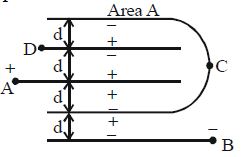
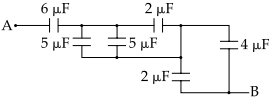
Find out equivalent capacitance between $A$ and $B$.
Diffcult


Download our appand get started for free
Experience the future of education. Simply download our apps or reach out to us for more information. Let's shape the future of learning together!No signup needed.*
Similar Questions
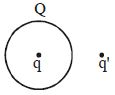
- 1A thin metallic spherical shell contains a charge $Q$ on it. A point charge $+q$ is placed at the centre of the shell and another charge $q'$ is placed outside it as shown in fig. All the three charges are positive. The force on the central charge due to the shell is :-View Solution
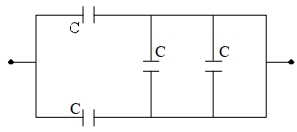
- 2View SolutionThe equivalent capacitance of the combination shown is
- 3Assume that an electric field $\overrightarrow E = 30{x^2}\hat i$ exists in space. Then the potential difference $V_A -V_O$, where $V_O$ is the potential at the origin and $V_A$ the potential at $x = 2\, m$ isView Solution
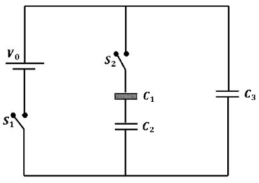
- 4Three identical capacitors $\mathrm{C}_1, \mathrm{C}_2$ and $\mathrm{C}_3$ have a capacitance of $1.0 \mu \mathrm{F}$ each and they are uncharged initially. They are connected in a circuit as shown in the figure and $\mathrm{C}_1$ is then filled completely with a dielectric material of relative permittivity $\varepsilon_{\mathrm{r}}$. The cell electromotive force (emf) $V_0=8 \mathrm{~V}$. First the switch $S_1$ is closed while the switch $S_2$ is kept open. When the capacitor $C_3$ is fully charged, $S_1$ is opened and $S_2$ is closed simultaneously. When all the capacitors reach equilibrium, the charge on $\mathrm{C}_3$ is found to be $5 \mu \mathrm{C}$. The value of $\varepsilon_{\mathrm{r}}=$. . . .View Solution
(image)
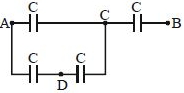
- 5The equivalent capacitance between $A$ and $B$ in the circuit given below is.....$μF$View Solution
- 6A capacitor is charged with a battery and energy stored is $U$. After disconnecting battery another capacitor of same capacity is connected in parallel to the first capacitor. Then energy stored in each capacitor isView Solution
- 7The plates of a parallel plate capacitor with no dielectric are connected to a voltage source. Now a dielectric of dielectric constant $K $ is inserted to fill the whole space between the plates with voltage source remaining connected to the capacitor.View Solution
- 8Three concentric metallic spherical shell $A, B$ and $C$ or radii $a, b$ and $c$ $(a < b < c)$ have surface charge densities $- \sigma , + \sigma ,$ and $- \sigma $ respectively. The potential of shell $A$ is :View Solution
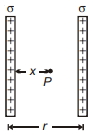
- 9For two infinitely long charged parallel sheets, the electric field at $P$ will beView Solution
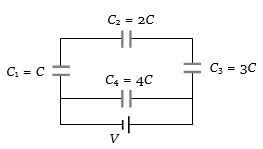
- 10A network of four capacitors of capacity equal to ${C_1} = C,\,\,{C_2} = 2C,\,{C_3} = 3C$ and ${C_4} = 4C$ are conducted in a battery as shown in the figure. The ratio of the charges on ${C_2}$ and ${C_4}$ isView Solution