Question
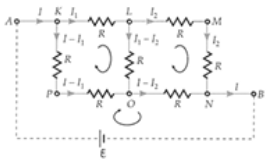
Find the equivalent resistance between the terminals $A$ and $B$ in the network shown in Figure. Given each resistor $R$ is $10 \Omega$.
Image

Answer

Imagine a battery of $emf ,$ having no internal resistance, connected between the points $A$ and $B$. The distribution of current through various branches is as shown in Figure.
Image

Applying Kirchhoff's second law to loop $\text{KLOPK},$ we get
$ I _1 R +\left( I _1- I _2\right) R -2\left( I - I _1\right) R =0$
$\text { or } 4 I _1- I _2=2 I \ldots \text { (i) }$
Similarly, from the loop $\text{LMNOL},$ we have
$2 I _2 R -\left( I - I _2\right) R -\left( I _1- I _2\right) R =0$
$\text { or }- I _1+4 I _1= I \ldots \text { (ii) }$
From the loop $\text{AKPONBEA},$ we have
$2\left( I - I _1\right) R +\left( I - I _2\right) R =\varepsilon \ldots(iii)$
Solving equations $(i)$ and $(ii),$ we get
$I_1=\frac{3}{5} I$ and $I_2=\frac{2}{5} I$
Substituting these values in equation $(iii),$ we get
$2\left(I-\frac{3}{5} I\right) R+\left(I-\frac{2}{5} I\right) R=\varepsilon$
$\text { or } \frac{7}{5} I R=\varepsilon \ldots \text { (iv) }$
If $R^{\prime}$ is the equivalent resistance between $A$ and $B ,$ then
$I R^{\prime}=\varepsilon \ldots( v )$
From $(iv)$ and $(v), I R^{\prime}=\frac{7}{5} I R$
or $R^{\prime}=\frac{7}{5} R=\frac{7}{5} \times 10=14 \Omega$

Need a full question paper?

Generate a complete, print-ready paper with questions like this in minutes — across 16+ boards, with answer keys.
Start Generating Free

Similar questions

If mercury and glass had equal coefficient of volume expansion, could we make a mercury thermometer in a glass tube?
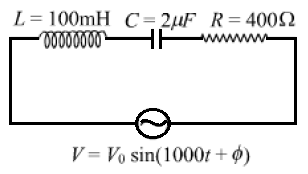
  1. Find the value of the phase difference between the current and the voltage in the series $\text{LCR}$ circuit shown below. Which one leads in phase: current or voltage?
  2. Without making any other change, find the value of the additional capacitor $C_1,$ to be connected in parallel with the capacitor $C,$ in order to make the power factor of the circuit unity.
In an accelerator experiment on high$-$energy collisions of electrons with positrons, a certain event is interpreted as annihilation of an electron$-$positron pair of total energy $10.2\ BeV$ into two $γ-$rays of equal energy. What is the wavelength associated with each $γ-$ray? $(1\ BeV = 10^9\ eV)$.
State difference between the working and non-working current.
The noise level in a class-room in absence of the teacher is 50dB when 50 students are present. Assuming that on the average each student outputs same sound energy per second, what will be the noise level if the number of students is increased to 100?
Show that the wavelength of electro-magnetic radiation is equal to the de-Broglie wavelength of its quantum (photon).
A circular coil of $16$ turns and radius $10 \ cm$ carrying a current of $0.75 A$ rests with its plane normal to an external field of magnitude $5.0 \times 10^{–2} T.$ The coil is free to turn about an axis in its plane perpendicular to the field direction. When the coil is turned slightly and released, it oscillates about its stable equilibrium with a frequency of $2.0 s^{–1}.$ What is the moment of inertia of the coil about its axis of rotation?
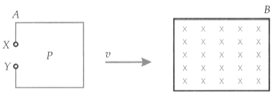
A rectangular coil P is moved from a point A to another point B with uniform velocity 'v' through a region of a uniform magnetic field acting normally inwards as shown in the figure. Show graphically (i) the variation of magnetic flux associated with the coil with time, (ii) the variation of induced emf across points X and Y of the coil with time. 
Image

Explain the nature of variation in magnetic flux as represented by the graph in the first case.
A nearsighted person cannot see beyond 25cm. Assuming that the separation of them glass from the eye is 1cm, find the power of lens needed to see distant objects.
Rate of change of electric field in the region between the plates of capacitor is $1.5 \times 10^{12} Vm ^{-1} s^{ 1 }$. If circular plate of capacitor has a radius of 55 mm , then find the magnitude of displacement current.