Question
Find the maximum magnifying power of a compound Microscope having a 25 diopter lens as the objective, a 5 diopter lens as the eyepiece and the separation 30cm between the two lenses. The least distance for clear vision is 25cm.
Answer

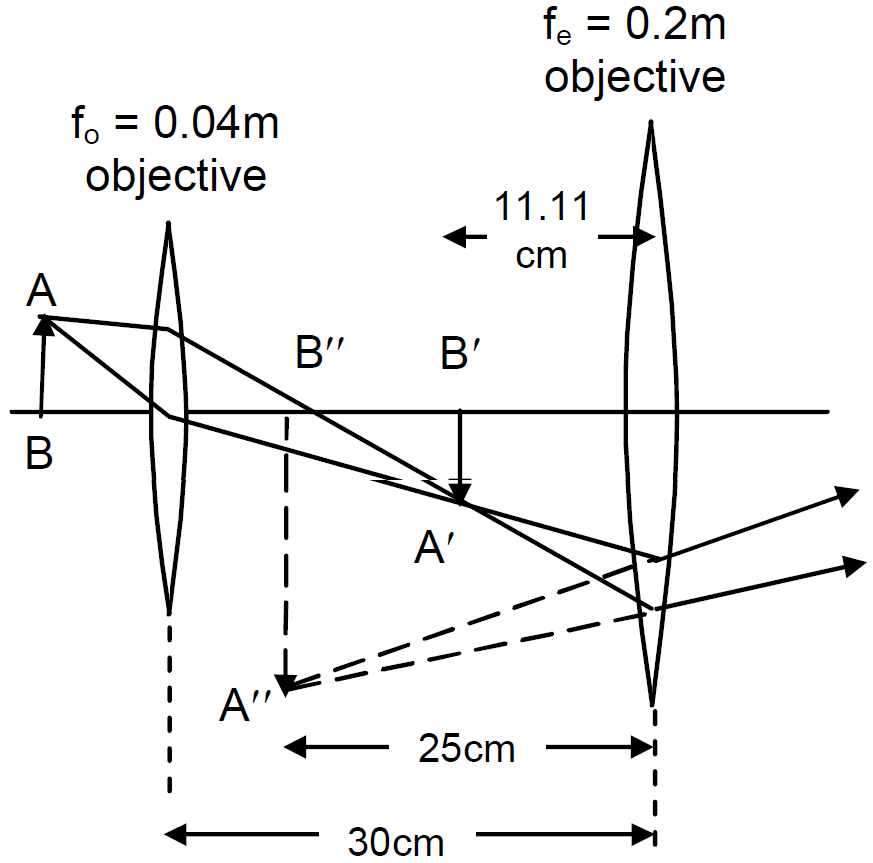
For the given compound microscope$\text{f}_0=\frac{1}{25\text{ diopter}}=0.04\text{m}=4\text{cm,}$ $\text{f}_\text{e}=\frac{1}{5\text{ diopter}}=0.2\text{m}=20\text{cm}$
D = 25cm, separation between objective and eyepiece = 30cm T
he magnifying power is maximuwm hen the image is formed by the eye piece at least distance of clear vision
i.e. D = 25cm for the eye piece,
$v_e= -25cm, f_e = 20cm$ For lens formula, $\frac{1}{\text{v}_\text{e}}-\frac{1}{\text{u}_\text{e}}=\frac{1}{\text{f}_\text{e}}$
$\Rightarrow\frac{1}{\text{u}_\text{e}}=\frac{1}{\text{v}_\text{e}}-\frac{1}{\text{f}_\text{e}}$
$\Rightarrow\frac{1}{\text{u}_\text{e}}\frac{1}{-25}-\frac{1}{20} $
$\Rightarrow\text{u}_\text{e}=11.11\text{cm}$
So, for the objective lens,
the image distance should be $v_0 = 30 - (11.11) = 18.89cm$
Now, for the objective lens, $v_0 = +18.89cm$ (because real image is produced)
$f_0 = 4cm$ So, $\frac{1}{\text{u}_\text{o}}=\frac{1}{\text{v}_\text{o}}-\frac{1}{\text{f}_\text{o}}$
$\Rightarrow \frac{1}{18.89}-\frac{1}{4}\\=0.053-0.25=-0.197$
$\Rightarrow\text{u}_\text{o}=-5.07\text{cm}$
So, the maximum magnificent power is given by$\text{m}=-\frac{\text{v}_\text{o}}{\text{u}_\text{o}}\Big[1+\frac{\text{D}}{\text{f}_\text{e}}\Big]=\frac{18.89}{-5.07}\Big[1+\frac{25}{20}\Big]$
$=3.7225\times2.25=8.376$

Need a full question paper?

Generate a complete, print-ready paper with questions like this in minutes — across 16+ boards, with answer keys.
Start Generating Free

Similar questions

Obtain an expression for induced electromotive force due to rotational motion of a disc in a uniform magnetic field.
Show that the first few frequencies of light that is emitted when electrons fall to the $n^{th}$ level from levels higher than n, are approximate harmonics (i.e. in the ratio 1 : 2: 3...) when n > > 1.
Oxygen is filled in a closed metal jar of volume $1.0 \times 10^{-3} \mathrm{~m}^3$ at a pressure of $1.5 \times 10^5 \mathrm{~Pa}$ and temperature 400 K . The jar has a small leak in it. The atmospheric pressure is $1.0 \times 10^5 \mathrm{~Pa}$ and the atmospheric temperature is 300 K Find the mass of the gas that leaks out by the time the pressure and the temperature inside the jar equalise with the surrounding.
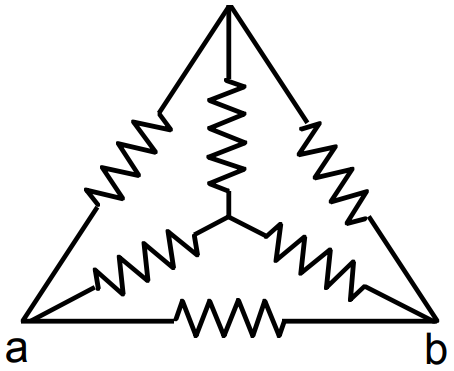
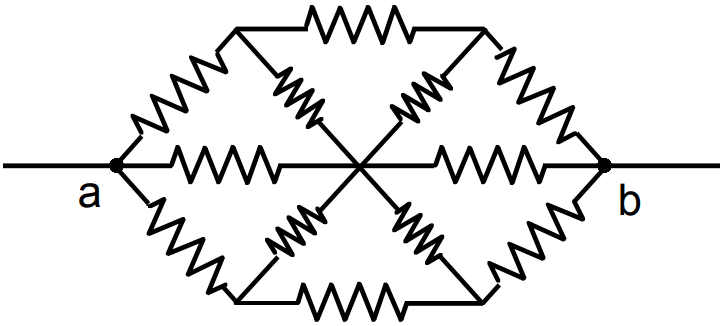
Find the equivalent resistance of the circuits shown in the figure. between the points a and b. Each resistor has resistance r.

The convex surface of a thin concavo-convex lens of glass of refractive index 1.5 has a radius of curvature 20cm. The concave surface has a radius of curvature 60cm. The convex side is silvered and placed on a horizontal surface as shown in figure.
  1. Where should a pin be placed on the axis so that its image is formed at the same place?
  2. If the concave part is filled with water $\Big(\mu=\frac{4}{3}\Big),$ find the distance through which the pin should be moved so that the image of the pin again coincides with the pin.
A proton goes undeflected in a crossed electric and magnetic field (the fields are perpendicular to each other) at a speed of $2.0 \times 10^5ms^{-1}$. The velocity is perpendicular to both the fields. When the electric field is switched off, the proton moves along a circle of radius 4.0cm. Find the magnitudes of the electric and magnetic fields. Take the mass of the proton $= 1.6 \times 10^{-27}kg$
State Gauss theorem in electrostatics. Apply this theorem to obtain the expression for the electric field at a point due to an infinitely long, thin, uniformly charged straight wire of linear charge density $\lambda\text{Cm}^{-1}.$
A small block oscillates back and forth on a smooth concave surface of radius R figure. Find the time period of small oscillation.
A heavy ball is suspended from the ceiling of a motor car through a light string. A transverse pulse travels at a speed of 60cm/s on the string when the car is at rest and 62cm/s when the car accelerates on a horizontal road. Find the acceleration of the car. Take $g = 10m/s^2.$
Consider an infinitely long wire carrying a current I (t), with $\frac{\text{dI}}{\text{dt}}=\lambda=\text{constant}$. Find the current produced in the rectangular loop of wire ABCD if its resistance is R (Fig).