Question
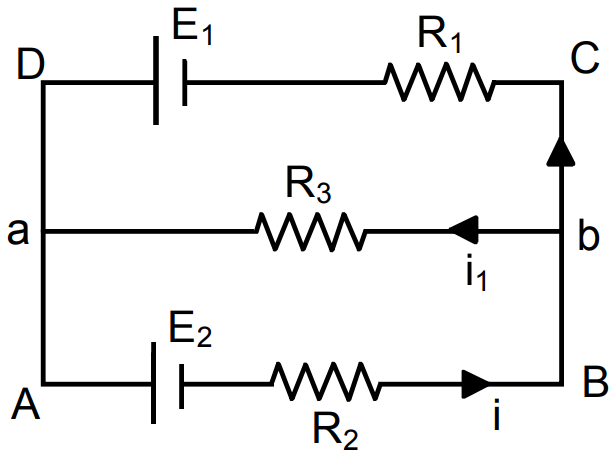
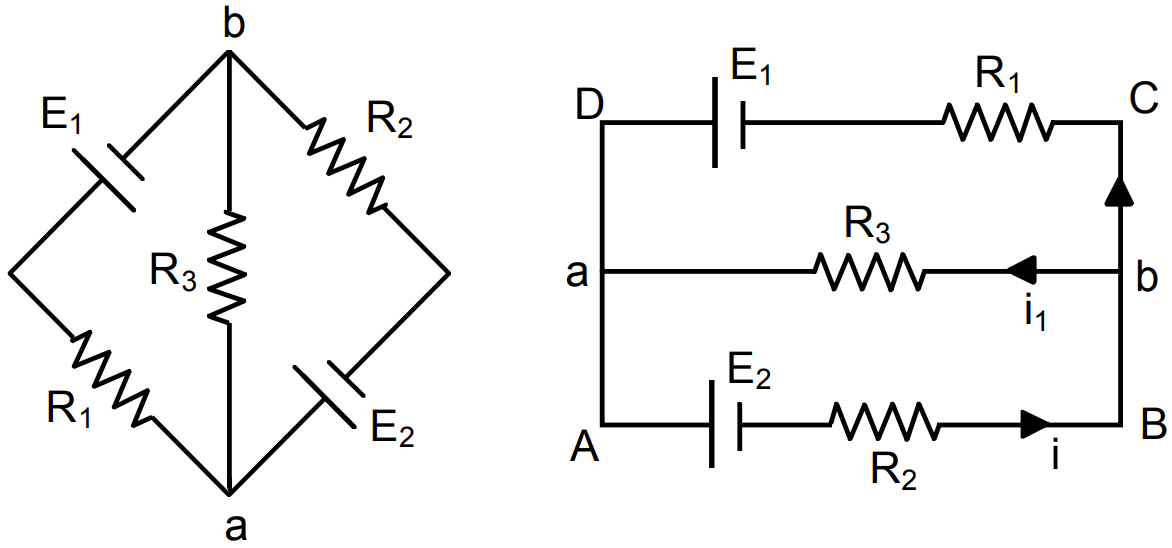
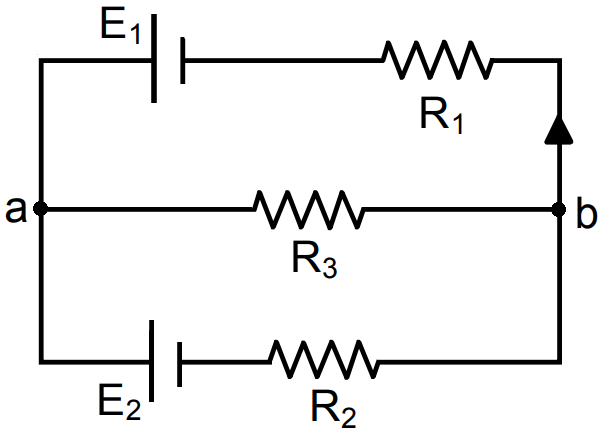
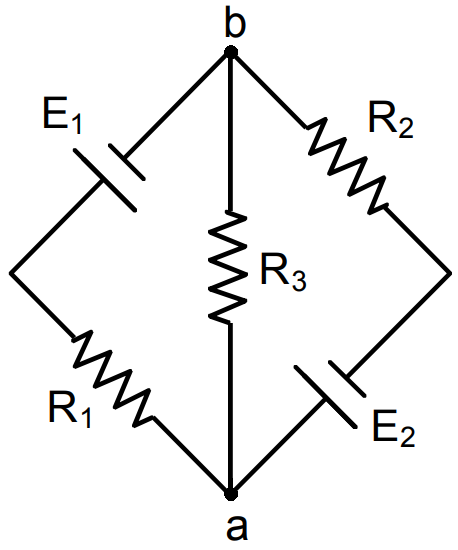
Find the potential difference $V_a - V_b $ in the circuits shown in figure.

Answer

  1. In circuit, AB ba A


$\text{E}_2+\text{iR}_2+\text{i}_1\text{R}_3=0$

In circuit, $\text{i}_1\text{R}_3+\text{E}_1-(\text{i}-\text{i}_1)\text{R}_1=0$

$\Rightarrow\text{i}_1\text{R}_3+\text{E}_1-\text{iR}_1+\text{i}_1\text{R}_1=0$

$[\text{iR}_2+\text{i}_1\text{R}_3\ \ \ \ \ \ \ \ \ \ \ \ \ \ \ \ \ \ \ \ \ \ =-\text{E}_2]\text{R}_1\\ [\text{iR}_2-\text{i}_1(\text{R}_1+\text{R}_3)\ \ \ \ \ \ \ \ \ =\text{E}_1]\text{R}_2\\\underline{\ \ \ \ \ \ \ \ \ \ \ \ \ \ \ \ \ \ \ \ \ \ \ \ \ \ \ \ \ \ \ \ \ \ \ \ \ \ \ \ \ \ \ \ \ \ \ \ \ \ \ \ \ \ \ \ \ }\\\text{iR}_2\text{R}_1+\text{i}_1\text{R}_3\text{R}_1\ \ \ \ \ \ \ \ \ \ \ \ \ =-\text{E}_2\text{R}_1\\\text{iR}_2\text{R}_1-\text{i}_1\text{R}_2(\text{R}_1+\text{R}_3)=\ \ \ \text{E}_1\text{R}_2\\\underline{ \ \ \ \ \ \ \ \ \ \ \ \ \ \ \ \ \ \ \ \ \ \ \ \ \ \ \ \ \ \ \ \ \ \ \ \ \ \ \ \ \ \ \ \ \ \ \ \ \ \ \ \ \ \ \ \ \ }$

$\text{iR}_3\text{R}_1+\text{i}_1\text{R}_2\text{R}_1+\text{i}_1\text{R}_2\text{R}_3=\text{E}_1\text{R}_2-\text{E}_1\text{R}_1$

$\Rightarrow\text{i}_1(\text{R}_3\text{R}_1+\text{R}_2\text{R}_1+\text{R}_2\text{R}_3)=\text{E}_1\text{R}_2-\text{E}_2\text{R}_1$

$\Rightarrow\text{i}_1=\frac{\text{E}_1\text{R}_2-\text{E}_2\text{R}_1}{\text{R}_3\text{R}_1+\text{R}_2\text{R}_1+\text{R}_2\text{R}_3}$

$\Rightarrow\frac{\text{E}_1\text{R}_2\text{R}_3-\text{E}_2\text{R}_1\text{R}_3}{\text{R}_3\text{R}_1+\text{R}_2\text{R}_1+\text{R}_2\text{R}_3}=\Bigg(\frac{\frac{\text{E}_1}{\text{R}_1}-\frac{\text{E}_2}{\text{R}_2}}{\frac{1}{\text{R}_2}+\frac{1}{\text{R}_1}+\frac{1}{\text{R}_3}}\Bigg)$
  1. $\therefore$ Same as a

Need a full question paper?

Generate a complete, print-ready paper with questions like this in minutes — across 16+ boards, with answer keys.
Start Generating Free

Similar questions

  1. Draw a schematic ray diagram of a compound microscope when image is formed at distance of distinct vision.
  2. Write the expression for resolving power of a compound microscope. How can the resolving power of a microscope be increased?
A block of mass 0.5kg hanging from a vertical spring executes simple harmonic motion of amplitude 0.1m and time period 0.314s. Find the maximum force exerted by. the spring on the block.
Electrons are continuously in motion within a conductor but there is no current in it unless some source of potential is applied across its ends. Give reason.
Draw a plot showing the variation of photoelectric current with collector plate potential for two different frequencies, $ν_1 > ν_2,$ of incident radiation having the same intensity. In which case will the stopping potential be higher? Justify your answer.
State Biot – Savart law. Deduce the expression for the magnetic field at a point on the axis of a current carrying circular loop of radius ‘R’, distant ‘x’ from the centre. Hence write the magnetic field at the centre of a loop.
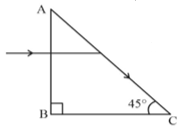
A light ray entering a right $-$ angled prism undergoes refraction at the face $AC$ as shown in Figure
$(I)$ What is the refractive index of the material of the prism in Figure?
Image
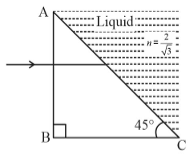
$(II) \ (a) $ If the side $AC$ of the above prism is now surrounded by a liquid of refractive index $\frac{2}{\sqrt{3}}$ as shown in Figure, determine if the light ray continues to graze along the interface $AC$ or undergoes total internal reflection or undergoes refraction into the liquid.

Image

$(b)$ Draw the ray diagram to represent the path followed by the incident ray with the corresponding angle values.
$($Given, $\sin ^{-1}\left(\frac{\sqrt{2}}{\sqrt{3}}\right)=54.6^{\circ})$
Answer the following questions.
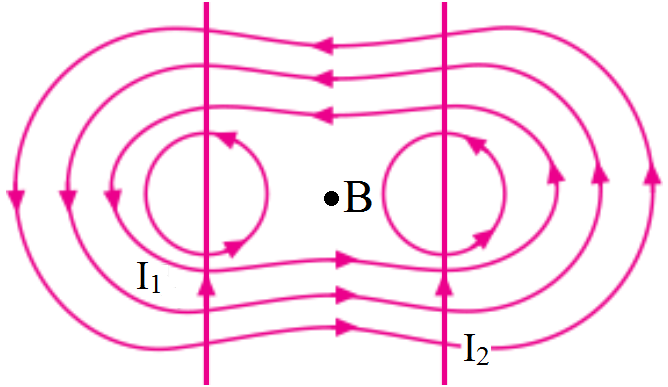
  1. Draw the magnetic field lines due to two straight, long, parallel conductors carrying currents $I_1$ and $I_2$ in the same direction. Write an expression for the force acting per unit length on one conductor due to other. Is this force attractive or repulsive?
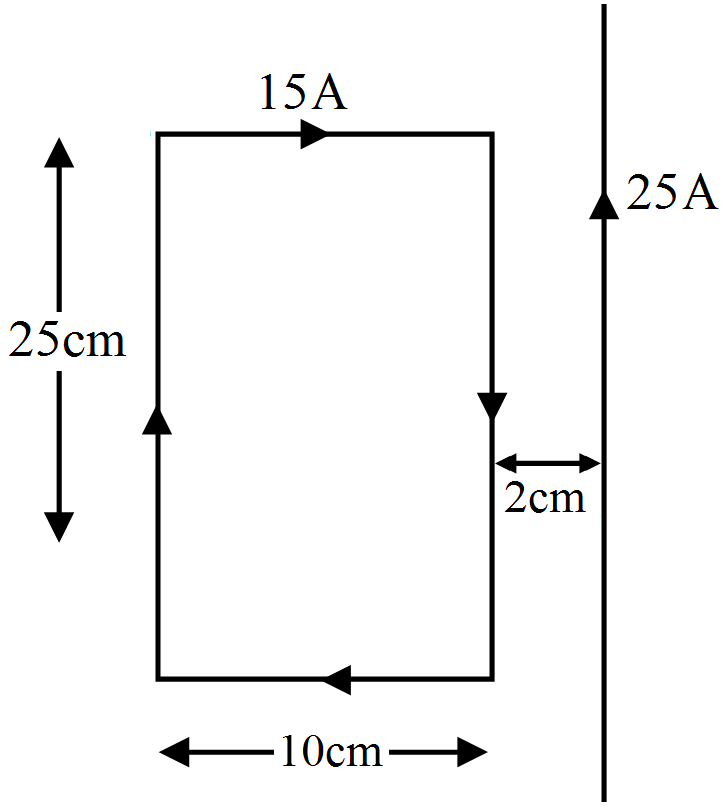
  1. Figure shows a rectangular current-carrying loop placed 2cm away from a long, straight, current-carrying conductor. What is the direction and magnitude of the net force acting on the loop?
  1. In a typical nuclear reaction, e.g.
$^{2}_{1}\text{H} +^{2}_{1}\text{H}\rightarrow^{3}_{2}\text{He} + \text{n} + 3.27\text{MeV}$

although number of nucleons is conserved, yet energy is released. How? Explain.
  1. Show that nuclear density in a given nucleus is independent of mass number A.
In a pure semiconductor, the number of conduction electrons is $6 \times 10^{19}$ per cubic metre. How many holes are there in a sample of size $1cm × 1cm × 1mm?$