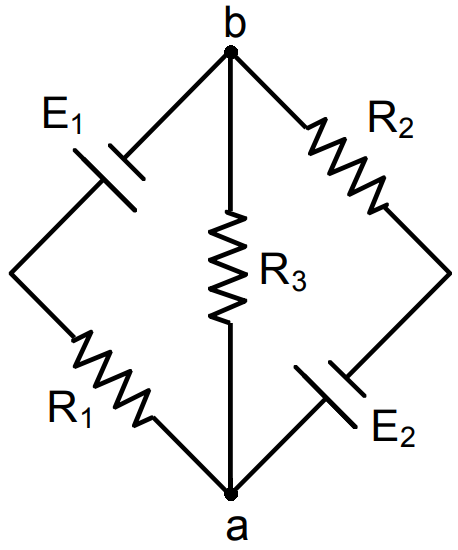
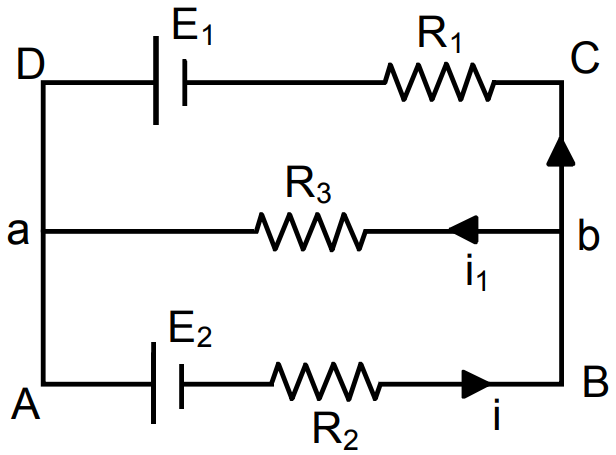
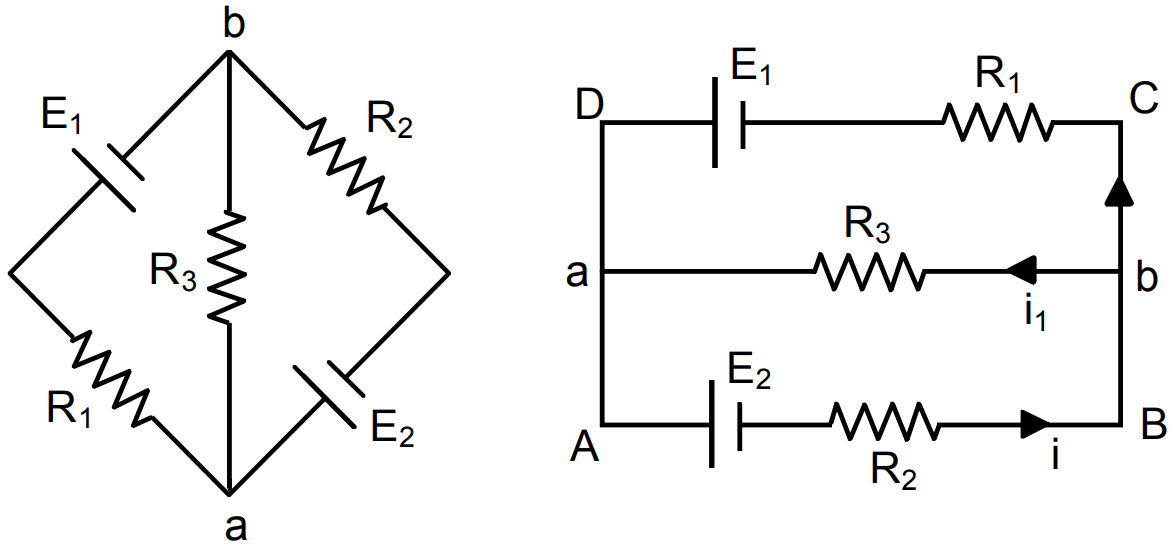
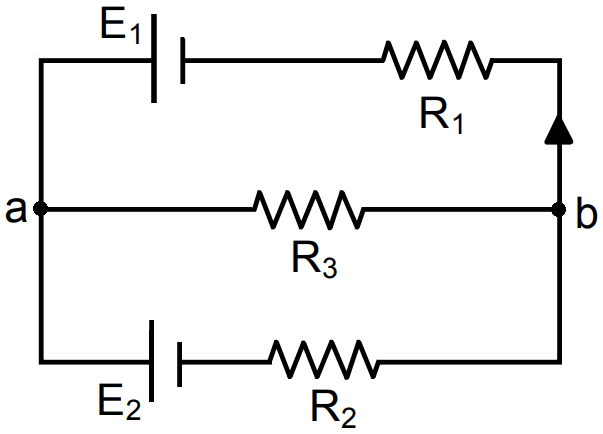
Find the potential difference $V_a - V_b$ in the circuits shown in figure.
Download our app for free and get startedPlay store
  1. In circuit, $AB$ ba $A$

$\text{E}_2+\text{iR}_2+\text{i}_1\text{R}_3=0$
In circuit, $\text{i}_1\text{R}_3+\text{E}_1-(\text{i}-\text{i}_1)\text{R}_1=0$
$\Rightarrow\text{i}_1\text{R}_3+\text{E}_1-\text{iR}_1+\text{i}_1\text{R}_1=0$
$[\text{iR}_2+\text{i}_1\text{R}_3\ \ \ \ \ \ \ \ \ \ \ \ \ \ \ \ \ \ \ \ \ \ =-\text{E}_2]\text{R}_1\\ [\text{iR}_2-\text{i}_1(\text{R}_1+\text{R}_3)\ \ \ \ \ \ \ \ \ =\text{E}_1]\text{R}_2\\\underline{\ \ \ \ \ \ \ \ \ \ \ \ \ \ \ \ \ \ \ \ \ \ \ \ \ \ \ \ \ \ \ \ \ \ \ \ \ \ \ \ \ \ \ \ \ \ \ \ \ \ \ \ \ \ \ \ \ }\\\text{iR}_2\text{R}_1+\text{i}_1\text{R}_3\text{R}_1\ \ \ \ \ \ \ \ \ \ \ \ \ =-\text{E}_2\text{R}_1\\\text{iR}_2\text{R}_1-\text{i}_1\text{R}_2(\text{R}_1+\text{R}_3)=\ \ \ \text{E}_1\text{R}_2\\\underline{ \ \ \ \ \ \ \ \ \ \ \ \ \ \ \ \ \ \ \ \ \ \ \ \ \ \ \ \ \ \ \ \ \ \ \ \ \ \ \ \ \ \ \ \ \ \ \ \ \ \ \ \ \ \ \ \ \ }$
$\text{iR}_3\text{R}_1+\text{i}_1\text{R}_2\text{R}_1+\text{i}_1\text{R}_2\text{R}_3=\text{E}_1\text{R}_2-\text{E}_1\text{R}_1$
$\Rightarrow\text{i}_1(\text{R}_3\text{R}_1+\text{R}_2\text{R}_1+\text{R}_2\text{R}_3)=\text{E}_1\text{R}_2-\text{E}_2\text{R}_1$
$\Rightarrow\text{i}_1=\frac{\text{E}_1\text{R}_2-\text{E}_2\text{R}_1}{\text{R}_3\text{R}_1+\text{R}_2\text{R}_1+\text{R}_2\text{R}_3}$
$\Rightarrow\frac{\text{E}_1\text{R}_2\text{R}_3-\text{E}_2\text{R}_1\text{R}_3}{\text{R}_3\text{R}_1+\text{R}_2\text{R}_1+\text{R}_2\text{R}_3}=\Bigg(\frac{\frac{\text{E}_1}{\text{R}_1}-\frac{\text{E}_2}{\text{R}_2}}{\frac{1}{\text{R}_2}+\frac{1}{\text{R}_1}+\frac{1}{\text{R}_3}}\Bigg)$
  1. $\therefore$ Same as a
art

Download our app
and get started for free

Experience the future of education. Simply download our apps or reach out to us for more information. Let's shape the future of learning together!No signup needed.*

Similar Questions

  • 1
    A uniform wire of resistance $100\Omega$ is melted and recast as a wire of length is double that of the original. What would be the resistance of the wire?
    View Solution
  • 2
    For the potentiometer circuit shown in the given figure, points X and Y represent the two terminals of an unknown emf E'. A student observed that when the jockey is moved from the end A to the end B of the potentiometer wire, the deflection in the galvanometer remains in the same direction.
    What may be the two possible faults in the circuit that could result in this observation? If the galvanometer deflection at the end B is (i) more, (ii) less than at the end A, which of the two faults, listed above, would be there in the circuit? Give reason in support of your answer in each case.
    View Solution
  • 3
    1. Two cells of emf $E_1$ and $E_2$ have their internal resistances $r_1$ and $r_2$, respectively. Deduce an expression for the equivalent emf and internal resistance of their parallel combination when connected across an external resistance $R.$ Assume that the two cells are supporting each other.
    2. In case the two cells are identical, each of emf $E = 5V$ and internal resistance $\text{r}=2\Omega,$ calculate the voltage across the external resistance $\text{R}=10\Omega.$
    View Solution
  • 4
    A storage battery of emf $8.0 V$ and internal resistance $0.5\ \Omega$ is being charged by a $120 V\  dc$ supply using a series resistor of $15.5\ \Omega.$ What is the terminal voltage of the battery during charging? What is the purpose of having a series resistor in the charging circuit?
    View Solution
  • 5
    Is the motion of a charge across junction momentum conserving? Why or why not?
    View Solution
  • 6
    A wire $AB$ is carrying a steady current of $12 A$ and is lying on the table. Another wire $CD$ carrying $5A$ is held directly above $AB$ at a height of $1 mm.$ Find the mass per unit length of the wire $CD$ so that it remains suspended at its position when left free. Give the direction of the current flowing in $CD$ with respect to that in $AB.$ $[$Take the value of $g = 10 ms^{–2}]$
    View Solution
  • 7
    1. Write the principle of working of a metre bridge.
    2. In a metre bridge, the balance point is found at a distance $l_1$ with resistances R and S as shown in the figure.

    An unknown resistance X is now connected in parallel to the resistance S and the balance point is found at a distance $l_2$. Obtain a formula for X in terms of $l_1$, $l_2$ and S.
    View Solution
  • 8
    A (i) series (ii) parallel combination of two given resistors is connected, one by one, across a cell. In which case will the terminal potential difference, across the cell have a higher value?
    View Solution
  • 9
    In the given circuit, with steady current, calculate the potential difference across the capacitor and the charge stored in it.
    View Solution
  • 10
    A potential difference $V$ is applied across a conductor of length $L$ and diameter $D.$ How is the drift velocity, $V_d,$ of charge carriers in the conductor affected when $(i) \ V$ is halved, $(ii) \ L$ is doubled and $(iii) \ D$ is halved? Justify your answer in each case.
    View Solution