MCQ
Find the ratio of time periods of two identical springs if they are first joined in series $\&$ then in parallel $\&$ a mass $m$ is suspended from them :
  • A
    $4$
  • $2$
  • C
    $1$
  • D
    $3$

Answer

Correct option: B.
$2$
b
$\mathrm{T}_{1}=2 \pi \sqrt{\frac{\mathrm{m}}{\mathrm{k}_{\mathrm{eq}}}}(\text { in series })$

$\frac{1}{\mathrm{k}_{\mathrm{eq}}}=\frac{1}{\mathrm{k}}+\frac{1}{\mathrm{k}}=\frac{2}{\mathrm{k}}$

$\therefore \quad k_{e q}=\frac{k}{2}$

$\therefore \quad \mathrm{T}_{1}=2 \pi \sqrt{\frac{2 \mathrm{m}}{\mathrm{k}}}$

$\mathrm{T}_{2}=2 \pi \sqrt{\frac{\mathrm{m}}{\mathrm{k}^{\prime}}}(\text { in parallel })$

But $k^{\prime}=k+k=2 k$

$\mathrm{T}_{2}=2 \pi \sqrt{\frac{\mathrm{m}}{2 \mathrm{k}}}$

$\therefore \frac{\mathrm{T}_{1}}{\mathrm{T}_{2}}=\frac{2 \pi \sqrt{\frac{2 \mathrm{m}}{\mathrm{k}}}}{2 \pi \sqrt{\frac{\mathrm{m}}{2 \mathrm{k}}}}=2$

Need a full question paper?

Generate a complete, print-ready paper with questions like this in minutes — across 16+ boards, with answer keys.
Start Generating Free

Similar questions

Three perfect gases at absolute temperatures $T_1 , T_2$ and $T_3$ are mixed. The masses of molecules are $m_1 , m_2$ and $m_3$ and the number of molecules are $n_1, n_2$ and $n_3$ respectively. Assuming no loss of energy, the final temperature of the mixture is
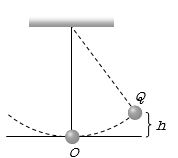
The bob of a simple pendulum is displaced from its equilibrium position $O$ to a position $Q$ which is at height h above $O$ and the bob is then released. Assuming the mass of the bob to be $m$ and time period of oscillations to be $2.0\, sec$, the tension in the string when the bob passes through $O$ is
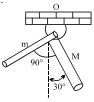
Two uniform rods of equal length but different masses are rigidly joined to form an $L$ -shaped body, which is then pivoted as shown. If in equilibrium the body is in the shown configuration, ratio $M/m$ will be:
A body of weight 72 N moves from the surface of earth at a height half of the radius of earth, then gravitational force exerted on it will be:
A sine wave has an amplitude $A$ and wavelength $\lambda$. Let $V$ be the wave velocity and $v$ be the maximum velocity of a particle in the medium. Then 
Which of the following most closely depicts the correct variation of the gravitational potential $V(r)$ due to a large planet of radius $R$ and uniform mass density ? (figures are not drawn to scale)
The potential energy of a molecule on the surface of a liquid compared to one inside the liquid is
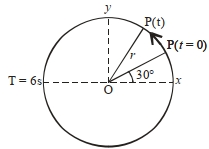
For particle $P$ revolving round the centre $O$ with radius of circular path $r$ and angular velocity $\omega$, as shown in below figure, the projection of $OP$ on the $x$-axis at time $t$ is $.................$.
A body rotating at $20\ rad/sec$ is acted upon by a constant torque providing it a deceleration of $2\ rad/sec^2$. At what time will the body have kinetic energy same as the initial value if the torque continues to act ...... $\sec.$
$A$ ship $X$ moving due north with speed $v$ observes that another ship $Y$ is moving due west with same speed $v$. The actual velocity of $Y$ is $........$.