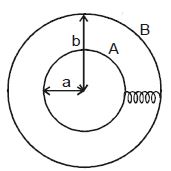
Two spherical conductors $A$ and $B$ of radii $a$ and $b$ $(b > a)$ are placed concentrically in air. The two are connected by a copper wire as shown in figure. Then the equivalent capacitance of the system is
AIIMS 2017, Medium
Download our app for free and get started
All the charge given to inner sphere will pass on to the outer one. So capacitance that of outer one is $4\pi {\varepsilon _0}b$.

Download our appand get started for free
Experience the future of education. Simply download our apps or reach out to us for more information. Let's shape the future of learning together!No signup needed.*
Similar Questions
- 1A spherical conductor of radius $2\,m$ is charged to a potential of $120\,V.$ It is now placed inside another hollow spherical conductor of radius $6\,m.$ Calculate the potential to which the bigger sphere would be raised......$V$View Solution
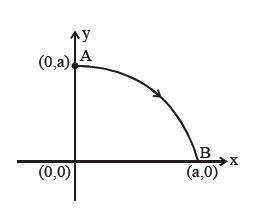
- 2Electric field at a place is $\overrightarrow {E\,} = {E_0}\hat i\,V/m$ . A particle of charge $+q_0$ moves from point $A$ to $B$ along a circular path find work done in this motion by electric fieldView Solution
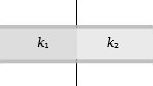
- 3A parallel plate capacitor with air as medium between the plates has a capacitance of $10\,\mu F$. The area of capacitor is divided into two equal halves and filled with two media as shown in the figure having dielectric constant ${k_1} = 2$and ${k_2} = 4$. The capacitance of the system will now be.......$\mu F$View Solution
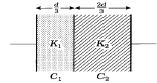
- 4A parallel plate capacitor with air between the plates has capacitance of $9\ pF$. The separation between its plates is '$d$'. The space between the plates is now filled with two dielectrics. One of the dielectrics has dielectric constant $k_1 = 3$ and thickness $\frac{d}{3}$ while the other one has dielectric constant $k_2 = 6$ and thickness $\frac{2d}{3}$ . Capacitance of the capacitor is now.......$pF$View Solution
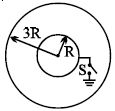
- 5Two thin conducting shells of radii $R$ and $3R$ are shown in the figure. The outer shell carries a charge $+ Q$ and the inner shell is neutral. The inner shell is earthed with the help of a switch $S$.View Solution
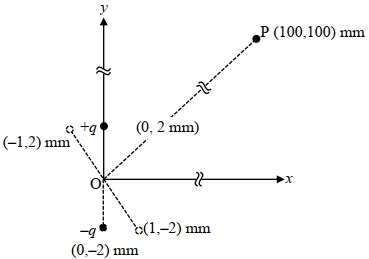
- 6An electric dipole is formed by two charges $+q$ and $-q$ located in xy-plane at $(0,2) \mathrm{mm}$ and $(0,-2) \mathrm{mm}$, respectively, as shown in the figure. The electric potential at point $\mathrm{P}(100,100) \mathrm{mm}$ due to the dipole is $V_0$. The charges $+q$ and $-q$ are then moved to the points $(-1,2) \mathrm{mm}$ and $(1,-2) \mathrm{mm}$, respectively. What is the value of electric potential at $P$ due to the new dipole?View Solution
- 7A metal ball of radius $R$ is placed concentrically inside a hollow metal sphere of inner radius $2R $ and outer radius $3R$. The ball is given a charge $+2Q$ and the hollow sphere a total charge $- Q$. The electrostatic potential energy of this system is :View Solution

- 8A spherical drop of capacitance $1\,\,\mu F$ is broken into eight drops of equal radius. Then, the capacitance of each small drop is ......$\mu F$View Solution
- 9A resistor '$R$' and $2\ μF$ capacitor in series is connected through a switch to $200\ V$ direct supply. Across the capacitor is a neon bulb that lights up at $120\ V$. Calculate the value of $R$ to make the bulb light up $5\ s$ after the switch has been closed. $(log_{10} 2.5 = 0.4)$.View Solution
- 10A capacitor of capacitance $C$ is charged to potential difference $V_0$. Now this capacitor is connected to an ideal inductor. When $25\%$ of energy of capacitor is transferred to inductor then at that time what will be potential difference across capacitorView Solution