MCQ
For a gas, $y = 1.4$ then atomicity, $C_p$ and $C_v$ of the gas are:
  • A
    Monoatomic $\frac52\text{R},\frac32\text{R}$
  • B
    Monoatomic $\frac72\text{R},\frac52\text{R}$
  • Diatomic $\frac72\text{R},\frac52\text{R}$
  • D
    Triatomic $\frac72\text{R},\frac52\text{R}$
Answer

Correct option: C.
Diatomic $\frac72\text{R},\frac52\text{R}$

Need a full question paper?

Generate a complete, print-ready paper with questions like this in minutes — across 16+ boards, with answer keys.

Start Generating Free

Similar questions

Two non-reactive monoatomic ideal gases have their atomic masses in the ratio $2 : 3$. The ratio of their partial pressures, when enclosed in a vessel kept at a constant temperature, is $4 : 3$. The ratio of their densities is :-
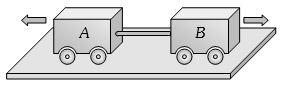
Two carts of masses $200\, kg$ and $300 \,kg$ on horizontal rails are pushed apart. Suppose the coefficient of friction between the carts and the rails are same. If the $200 \,kg$ cart travels a distance of $36 \,m$ and stops, then the distance travelled by the cart weighing $300 \,kg$ is ........ $m$
From an inclined plane a sphere, a disc, a ring and a spherical shell of same radius are rolled without slipping from the same height simultaneously. The order of their reaching at the base will be
The frequency changes by $10\%$ as a sound source approaches a stationary observer with constant speed $v_s$. What would be the percentage change in frequency as the source recedes the observer with the same speed. ... $\%$ Given that $v_s < v$. ($v =$ speed of sound in air)
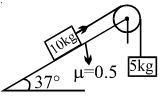
The blocks are in equilibrium. The friction force acting on $10 kg$ block is :
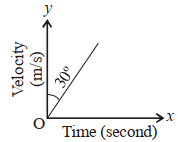
The velocity-time graph for one-dimensional motion of a particle is as shown in the figure. The acceleration of the particle is (in $m / s ^2$ ):
Image
If vectors $\overrightarrow {A} = cos\omega t\hat i + sin\omega t\hat j$ and $\overrightarrow {B} = cos\frac{{\omega t}}{2}\hat i + sin\frac{{\omega t}}{2}\hat j$ are functions of time, then the value of $t$ at which they are orthogonal to each other is 
If there is no external force acting on a nonrigid body, which of the following quantities must remain constant?
A particle moves along a circle if radius $\frac{{20}}{\pi }\;m$ with constant tangential acceleration. If the velocity of the particle is $80\;m/s$ at the end of the second revolution after motion has begun the tangential acceleration is
While measuring diameter of wire using screw gauge the following readings were noted. Main scale reading is $1 \mathrm{~mm}$ and circular scale reading is equal to $42$ divisions. Pitch of screw gauge is $1 \mathrm{~mm}$ and it has $100$ divisions on circular scale. The diameter of the wire is $\frac{x}{50} \mathrm{~mm}$. The value of $x$ is :