MCQ
Two vessels having equal volume contain molecular hydrogen at one atmosphere and helium at two atmosphere pressure respectively. If both samples are at the same temperature the mean velocity of hydrogen molecule is:

Answer

  1. $\sqrt{2}$ times that of helium.

Need a full question paper?

Generate a complete, print-ready paper with questions like this in minutes — across 16+ boards, with answer keys.

Start Generating Free

Similar questions

Two projectiles A and B thrown with speeds in the ratio $1:\sqrt{2}$ acquired the same height. If A is thrown at an angle of 45° with the horizontal, then angle of projection of B will be:
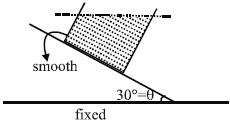
A container of liquid release from the rest, on a smooth inclined plane as shown in the figure. Length of at the inclined plane is sufficient, and assume liquid finally equilibrium. Finally liquid surface makes an angle with horizontal ...... $^o$
A force $F$ is needed to break a copper wire having radius $R.$ The force needed to break a copper wire of radius $2R$ will be
Two identical p-ri junctions may be connected in series with a battery in three ways (figure). The potential difference across the two p-n. junctions are equal in:
  1. Circuit 1 and circuit 2.
  2. Circuit 2 and circuit 3.
  3. Circuit 3 and circuit 1.
  4. Circuit 1 only.

A wire of length 2m is made from 10cm3 of copper. A force F is applied so that its length increases by 2mm. Another wire of length 8m is made from the same volume of copper. If the force F is applied to it, its length will increase by:
A body is in pure rotation. The linear speed $v$​ of a particle, the distance $r$ of the particle from the axis and angular velocity $\omega $ of the body are related as $\omega  = \frac{v}{r}$, thus
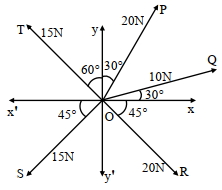
The resultant of these forces $\overrightarrow{O P}, \overrightarrow{O Q}, \overrightarrow{O R}, \overrightarrow{O S}$ and $\overrightarrow{{OT}}$ is approximately $\ldots \ldots {N}$.

[Take $\sqrt{3}=1.7, \sqrt{2}=1.4$ Given $\hat{{i}}$ and $\hat{{j}}$ unit vectors along ${x}, {y}$ axis $]$

A particle of mass $m$ describes a circle of radius $r$. The centripetal acceleration of the particle is $4/r^2$. What will be the momentum of the particle?
In forced oscillations, a particle oscillates simple harmonically with a frequency equal to
Inside a uniform spherical shell:
  1. The gravitational potential is zero.
  2. The gravitational field is zero.
  3. The gravitational potential is same everywhere.
  4. The gravitational field is same everywhere.