MCQ
Ratio between maximum range and square of time of flight in projectile motion is
  • $\frac{g}{2}$
  • B
    $\frac{g}{5}$
  • C
    $\frac{g}{10}$
  • D
    $\frac{g}{12}$

Answer

Correct option: A.
$\frac{g}{2}$
a
The maximum range of projectile motion is given as,

$R=\frac{u^{2} \sin 2 \theta}{g}$

The time of flight of projectile motion is given as,

$T=\frac{2 u \sin \theta}{g}$

The square of time of flight of projectile motion is,

$T^{2}=\left(\frac{2 u \sin \theta}{g}\right)^{2}$

$=\frac{4 u^{2} \sin ^{2} \theta}{g^{2}}$

The ratio of maximum range and square of time of flight in projectile motion is calculated as,

$\frac{R}{T^{2}}=\frac{\frac{u^{2} \sin 2 \theta}{g}}{\frac{4 u^{2} \sin ^{2} \theta}{g^{2}}}$

$=\frac{g}{2} \cot \theta$

Need a full question paper?

Generate a complete, print-ready paper with questions like this in minutes — across 16+ boards, with answer keys.
Start Generating Free

Similar questions

The coefficient of volumetric expansion of mercury is $18 × 10^{-5}{°C^{-1}}$. A thermometer bulb has a volume $10^{-6}\, m^3$ and cross section of stem is $ 0.004 \,cm^2$. Assuming that bulb is filled with mercury at $0°C$ then the length of the mercury column at $100°C$ is
Modulus of rigidity of diamond is
If the velocity varies parabolically, how does the acceleration vary?
Two sources $A$ and $B$ are sounding notes of frequency $660 \,Hz$. $A$ listener moves from $A$ to $B$ with a constant velocity $u$. If the speed of sound is $330 \,m / s$, what must be the value of $u$ so that he hears $8$ beats per second is .......... $m / s$
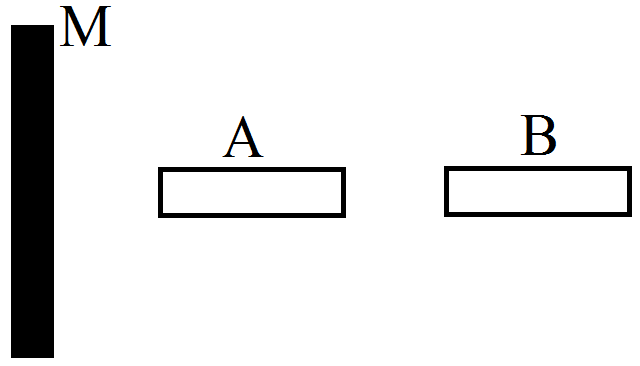
A large nonconducting sheet M is given a uniform charge density. Two uncharged small metal rods A and B are placed near the sheet as shown in figure:
  1. M attracts A.
  2. M attracts B.
  3. A attracts B.
  4. B attracts A.

If force $F$ , velocity $V$ and time $T$ are taken as fundamental units then dimension of force in the pressure is
An aeroplane of mass $3 \times 10^4\,kg$ and total wing area of $120\,m^2$ is in a level flight at some height. The difference in pressure between the upper and lower surfaces of its wings in kilopascals is........... $kPa$ $(g=10\,m/s^2)$
The radius of gyration of a uniform rod of length L about an axis passing through its centre of mass is:
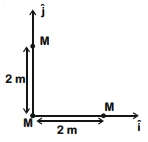
Three identical spheres, each of mass $M ,$ are placed at the corners of a right angle triangle with mutually perpendicular sides equal to $2 \;m$ (see figure). Taking the point of intersection of the two mutually perpendicular sides as the origin, find the position vector of centre of mass.
We write the relation for Boyle's law in the form $PV = C$ when the temperature remains constant. In this relation, the magnitude of $C$ depends upon