For a periodic motion represented by the equation $Y=\sin \omega t+\cos \omega t$ The amplitude of the motion is
JEE MAIN 2023, Easy


Download our appand get started for free
Experience the future of education. Simply download our apps or reach out to us for more information. Let's shape the future of learning together!No signup needed.*
Similar Questions
- 1The particle executing simple harmonic motion has a kinetic energy $K_0cos^2 \omega t$. The maximum values of the potential energy and the total energy are respectivelyView Solution
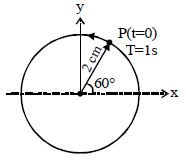
- 2Figure shows the circular motion of a particle. The radius of the circle, the period, sense of revolution and the initial position are indicated in the figure. The simple harmonic motion of the $x-$ projection of the radius vector of the rotating particle $P$ isView Solution
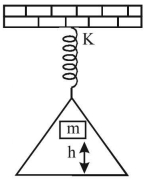
- 3A load of mass $m$ falls from a height $h$ on to the scale pan hung from the spring as shown in the figure. If the spring constant is $k$ and mass of the scale pan is zero and the mass $m$ does not bounce relative to the pan, then the amplitude of vibration isView Solution
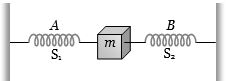
- 4In the figure, ${S_1}$ and ${S_2}$ are identical springs. The oscillation frequency of the mass $m$ is $f$. If one spring is removed, the frequency will becomeView Solution
- 5A simple pendulum oscillates in air with time period $T$ and amplitude $A$. As the time passesView Solution
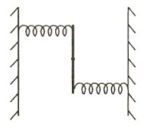
- 6A uniform rod of length $L$ and mass $M$ is pivoted at the centre. Its two ends are attached to two springs of equal spring constants $k$. The springs are fixed to rigid supports as shown in the figure, and the rod is free to oscillate in the horizontal plane. The rod is gently pushed through a small angle $\theta$ in one direction and released. The frequency of oscillation isView Solution
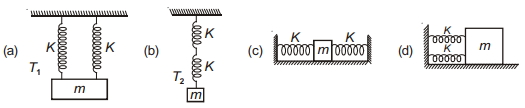
- 7A mass $m$ is attached to two springs of same force constant $K$, as shown in following four arrangements. If $T_1, T_2, T_3$ and $T_4$ respectively be the time periods of oscillation in the following arrangements, in which case time period is maximum?View Solution
- 8View SolutionIn a simple harmonic motion, when the displacement is one-half the amplitude, what fraction of the total energy is kinetic?
- 9For a particle executing simple harmonic motion, the kinetic energy $K$ is given by $K = {K_o}{\cos ^2}\omega t$. The maximum value of potential energy isView Solution
- 10Acceleration of a particle, executing $SHM$, at it’s mean position isView Solution