For a system with newtons law of cooling applicable the initial rate of cooling is $R^0\ C/sec$ find the time when temperature diff. $\Delta T_0 =$ initial temperature difference, is reduced to half.
Diffcult


Download our appand get started for free
Experience the future of education. Simply download our apps or reach out to us for more information. Let's shape the future of learning together!No signup needed.*
Similar Questions
- 1A hollow sphere of inner radius $R$ and outer radius $2R$ is made of a material of thermal conductivity $K$. It is surrounded by another hollow sphere of inner radius $2R$ and outer radius $3R$ made of same material of thermal conductivity $K$. The inside of smaller sphere is maintained at $0^o C$ and the outside of bigger sphere at $100^o C$. The system is in steady state. The temperature of the interface will be ........ $^oC$View Solution
- 2A certain stellar body has radius $50 \,R_{s}$ and temperature $2 \,T_{s}$ and is at a distance of $2 \times 10^{10} \,AU$ from the earth. Here, $AU$ refers to the earth-sun distance and $R_{s}$ and $T_{s}$ refer to the sun's radius and temperature, respectively. Take, both star and sun to be ideal black bodies. The ratio of the power received on earth from the stellar body as compared to that received from the sun is close toView Solution
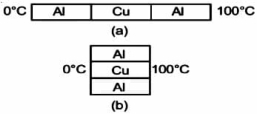
- 3The three rods shown in figure have identical dimensions. Heat flows from the hot end at a rate of $40 \,W$ in the arrangement $(a)$. Find the rates of heat flow when the rods are joined as in arrangement $(b)$ is ......... $W$ (Assume $K_al=200 \,W / m ^{\circ} C$ and $\left.K_{c u}=400 \,W / m ^{\circ} C \right)$View Solution
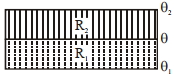
- 4The temperature $\theta$ at the junction of two insulating sheets, having thermal resistances $R _{1}$ and $R _{2}$ as well as top and bottom temperatures $\theta_{1}$ and $\theta_{2}$ (as shown in figure) is given byView Solution
- 5A body takes $10$ minutes to cool down from $62^o C$ to $50^o C$. If the temperature of surrounding is $26^o C$ then in the next $10$ minutes temperature of the body will be ......... $^oC$View Solution
- 6Relation between emissivity $e$ and absorptive power $a$ is (for black body)View Solution
- 7$A$ cylinder of radius $R$ made of a material of thermal conductivity ${K_1}$ is surrounded by a cylindrical shell of inner radius $R$ and outer radius $2R$ made of material of thermal conductivity ${K_2}$. The two ends of the combined system are maintained at two different temperatures. There is no loss of heat across the cylindrical surface and the system is in steady state. The effective thermal conductivity of the system isView Solution
- 8Two cylinders $P$ and $Q$ have the same length and diameter and are made of different materials having thermal conductivities in the ratio $2 : 3$ . These two cylinders are combined to make a cylinder. One end of $P$ is kept at $100°C$ and another end of $Q$ at $0°C$ . The temperature at the interface of $P$ and $Q$ is ...... $^oC$View Solution
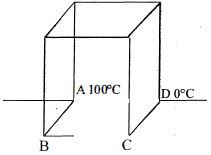
- 9Find Temperature difference between $B$ and $C$ ? (All rods are identical)View Solution
- 10At temperature $T$ , the power radiated by a body is $Q$ watts. At the temperature $3T$ the power radiated by it will beView Solution