At temperature $T$ , the power radiated by a body is $Q$ watts. At the temperature $3T$ the power radiated by it will be
Medium
Download our app for free and get started
(d) Power radiated $P \propto {T^4}$
==> $\frac{{{P_1}}}{{{P_2}}} = {\left( {\frac{{{T_1}}}{{{T_2}}}} \right)^4}$
==> $\frac{Q}{{{P_2}}} = {\left( {\frac{T}{{3T}}} \right)^4}$ ==> ${P_2} = 81Q$

Download our appand get started for free
Experience the future of education. Simply download our apps or reach out to us for more information. Let's shape the future of learning together!No signup needed.*
Similar Questions
- 1View SolutionA thermos flask is polished well
- 2A constant potential difference is applied to the ends of a graphite rod, whose resistance decreases with a rise of temperature. The rod can be $(1)$ covered with asbestos or $(2)$ left open to atmosphere. Answer for steady state.View Solution
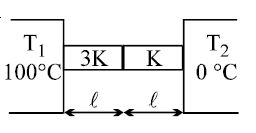
- 3Two rods $A$ and $B$ of same cross-sectional are $A$ and length $l$ connected in series between a source $(T_1 = 100^o C)$ and a sink $(T_2 = 0^o C)$ as shown in figure. The rod is laterally insulated If $G_A$ and $G_B$ are the temperature gradients across the rod $A$ and $B$, thenView Solution
- 4Hot water kept in a beaker placed in a room cools from ${70^o}C$ to $60°C$ in $4$ minutes. The time taken by it to cool from ${69^o}C$ to ${59^o}c$ will beView Solution
- 5The total radiative power emitted by spherical black body with radius $R$ and temperature $T$ is $P$. If the radius is doubled and the temperature is halved, then the radiative power will beView Solution
- 6A black body radiates heat energy at the rate of $2\times10^5\, J/sm^2$ at temp. of $127\,^oC$. The temp of black body at which rate becomes $32\times10^5\, J/s-m^2%$ is ....... $^oC$View Solution
- 7A sphere at temperature $600\,K$ is placed in an environment of temperature is $200\,K$ . Its cooling rate is $H$ . If its temperature reduced to $400\,K$ then cooling rate in same environment will becomeView Solution
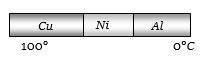
- 8A composite metal bar of uniform section is made up of length $25 cm$ of copper, $10 cm$ of nickel and $15 cm$ of aluminium. Each part being in perfect thermal contact with the adjoining part. The copper end of the composite rod is maintained at ${100^o}C$ and the aluminium end at ${0^o}C$. The whole rod is covered with belt so that there is no heat loss occurs at the sides. If ${K_{{\rm{Cu}}}} = 2{K_{Al}}$ and ${K_{Al}} = 3{K_{{\rm{Ni}}}}$, then what will be the temperatures of $Cu - Ni$ and $Ni - Al$ junctions respectivelyView Solution
- 9At $127^o C$ radiates energy is $2.7 \times 10^{-3} J/s$. At ....... $K$ temperature radiated energy is $4.32 \times 10^6 J/s$View Solution
- 10View SolutionIn a closed room, heat transfer takes place by