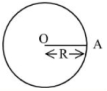
For a uniformly charged thin spherical shell, the electric potential $(V)$ radially away from the center $(O)$ of shell can be graphically represented as
- A
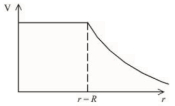
- B
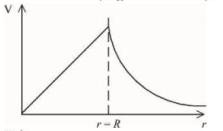
- C
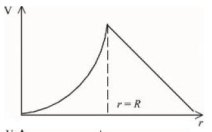
- D
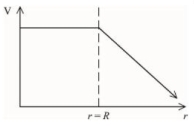
JEE MAIN 2023, Medium

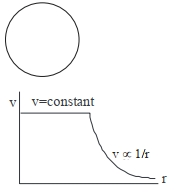

Download our appand get started for free
Experience the future of education. Simply download our apps or reach out to us for more information. Let's shape the future of learning together!No signup needed.*
Similar Questions
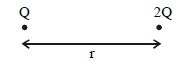
- 1Mass of charge $Q$ is $m$ and mass of charge $2Q$ is $4\,m$ . If both are released from rest, then what will be $K.E.$ of $Q$ at infinite separationView Solution
- 2A piece of cloud having area $25 \times {10^6}\,{m^2}$ and electric potential of ${10^5}$ $volts$. If the height of cloud is $0.75\,km$, then energy of electric field between earth and cloud will be.....$J$View Solution
- 3A conducting body $1$ has some initial charge $Q$, and its capacitance is $C$. There are two other conducting bodies, $2$ and $3$, having capacitances : $C_2 = 2C$ and $C_3 \rightarrow \infty$ . Bodies $2 $ and $3 $ are initially uncharged. "Body $2$ is touched with body $1$. Then, body $2$ is removed from body $1 $ and touched with body $3$, and then removed." This process is repeated $N$ times. Then, the charge on body $1$ at the end must beView Solution
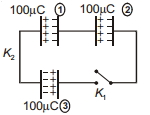
- 4Three identical charged capacitors each of capacitance $5 \,\mu F$ are connected as shown in figure. Potential difference across capacitor $(3)$, long time after the switches $K_1$ and $K_2$ are is closed, is ............ $V$View Solution
- 5A solid conducting sphere, having a charge $Q$, is surrounded by an uncharged conducting hollow spherical shell. Let the potential difference between the surface of the solid sphere and that of the outer surface of the hollow shell be $V$. If the shell is now given a charge of $-4\, Q$, the new potential difference between the same two surface is......$V$View Solution
- 6The capacities of two conductors are ${C_1}$ and ${C_2}$ and their respective potentials are ${V_1}$ and${V_2}$. If they are connected by a thin wire, then the loss of energy will be given byView Solution
- 7Four charges $2C, -3C, -4C$ and $5C$ respectively are placed at all the corners of a square. Which of the following statements is true for the point of intersection of the diagonals ?View Solution
- 8From a supply of identical capacitors rated $8\ \mu F$, $250\ V$, the minimum number of capacitors required to form a composite $16$ $\mu F$, $1000$ $V$ is :View Solution
- 9If identical charges $( - q)$ are placed at each corner of a cube of side $b$, then electric potential energy of charge $( + q)$ which is placed at centre of the cube will beView Solution
- 10View SolutionThe potential to which a conductor is raised, depends on