Question
For an ideal gas, in an isothermal process

Answer

(c)In isothermal process temperature remains constant.

Need a full question paper?

Generate a complete, print-ready paper with questions like this in minutes — across 16+ boards, with answer keys.
Start Generating Free

Similar questions

A moving body of mass $m$ and velocity $3 \,km/h$ collides with a rest body of mass $2\,m$ and sticks to it. Now the combined mass starts to move. What will be the combined velocity ............ $km/h$
A solid cube and a solid sphere of the same material have equal surface area. Both are at the same temperature ${120^o}C$, then
When a ray of light is incident normally on one refracting surface of an equilateral prism (Refractive index of the material of the prism $= 1.5$)
A $100\%$ efficient transformer has $100$ turns in the primary and $25$ turns in its secondary coil. If the current in the secondary coil is $4$ amp, then the current in the primary coil is.....$ amp$
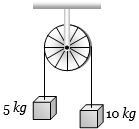
Two masses as shown are suspended from a massless pulley. Calculate the acceleration of the system when masses are left free
Projection of vector $\vec A$ on $\vec B$ is
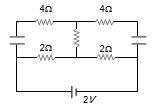
Find the power of the circuit ............ $W$
A beam of unpolarised light of intensity $I_0$ is passed through a polaroid $A$ and then through another polaroid $B$ which is oriented so that its principal plane makes an angle of $45^o $ relative to that of $A$. The intensity of the emergent light is
Two full turns of the circular scale of a screw gauge cover a distance of $1\ mm$ on its main scale. The total number of divisions on the circular scale is $50$. Further, it is found that the screw gauge has a zero error of $- 0.03\ mm$. While measuring the diameter of a thin wire, a student notes the main scale reading of $3\ mm$ and the number of circular scale divisions in line with the main scale as $35$. The diameter of the wire is  ....... $mm$
A single slit of width $b$ is illuminated by a coherent monochromatic light of wavelength $\lambda $. If the second and fourth minima in the diffraction pattern at a distance $1\,m$ from the slit are at $3\, cm$ and $6\, cm$ respectively from the central maximum, what is the width of the central maximum ?......$cm$ (i.e. distance between first minimum on either side of the central maximum)