MCQ
For germanium diode, the junction voltage is about _____.
- A0.7V
- B0.3
- C0.6V
- D3V
Explanation:
The junction voltage Vo for a germanium diode is 0.3 V at room temperature. This potential opposes the diffusion of electrons from n-side and holes from p-side. It is 0.7 eV for Si at room temperature.
Generate a complete, print-ready paper with questions like this in minutes — across 16+ boards, with answer keys.
Two protons A and B are placed in space between plates of a parallel plate capacitor charged upto V volts (See fig.) Forces on protons are  and
and  , then
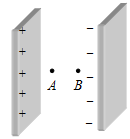
|
(a) |
(b) |
(c) |
(d) Nothing can be said |
We have two wires A and B of same mass and same material. The diameter of the wire A is half of that B. If the resistance of wire A is 24 ohm then the resistance of wire B will be
|
(a) 12 Ohm |
(b) 3.0 Ohm |
(c) 1.5 Ohm |
(d) None of the above |
A dip needle vibrates in the vertical plane perpendicular to the magnetic meridian. The time period of vibration is found to be 2 seconds. The same needle is then allowed to vibrate in the horizontal plane and the time period is again found to be 2 seconds. Then the angle of dip is
|
(a) 0o |
(b) 30o |
(c) 45o |
(d) 90o |
Which of the following waves have the maximum wavelength
|
(a) X-rays |
(b) I.R. rays |
(c) UV rays |
(d) Radio waves |
In Young's experiment, light of wavelength 4000 Å is used to produce bright fringes of width 0.6 mm, at a distance of 2 meters. If the whole apparatus is dipped in a liquid of refractive index 1.5, then fringe width will be
|
(a) 0.2 mm |
(b) 0.3 mm |
(c) 0.4 mm |
(d) 1.2 mm |
Three observers A, B and C measure the speed of light coming from a source to be  and
and  . The observer A moves towards the source, the observer C moves away from the source with the same speed. The observer B stays stationary. the surrounding space is vacuum every where. Then
(a) 
|
(b) 
|
(c) 
|
(d) 
|


