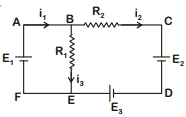
For the circuit given below, the Kirchoff's loop rule for the loop $BCDEB$ is given by the equation
NEET 2020, Medium


Download our appand get started for free
Experience the future of education. Simply download our apps or reach out to us for more information. Let's shape the future of learning together!No signup needed.*
Similar Questions
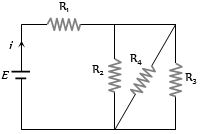
- 1In the circuit given $E = 6.0 \,V, R_1 = 100\, ohms, R_2 = R_3 = 50\, ohms, R_4 = 75\, ohms$. The equivalent resistance of the circuit, in $ohms$, isView Solution
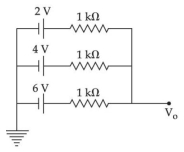
- 2In the given figure, the value of $V_{0}$ will be $.....V$.View Solution
- 3At what temperature will the resistance of a copper wire become three times its value at $0\,^oC$ ................. $^oC$ (Temperature coefficient of resistance for copper = $4 × 10^{-3} \,per\, \,^oC$ )View Solution
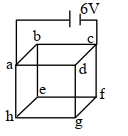
- 4Twelve wires each having resistance $2 \Omega$ are joined to form a cube. A battery of $6 \mathrm{~V}$ emf is joined across point $\mathrm{a}$ and $\mathrm{c}$. The voltage difference between $e$ and $f$ is.______.V.View Solution
- 5View SolutionThe resistivity of a wire depends on its
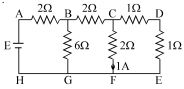
- 6View SolutionWhen cells are connected in parallel, then
- 7$3$ identical bulbs are connected in series and these together dissipate a power $P$. If now the bulbs are connected in parallel, then the power dissipated will beView Solution
- 8In a potentiometer circuit there is a cell of $e.m.f.$ $2\, volt$, a resistance of $5\, ohm$ and a wire of uniform thickness of length $1000\, cm$ and resistance $15\, ohm$. The potential gradient in the wire isView Solution
- 9An electric bulb marked $40\, W$ and $200\, V$, is used in a circuit of supply voltage $100\, V$. Now its power isView Solution
- 10The figure shows a network of resistors and $a$ battery. If $1\,A$ current flowsthrough the branch $CF$, then answer the following questions The $\mathrm{emf}$ $E$ of the battery is If a zero resistance wire is connected in parallel to branch $CF$ ............... $V$View Solution