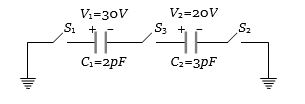
For the circuit shown, which of the following statements is true
IIT 1999, Medium
Download our app for free and get started
(d) Charges on capacitors are ${Q_1} = 30 \times 2 = 6\,pC$ and ${Q_2} = 20 \times 3 = 60\,pC$ or ${Q_1} = {Q_2} = Q\,({\rm{say}})$
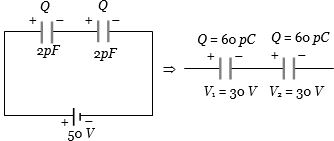
The situation is situation is similar as the two capacitors in series are first charged with a battery of $emf$ $50 \,V$ and then disconnected
when $S_3$ is closed ${V_1} = 30\,V$ and ${V_2} = 20\,V$
The situation is situation is similar as the two capacitors in series are first charged with a battery of $emf$ $50 \,V$ and then disconnected
when $S_3$ is closed ${V_1} = 30\,V$ and ${V_2} = 20\,V$

Download our appand get started for free
Experience the future of education. Simply download our apps or reach out to us for more information. Let's shape the future of learning together!No signup needed.*
Similar Questions
- 1A dielectric slab of dielectric constant $K$ is placed between the plates of a parallel plate capacitor carrying charge $q$. The induced charge $q^{\prime}$ on the surface of slab is given byView Solution
- 2If the charge on a capacitor is increased by $2$ coulomb, the energy stored in it increases by $21\%$. The original charge on the capacitor is....$C$View Solution
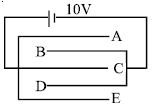
- 3Five identical capacitor plates are arranged such that they make capacitors each of $2\ \mu F$. The plates are connected to a source of $emf$ $10\ V$. The charge on plate $C$ is......$ \mu C$View Solution
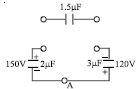
- 4Two capacitors of $2$ $\mu F$ and $3$ $\mu F$ are charged to $150$ $volt$ and $120$ $volt$ respectively. The plates of capacitor are connected as shown in the figure. A discharged capacitor of capacity $1.5$ $\mu F$ falls to the free ends of the wire. ThenView Solution
- 5Identify the $WRONG$ statementView Solution
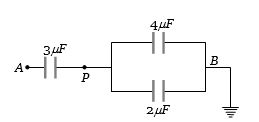
- 6In the figure a potential of $+$ $1200\, V$ is given to point $A$ and point $B$ is earthed, what is the potential at the point $P$....$V$View Solution
- 7Consider two points $1$ and $2$ in a region outside a charged sphere. Two points are not very far away from the sphere. If $E$ and $V$ represent the electric field vector and the electric potential, which of the following is not possibleView Solution
- 8Two identical metal balls of radius $r$ are at a distance $a (a >> r)$ from each other and are charged, one with potential $V_1$ and other with potential $V_2$. The charges $q_1$ and $q_2$ on these balls in $CGS$ esu areView Solution
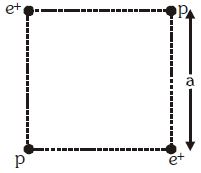
- 9Two positrons $(e^+)$ and two protons $(p)$ are kept on four corners of a square of side $a$ as shown in figure. The mass of proton is much larger than the mass of positron. Let $q$ denotes the charge on the proton as well as the positron then the kinetic energies of one of the positrons and one of the protons respectively after a very long time will be-View Solution
- 10The energy and capacity of a charged parallel plate capacitor are $U$ and $C$ respectively. Now a dielectric slab of $\in _r = 6$ is inserted in it then energy and capacity becomes (Assume charge on plates remains constant)View Solution