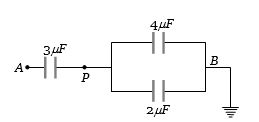
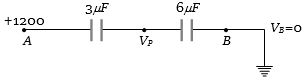
In the figure a potential of $+$ $1200\, V$ is given to point $A$ and point $B$ is earthed, what is the potential at the point $P$....$V$
Medium


Download our appand get started for free
Experience the future of education. Simply download our apps or reach out to us for more information. Let's shape the future of learning together!No signup needed.*
Similar Questions
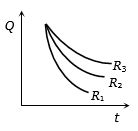
- 1Three identical capacitors are given a charge $Q$ each and they are then allowed to discharge through resistance $R_1, R_2\,$ and $\,R_3$. Their charges, as a function of time shown in the graph below. The smallest of the three resistance isView Solution
- 2A capacitor $4\,\mu F$ charged to $50\, V$ is connected to another capacitor of $2\,\mu F$ charged to $100 \,V$ with plates of like charges connected together. The total energy before and after connection in multiples of $({10^{ - 2}}\,J)$ isView Solution
- 3A thin spherical conducting shell of radius $R$ has a charge $q$ . Another charge $Q$ is placed at the centre of the shell. The electrostatic potential at a point $P$ at a distance $R/2$ from the centre of the shell isView Solution
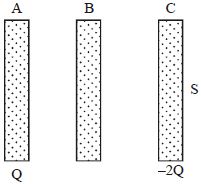
- 4Three identical metal plates with large surface areas are kept parallel to each other as shown in figure. The left most plates is given a charge $Q$ and the right most plate $C$ is given a charge $-2Q.$ The middle plate $B$ is neutral. Then the charge appearing on the outer surface $S$ of the plate $C$ is :-View Solution
- 5A $700\,pF$ capacitor is charged by a $50\,V$ battery. The electrostatic energy stored by it isView Solution
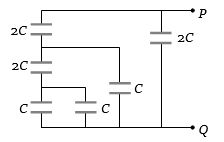
- 6View SolutionThe resultant capacitance of given circuit is
- 7View SolutionA hollow closed conductor of irregular shape is given some charge. Which of the following statements are correct ?
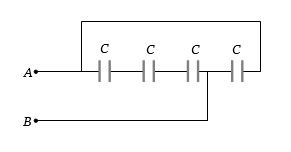
- 8The equivalent capacitance between $A$ and $B$ isView Solution
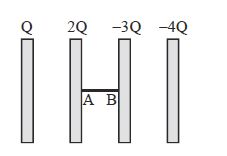
- 9View SolutionFour very large metal plates are given the charges as shown in figure. The middle two are then connected through a wire. Find the charge that will flow through the wire
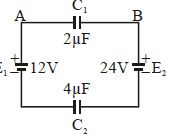
- 10Two capacitors $C_1$ and $C_2$ are connected in a cirucit as shown in figure. The potential difference $(V_A -V_B)$ is.....$V$View Solution