Question
For two statements are given-one labelled Assertion (A) and the other labelled Reason (R). Select the correct answer to these questions from the codes (a), (b), (c) and (d) as given below.
  1. Both A and R are true, and R is the correct explanation of A.
  2. Both A and R are true, but R is not the correct explanation of A.
  3. A is true but R is false.
  4. A is false and R is also false.
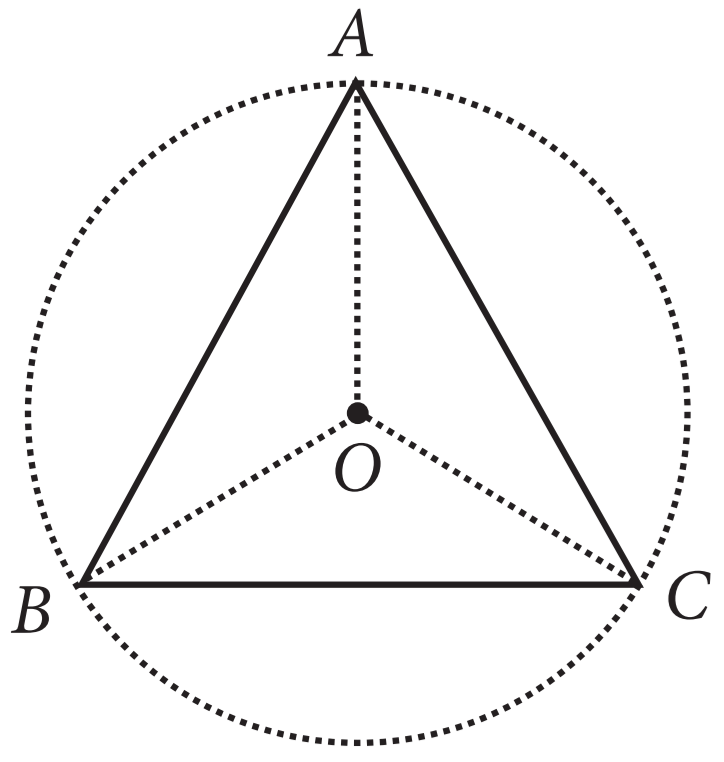
Assertion (A): Three equal charges are situated on a circle of radius r such that they form on equilateral triangle, then the electric field intensity at the centre is zero.
Reason (R): The force on unit positive charge at the centre, due to the three equal charges are represented by the three sides of a triangle taken in the same order. Therefore, electric field intensity at centre is zero.
Answer

  1. Both A and R are true, and R is the correct explanation of A.
Explanation:
Resultant of electric intensity at O due to B and C is equal and opposite to that due to A.
​​​​​​​​​​​​​​

Need a full question paper?

Generate a complete, print-ready paper with questions like this in minutes — across 16+ boards, with answer keys.

Start Generating Free

Similar questions

For two statements are given-one labelled Assertion (A) and the other labelled Reason (R). Select the correct answer to these questions from the codes (a), (b), (c) and (d) as given below.
  1. Both A and R are true, and R is the correct explanation of A.
  2. Both A and R are true, but R is not the correct explanation of A.
  3. A is true, but R is false.
  4. A is false, and R is also false.
Assertion (A): A capacitor can be broken by placing large amount of charge on it.
Reason (R): After breakage potential, the capacitor is destroyed.
For two statements are given-one labelled Assertion (A) and the other labelled Reason (R). Select the correct answer to these questions from the codes (a), (b), (c) and (d) as given below.
  1. Both A and R are true, and R is the correct explanation of A.
  2. Both A and R are true, but R is not the correct explanation of A.
  3. A is true, but R is false.
  4. A is false, and R is also false.
Assertion (A): Conductors having equal positive charge and volume, must also have same potential.
Reason (R): Potential depends only on charge and volume of conductor.
For question two statements are given$-$one labelled Assertion $(A)$ and the other labelled Reason $(R).$ Select the correct answer to these questions from the codes $(a), (b), (c)$ and $(d)$ as given below.
Assertion $(A):$ The positively charged nucleus of an atom has a radius of almost $10^{-15}m.$
Reason $(R):$ In $\alpha-$particle scattering experiment, the distance of closest approach for $\alpha-$particles is $10^{-15}m.$
For question two statements are given-one labelled Assertion (A) and the other labelled Reason (R). Select the correct answer to these questions from the codes (a), (b), (c) and (d) as given below.
  1. Both A and R are true and R is the correct explanation of A.
  2. Both A and R are true but R is NOT the correct explanation of A.
  3. A is true but R is false.
  4. A is false and R is also false.
Assertion (A): ln YDSE bright and dark fringe are equally spaced.
Reason (R): It only depends upon phase difference.
For question two statements are given-one labelled Assertion (A) and the other labelled Reason (R). Select the correct answer to these questions from the codes (a), (b), (c) and (d) as given below.
  1. Both A and R are true, and R is the correct explanation of A.
  2. Both A and R are true, but R is NOT the correct explanation of A.
  3. A is true, but R is false.
  4. A is false and R is also false.
Assertion (A): Electrons in the atom are held due to coulomb forces.
Reason (R): The atom is stable only because the centripetal force due to Coulomb's law is balanced by the centrifugal force.
For two statements are given-one labelled Assertion (A) and the other labelled Reason (R). Select the correct answer to these questions from the codes (a), (b), (c) and (d) as given below.
  1. Both A and R are true, and R is the correct explanation of A.
  2. Both A and R are true, but R is not the correct explanation of A.
  3. A is true, but R is false.
  4. A is false, and R is also false.
Assertion: KWhr is a commercial unit used for expressing consumed electric energy.
Reason: Kilo-watt hour is the unit of electric power.
For two statements are given-one labelled Assertion (A) and the other labelled Reason (R). Select the correct answer to these questions from the codes (a), (b), (c) and (d) as given below.
  1. Both A and R are true and R is the correct explanation of A.
  2. Both A and R are true but R is not the correct explanation of A.
  3. A is true but R is false.
  4. A is false and R is also false.
Assertion: An inductance and a resistance are connected in series with an A.C. circuit. ln this circuit the current and the potential difference across the resistance lags behind potential difference across the inductance by an angle $\frac{\pi}{2}.$
Reason: In L-R circuit voltage leads the current by phase angle which depends on the value ofinductance and resistance both.
For question two statements are given-one labelled Assertion (A) and the other labelled Reason (R). Select the correct answer to these questions front the codes (a), (b), (c) and (d) as given below.
  1. Both A and R are true and R is the correct explanation of A.
  2. Both A and R are true but R is NOT the correct explanation of A.
  3. A is true but R is false.
  4. A is false and R is also false.
Assertion (A): The threshold frequency of photoelectric effect supports the particle nature of light.
Reason (R): If frequency of incident light is less than the threshold frequency, electrons are not emitted from metal surface.
For question two statements are given-one labelled Assertion (A) and the other labelled Reason (R). Select the correct answer to these questions front the codes (a), (b), (c) and (d) as given below.
  1. Both A and R are true and R is the correct explanation of A.
  2. Both A and R are true but R is NOT the correct explanation of A.
  3. A is true but R is false.
  4. A is false and R is also false.
Assertion (A): On increasing the frequency of light, larger number of photoelectrons are emitted.
Reason (R): The number of electrons emitted is directly proportional to the intensity of incident light.
For two statements are given-one labelled Assertion (A) and the other labelled Reason (R). Select the correct answer to these questions from the codes (a), (b), (c) and (d) as given below.
  1. Both A and R are true, and R is the correct explanation of A.
  2. Both A and R are true, but R is not the correct explanation of A.
  3. A is true but R is false.
  4. A is false and R is also false.
Assertion (A): No two electric lines of force can intersect each other.
Reason (R): Tangent at any point of electric line of force gives the direction of electric field.