MCQ
For two statements are given$-$one labelled Assertion and the other labelled Reason. Select the correct answer to these questions from the codes $(a), (b), (c)$ and $(d)$ as given below.
Assertion: Oral contraceptive pills check ovulation.
Reason: Oral pills always contains combination of progesterone and estrogen.
  • A
    Both assertion and reason are true, and reason is the correct explanation of assertion.
  • B
    Both assertion and reason are true, but reason is not the correct explanation of assertion.
  • Assertion is true, but reason is false.
  • D
    Both assertion and reason are false.

Answer

Correct option: C.
Assertion is true, but reason is false.
Oral pills contain either progestin $($progesterone$)$ alone or a combination of progestogen and estrogen.

Need a full question paper?

Generate a complete, print-ready paper with questions like this in minutes — across 16+ boards, with answer keys.

Start Generating Free

Similar questions

For two statements are given$-$one labelled Assertion and the other labelled Reason. Select the correct answer to these questions from the codes $(a), (b), (c)$ and $(d)$ as given below.
Assertion: Enterobiasis is a sexually transmitted disease caused by pinworm.
Reason: Enterobiasis is treated with antihelminthic drugs.
Read the following and answer any four questions from $(i)$ to $(v)$ given below:
The endosperm makes the main source of food for the embryo. Generally the endosperm nucleus divides after the division of the oospore, but in several cases the endosperm is formed to a great extent even before the first division of the oospore. There are three general types of endosperm formation: $(a)$ nuclear type, $(b)$ cellular type and $(c)$ helobial type. The endosperm is usually triploid, but haploid endosperm is also found. Endosperm may either be completely consumed by the developing embryo before seed maturation, or it may persist in the mature seed.
  1. Haploid endosperm is found in :
  1. Pin us.
  2. Cauliflower.
  3. Sunflower.
  4. Pea.
  1. Persistent endosperm is found in:
$P$. Pea $Q$. Castor $R$. Bean $S.$ Coconut $T$. Groundnut.
  1. $Q$ and $S$.
  2. $P$ and $T$.
  3. $R, S$ and $T$.
  4. $P, S$ and $T$.
  1. Milk of tender coconut represents $(A)$ and the surrounding white coconut meal represents $(B).$
S. No
$A$
$B$
$(a)$
Cellular endosperm
Free- nuclear endosperm
$(b)$
Free $-$ nuclear endosperm
Cellular endosperm
$(c)$
Helobial endosperm
Cellular endosperm
$(d)$
Free-nuclear endosperm
Helobial endosperm
  1. If an endosperm cell of a gymnosperm contains $12$ chromosomes, the number of chromosomes in each cell of the root will be:
  1. $4$
  2. $24$
  3. $16$
  4. $6$
  1. In angiosperms, normally after fertilization:
  1. The zygote divides earlier than the primary endosperm nucleus.
  2. The primary endosperm nucleus divides earlier than the zygote.
  3. Both the zygote and primary endosperm nucleus divide simultaneously.
  4. Both the zygote and primary endosperm nucleus undergo a resting period.
For two statements are given$-$one labelled Assertion and the other labelled Reason. Select the correct answer to these questions from the codes $(a), (b), (c) $ and $(d)$ as given below.
Assertion: Chlamydia trachomatis is a human pathogen that causes trachoma, sexually transmitted and perinatal infection.
Reason: Chlamydia trachomatis has $\text{DEFGHIJK}$ serotypes.
For question, two statements are given$-$one labelled Assertion and the other labelled Reason. Select the correct answer to these questions from the codes $(a), (b), (c)$ and $(d)$ as given below. Assertion: Sequences of bases in one polynucleotide chain of $\text{DNA}$ can determine the sequence of bases in the other chain.
Reason: In a $\text{DNA}$, amount of adenine equals that of thymine and amount of guanine equals that of cytosine, i.e., $A = T$ and $C = G$.
Read the following and answer any four questions from $(i)$ to $(v)$ given below:
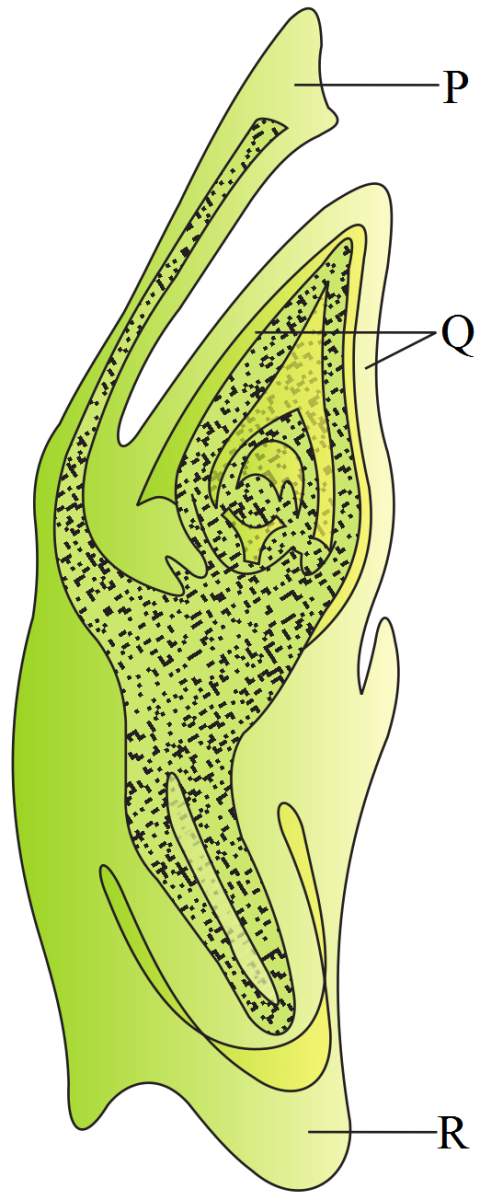
Embryo develops at the micropylar end of the embryo sac, where the zygote is situated. Most zygotes divided only after certain amount of endosperm is formed. The early stages of embryo development are similar in both monocotyledons and dicotyledons. The zygote gives rise to the proembryo and subsequently to the globular heart-shaped and mature embryo. A typical dicotyledonous embryo consists of an embryonal axis and two cotyledons. Embryo of monocotyledons possess only one cotyledon.
  1. True embryo develops as a result of fusion of:
  1. Two polar nuclei of embryo sac.
  2. An egg cell and a male gamete.
  3. Synergid and male gamete.
  4. A male gamete and antipodals.
  1. Refer to the given diagram of the embryo of an angiospermous plant with parts labelled $P, Q$ and $R$. Select the correct statement$(s)$ regarding this.
  1. Part $'P\ '$ supplies nutrition to the developing embryo.
  2. Part $'Q\ '$ is the protective sheath of radicle and root cap.
  3. Part $'R\ '$ is the protective sheath of shoot apex and leaf primordia.
  4. The embryo shown in the diagram is present in members of Family Poaceae.
  1. $(IV)$ only.
  2. $(II)$ and $(III)$ only.
  3. $(I)$ and $(IV)$ only.
  4. $(I), (II), (III)$ and $(IV).$
  1. Which of the given statements are true?
  1. During the development of a dicot embryo, heart$-$shaped embryo is followed by globular embryo.
  2. The part of embryonal axis above the level of cotyledons is epicotyl, while the part below the level of cotyledons is hypocotyl.
  3. Monocot seeds possess a single cotyledon, represented by scutellum.
  1. $(I)$ and $(II).$
  2. $(II)$ and $(III).$
  3. $(I)$ and $(III).$
  4. $(I), (II)$ and $(III).$
  1. Consider the following parts of an embryonal axis of a dicot seed.
  1. Hypocotyl.
  2. Epicotyl.
  3. Radicle.
  4. Plumule.
In which of the following the above parts are correctly arranged from top to base?
  1. $(III) \rightarrow (I) \rightarrow (II) \rightarrow (IV).$
  2. $(II) \rightarrow (I) \rightarrow (III) \rightarrow (IV).$
  3. $(IV) \rightarrow (II) \rightarrow (I) \rightarrow (III).$
  4. $(III) \rightarrow (IV) \rightarrow (II) \rightarrow (I).$
  1. In grass family, the cotyledon, is called:
  1. Epiblast.
  2. Plumule.
  3. Scutellum.
  4. Perisperm.
Two statements are given$-$one labelled Assertion and the other labelled Reason. Select the correct answer to these questions from the codes $(a), (b), (c)$ and $(d)$ as given below.
Assertion: Selectable marker is meant for distinguishing a recombinant from non$-$recombinant.
Reason: Every recombinant can flourish in medium having both ampicillin and tetracycline, while the non- recombinants cannot.
For question two statements are given $-$ one labelled Assertion and the other labelled Reason. Select the correct answer to these questions from the codes $(a), (b), (c)$ and $(d)$ as given below.
Assertion : Aerenchyma is present in the leaves and petioles ofhydrophytes.
Reason : Aerenchyma imparts buoyancy to the hydrophytes.
For question two statements are given $-$ one labelled Assertion and the other labelled Reason. Select the correct answer to these questions from the codes $(a), (b), (c) $ and $(d)$ as given below.
Assertion : Generally the intraspecific competition is more intense than interspecific competition.
Reason : lntraspecific competition occurs when the resources are in short supply.
For two statements are given$-$one labelled Assertion and the other labelled Reason. Select the correct answer to these questions from the codes $(a), (b), (c)$ and $(d)$ as given below.
Assertion: Colpa a urea is a specialised pollinating agent of orchid Ophrys speculum.
Reason: Male Colpa mistakes the Ophrys flowers for female partner.
Read the following and answer any four questions from $(i)$ to $(v)$ given below:
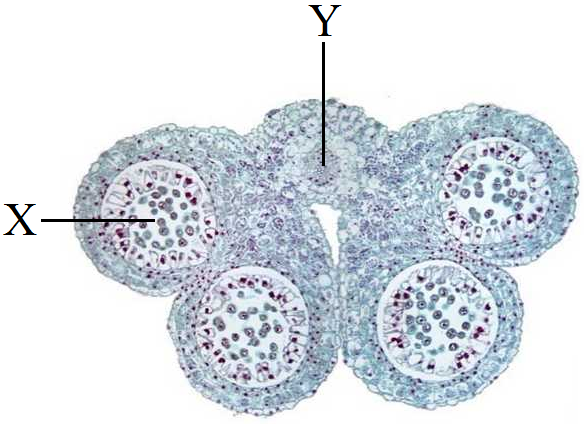
Many adaptations are found in flowers to achieve certain kind of pollination. The pollination achieved by insects is known as entomophily. The given diagram shows the cross-section of an anther of an insect pollinated flower.
  1. Which of the following is/ are the function $(s)$ of structure $Y$?
  1. To carry waste products away from the anther.
  2. To supply oxygen to the cells of the anther.
  3. To transport food and mineral salts to the anther.
  4. To supply water to the anther.
  1. Conly.
  2. $C$ and $D$ only.
  3. $A, B$ and $D$ only.
  4. $A, B, C$ and $D$.
  1. Which of the following most accurately describes the structures found in compartment $X$?
  1. They contain two haploid nuclei resulting from meiosis.
  2. They contain two haploid nuclei resulting from mitosis.
  3. They contain two haploid male gametes, resulting from mitosis.
  4. They contain a vegetative nucleus and pollen tube nucleus.
  1. Which of the following is a distinctive characteristic of insect $-$ pollinated flower?
  1. All of them have nectar guides on their flowers.
  2. They produce sugary fruit.
  3. Their pollen grains tend to have rough surfaces.
  4. They produce abundant quantities of pollen to make up for pollen grains that might be removed by the wind.
  1. Which of the following are likely characteristics of the structures found in $X$ and stamens of this plant?
S. No
Structure of $X$
Stamens
$(a)$
Abundant and light
Pendulous
$(b)$
Rough surfaces
Non $-$ pendulous
$(c)$
Light and sticky
Pendulous
$(d)$
Coarse and sticky
Protrude outside the flower
  1. Spiny or sticky pollen grains and large, attractively coloured flowers are associated with :
  1. Hydrophily.
  2. Entomophily.
  3. Ornithophily.
  4. Anemophily.