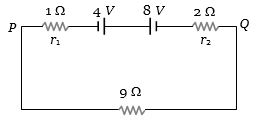
Two batteries of $e.m.f.$ $4\,V$ and $8 \,V$ with internal resistances $1\, \Omega$ and $2\,\Omega$ are connected in a circuit with a resistance of $9 \,\Omega$ as shown in figure. The current and potential difference between the points $P$ and $Q$ are
AIPMT 1988, Medium


Download our appand get started for free
Experience the future of education. Simply download our apps or reach out to us for more information. Let's shape the future of learning together!No signup needed.*
Similar Questions
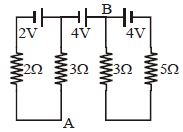
- 1In the given circuit calculate potential difference between $A$ and $B$ ............... $\mathrm{V}$View Solution
- 2An electric current is passed through a circuit containing two wires of the same material, connected in parallel. If the lengths and radii of the wires are in the ratio of $4/3$ and $2/3$, then the ratio of the currents passing through the wire will beView Solution
- 3View SolutionWhen electric bulbs of same power, but different marked voltage are connected in series across the power line, their brightness will be :
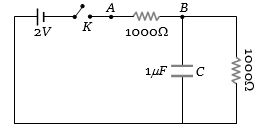
- 4When the key $K$ is pressed at time $t = 0$, which of the following statements about the current $I$ in the resistor $AB$ of the given circuit is trueView Solution
- 5What will be the most suitable combination of three resistors $A =2\, \Omega, B =4\, \Omega, C =6\, \Omega$ so that $\left(\frac{22}{3}\right)\Omega$ is equivalent resistance of combination$?$View Solution
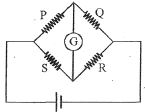
- 6Resistances are arranged in a cyclic order to form a balanced wheatstone bridge as shown in figure. Ratio of power consumed in the branches $P + Q$ and $R + S$ isView Solution
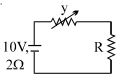
- 7In the figure shown the power generated in $y$ is maximum when $y = 5\,\Omega$ . Then $R$ is .............. $\Omega$View Solution
- 8View SolutionKirchhoff's second law is based on the law of conservation of
- 9Two rods of same material and length have their electric resistance in ratio $1:2$. When both rods are dipped in water, the correct statement will beView Solution
- 10Equivalent resistance between the adjacent corners of a regular $n$-sided polygon of uniform wire of resistance $R$ would be:View Solution