Force acting upon a charged particle kept between the plates of a charged condenser is $F$. If one plate of the condenser is removed, then the force acting on the same particle will become
Medium


Download our appand get started for free
Experience the future of education. Simply download our apps or reach out to us for more information. Let's shape the future of learning together!No signup needed.*
Similar Questions
- 1The two plates $X $ and $Y$ of a parallel plate capacitor of capacitance $C$ are given a charge of amount $Q$ each. $X$ is now joined to the positive terminal and $Y$ to the negative terminal of a cell of $emf$ $E = Q/C$.View Solution
- 2The capacitance of a parallel plate capacitor is $C$ when the region between the plate has air. This region is now filled with a dielectric slab of dielectric constant $k$. The capacitor is connected to a cell of $emf$ $E$, and the slab is taken outView Solution
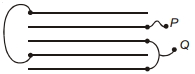
- 3The following arrangement consists of five identical metal plates parallel to each other. Area of each plate is $A$ and separation between the successive plates is $d$. The capacitance between $P$ and $Q$ isView Solution
- 4An electric charge $10^{-3}\ \mu C$ is placed at the origin $(0, 0)$ of $X-Y$ coordinate system. Two points $A$ and $B$ are situated at $(\sqrt 2 ,\sqrt 2 )$ and $(2, 0)$ respectively. The potential difference between the points $A$ and $B$ will be......$V$View Solution
- 5The condensers of capacity ${C_1}$ and ${C_2}$ are connected in parallel, then the equivalent capacitance isView Solution
- 6Consider a spherical shell of radius $R$ with a total charge $+ Q$ uniformly spread on its surface (centre of the shell lies at the origin $x=0$ ). Two point charges $+q$ and $-q$ are brought, one after the other from far away and placed at $x=-a / 2$ and $x=+a / 2( < R)$, respectively. Magnitude of the work done in this process isView Solution
- 7Four charges $2C, -3C, -4C$ and $5C$ respectively are placed at all the corners of a square. Which of the following statements is true for the point of intersection of the diagonals ?View Solution
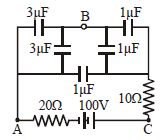
- 8In the figure below, what is the potential difference between the points $A$ and $B$ and between $B$ and $C$ respectively in steady stateView Solution
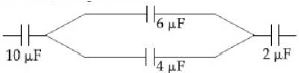
- 9In the figure shown below, the charge on the left plate of the $10\, \mu F$ capacitor is $-30\,\mu C.$ The charge on the right place of the $6\,\mu F$ capacitor is.....$\mu C$View Solution
- 10If potential (in volts) in a region is expressed as $V (x,y,z) =6xy-y+2yz $ the electric field (in $N/C$) at point $(1, 1, 0)$ isView Solution