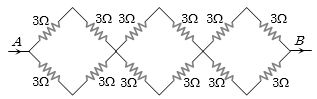
Four identical cells each having an electromotive force $(e.m.f.)$ of $12\,V$, are connected in parallel. The resultant electromotive force $(e.m.f.)$ of the combination is .............. $V$
Easy
Download our app for free and get started
(b) In parallel combination ${E_{eq}} = E = 12\,V$

Download our appand get started for free
Experience the future of education. Simply download our apps or reach out to us for more information. Let's shape the future of learning together!No signup needed.*
Similar Questions
- 1A wire of length $L$ and $3$ identical cells of negligible internal resistances are connected in series. Due to current, the temperature of the wire is raised by $\Delta T$ in a time $t$. A number $N$ of similar cells is now connected in series with a wire of the same material and cross-section but of length $2\, L$. The temperature of the wire is raised by the same amount $\Delta T$ in the same time $t$. the value of $N$ isView Solution
- 2A wire of length $5\,m$ and radius $1\,mm$ has a resistance of $1\, ohm$. What length of the wire of the same material at the same temperature and of radius $2\,mm$ will also have a resistance of $1\, ohm$ .............. $m$View Solution
- 3View SolutionIf in the experiment of Wheatstone's bridge, the positions of cells and galvanometer are interchanged, then balance points will
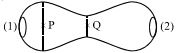
- 4Ametallic conductor of irregular cross-section is as shown in the figure. Aconstant potential difference is applied across the ends $(1)$ and $(2)$. Then :View Solution
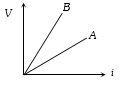
- 5$V-i$ graphs for parallel and series combination of two identical resistors are as shown in figure. Which graph represents parallel combinationView Solution
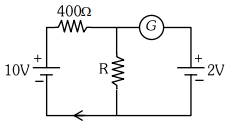
- 6If the galvanometer $G$ does not show any deflection in the circuit shown, the value of $R$ is given by $............\Omega$View Solution
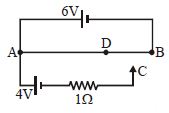
- 7A $6\, volt$ battery of negligible internal resistance resistance is connected across a uniform wire $AB$ of length $100\,cm$. The positive terminal of another battery of $emf$ $4\,V$ and internal resistance $1\,\Omega $ is joined to the point $A$ as shown in fig. Take the potential at $B$ to be zero. At which point $D$ of the wire $AB$, from left the potential is equal to the potential at $C$ ? ...................... $cm$ (approximately)View Solution
- 8How many calories of heat will be produced approximately in a $210\, watt$ electric bulb in $5$ minutes .............. $cal $View Solution
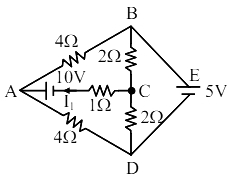
- 9The current flowing through the $1 \Omega$ resistor is $\frac{\mathrm{n}}{10} \ A. $ The value of $n$ is. . . . . . .View Solution
- 10In the network of resistors shown in the adjoining figure, the equivalent resistance between $A$ and $B$ is ............ $ohm$View Solution