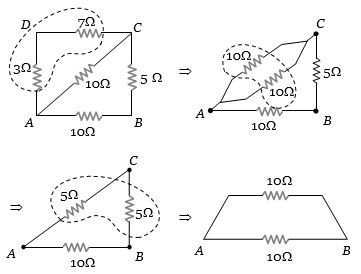
Four resistances $10$ $\Omega$, $5$ $\Omega$, $7$ $\Omega$ and $3$ $\Omega$ are connected so that they form the sides of a rectangle $AB$, $BC$, $CD$ and $DA$ respectively. Another resistance of $10$ $\Omega$ is connected across the diagonal $AC$. The equivalent resistance between $A$ and $B $ is .............. $\Omega$
Medium


Download our appand get started for free
Experience the future of education. Simply download our apps or reach out to us for more information. Let's shape the future of learning together!No signup needed.*
Similar Questions
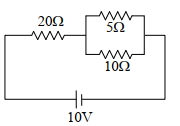
- 1The ratio of heat dissipated per second through the resistance $5 \Omega$ and $10 \Omega$ in the circuit given below is: :View Solution
- 2Two resistances $r_1$ and $r_2\left(r_1 < r_2\right)$ are joined in parallel. The equivalent resistance $R$ is such thatView Solution
- 3A potentiometer is an accurate and versatile device to make electrical measurements of $EMF$ because the method involvesView Solution
- 4In a Wheatstone’s bridge all the four arms have equal resistance $R$. If the resistance of the galvanometer arm is also $R$, the equivalent resistance of the combination as seen by the battery isView Solution
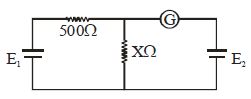
- 5In the adjoining circuit, the battery $E_1$ has an emf of $12\, volt$ and zero internal resistance while the battery $E_2$ has an $emf$ of $2\, volt$. If the galvanometer $G$ reads zero, then the value of the resistance $X$ (in $ohm$ ) isView Solution
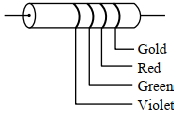
- 6View SolutionThe colour coding on a carbon resistor is shown in the given figure. The resistance value of the given resistor is:
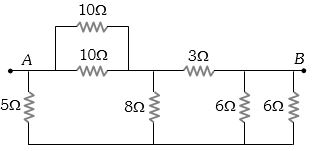
- 7Seven resistances are connected as shown in the figure. The equivalent resistance between $A$ and $B$ is ............... $\Omega$View Solution
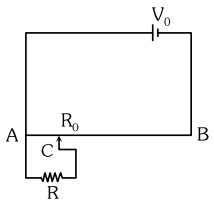
- 8The sliding contact $C$ is at one fourth of the length of the potentiometer wire $( AB )$ from $A$ as shown in the circuit diagram. If the resistance of the wire $AB$ is $R _0$, then the potential drop $( V )$ across the resistor $R$ isView Solution
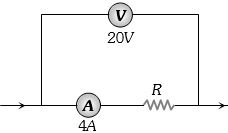
- 9In the diagram shown, the reading of voltmeter is $20\, V$ and that of ammeter is $4\, A$. The value of $R$ should be (Consider given ammeter and voltmeter are not ideal)View Solution
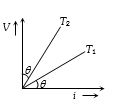
- 10The $V-i$ graph for a conductor at temperature ${T_1}$ and ${T_2}$ are as shown in the figure. $({T_2} - {T_1})$ is proportional toView Solution