An infinite number of charges each numerically equal to q and of the same sign are placed along the $x-$ axis at $x = 1,2,4,8.... \,metres$. Then the electric potential at $x = 0$ due to this set of charges is
Medium


Download our appand get started for free
Experience the future of education. Simply download our apps or reach out to us for more information. Let's shape the future of learning together!No signup needed.*
Similar Questions
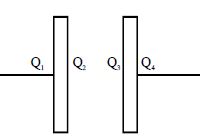
- 1In an insulated parallel-plate capacitor of capacitance $C$, the four surfaces have charges $Q_1, Q_2, Q_3$ and $Q_4$ as shown. The potential difference between the plate isView Solution
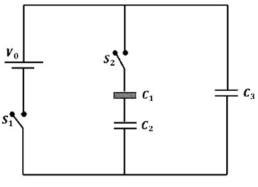
- 2. Three identical capacitors $C _1, C _2$ and $C _3$ have a capacitance of $1.0 \mu F$ each and they are uncharged initially. They are connected in a circuit as shown in the figure and $C _1$ is then filled completely with a dielectric material of relative permittivity $\varepsilon_{ r }$. The cell electromotive force (emf) $V_0=8 V$. First the switch $S_1$ is closed while the switch $S_2$ is kept open. When the capacitor $C_3$ is fully charged, $S_1$ is opened and $S_2$ is closed simultaneously. When all the capacitors reach equilibrium, the charge on $C _3$ is found to be $5 \mu C$. The value of $\varepsilon_{ r }=$. . . . .View Solution
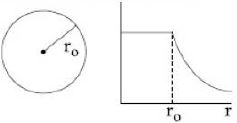
- 3The give graph shown variation (with distance $r$ from centre) ofView Solution
- 4Two positively charged particles $X$ and $Y$ are initially far away from each other and at rest. $X$ begins to move towards $Y$ with some initial velocity. The total momentum and energy of the system are $p$ and $E$.View Solution
- 5View SolutionThe energy of a charged capacitor resides in
- 6Two concentric hollow metallic spheres of radii $r_1$ and $r_2 (r_1 > r_2)$ contain charges $q_1$ and $q_2$ respectively. The potential at a distance $x$ between $r_1$ and $r_2$ will beView Solution
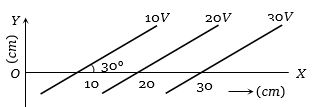
- 7View SolutionEquipotential surfaces are shown in figure. Then the electric field strength will be
- 8A $6\,\mu F$ capacitor is charged from $10\;volts$ to $20\;volts$. Increase in energy will beView Solution
- 9Two charged spherical conductors of radius $R_{1}$ and $\mathrm{R}_{2}$ are connected by a wire. Then the ratio of surface charge densities of the spheres $\left(\sigma_{1} / \sigma_{2}\right)$ is :View Solution
- 10A parallel plate capacitor is connected to a battery. The quantities charge, voltage, electric field and energy associated with the capacitor are given by $Q_0, V_0, E_0$ and $U_0$ respectively. A dielectric slab is introduced between plates of capacitor but battery is still in connection. The corresponding quantities now given by $Q, V, E$ and $U$ related to previous ones areView Solution